
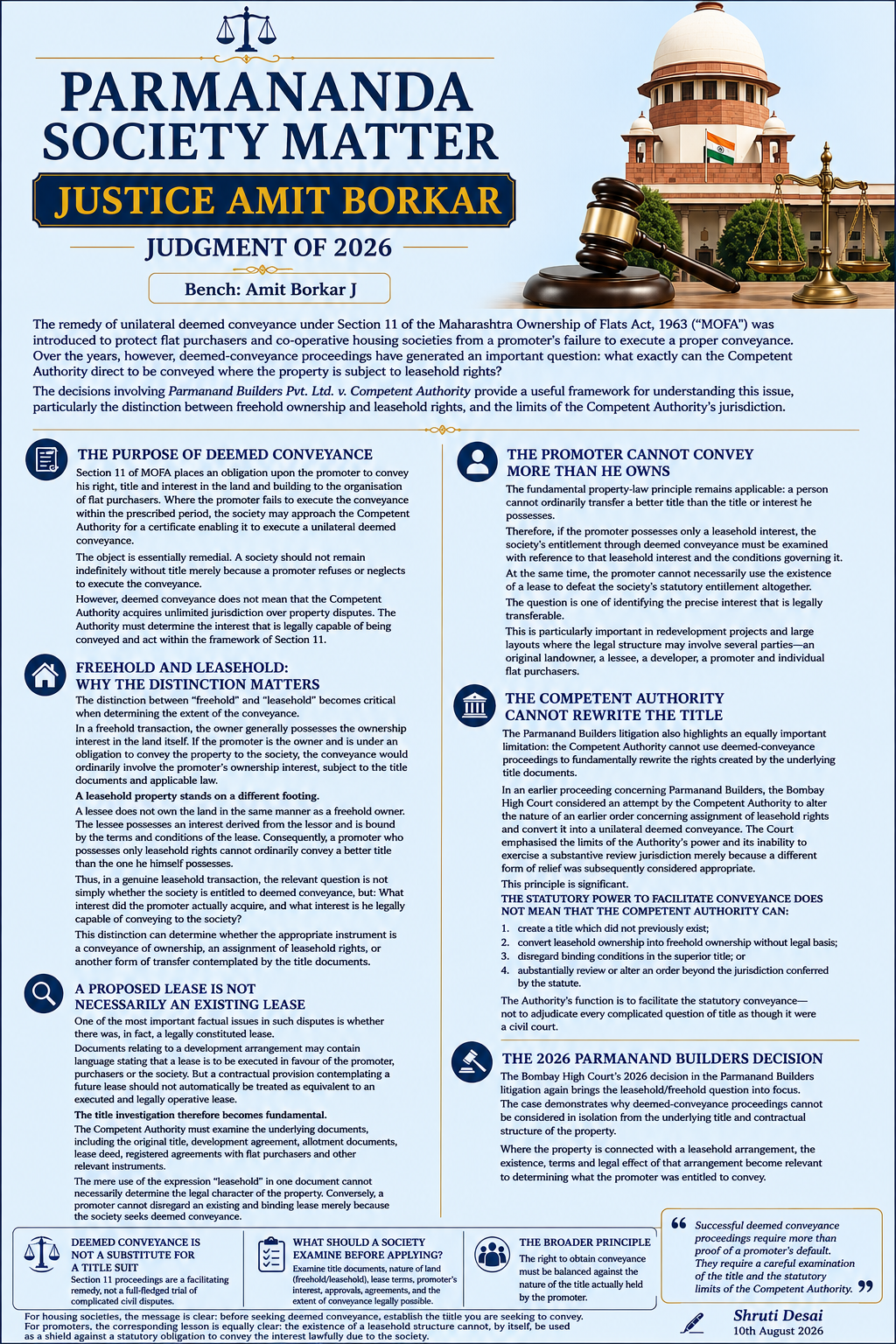
Bench: Amit Borkar J
The remedy of unilateral deemed conveyance under Section 11 of the Maharashtra Ownership of Flats Act, 1963 (“MOFA”) was introduced to protect flat purchasers and co-operative housing societies from a promoter’s failure to execute a proper conveyance. Over the years, however, deemed-conveyance proceedings have generated an important question: what exactly can the Competent Authority direct to be conveyed where the property is subject to leasehold rights?
The decisions involving Parmanand Builders Pvt. Ltd. v. Competent Authority provide a useful framework for understanding this issue, particularly the distinction between freehold ownership and leasehold rights, and the limits of the Competent Authority’s jurisdiction.
The purpose of deemed conveyance
Section 11 of MOFA places an obligation upon the promoter to convey his right, title and interest in the land and building to the organisation of flat purchasers. Where the promoter fails to execute the conveyance within the prescribed period, the society may approach the Competent Authority for a certificate enabling it to execute a unilateral deemed conveyance.
The object is essentially remedial. A society should not remain indefinitely without title merely because a promoter refuses or neglects to execute the conveyance.
However, deemed conveyance does not mean that the Competent Authority acquires unlimited jurisdiction over property disputes. The Authority must determine the interest that is legally capable of being conveyed and act within the framework of Section 11.
Freehold and leasehold: why the distinction matters
The distinction between “freehold” and “leasehold” becomes critical when determining the extent of the conveyance.
In a freehold transaction, the owner generally possesses the ownership interest in the land itself. If the promoter is the owner and is under an obligation to convey the property to the society, the conveyance would ordinarily involve the promoter’s ownership interest, subject to the title documents and applicable law.
A leasehold property stands on a different footing.
A lessee does not own the land in the same manner as a freehold owner. The lessee possesses an interest derived from the lessor and is bound by the terms and conditions of the lease. Consequently, a promoter who possesses only leasehold rights cannot ordinarily convey a better title than the one he himself possesses.
Thus, in a genuine leasehold transaction, the relevant question is not simply whether the society is entitled to deemed conveyance, but: What interest did the promoter actually acquire, and what interest is he legally capable of conveying to the society?
This distinction can determine whether the appropriate instrument is a conveyance of ownership, an assignment of leasehold rights, or another form of transfer contemplated by the title documents.
A proposed lease is not necessarily an existing lease ?
One of the most important factual issues in such disputes is whether there was, in fact, a legally constituted lease.
Documents relating to a development arrangement may contain language stating that a lease is to be executed in favour of the promoter, purchasers or the society. But a contractual provision contemplating a future lease should not automatically be treated as equivalent to an executed and legally operative lease.
The title investigation therefore becomes fundamental.
The Competent Authority must examine the underlying documents, including the original title, development agreement, allotment documents, lease deed, registered agreements with flat purchasers and other relevant instruments.
The mere use of the expression “leasehold” in one document cannot necessarily determine the legal character of the property. Conversely, a promoter cannot disregard an existing and binding lease merely because the society seeks deemed conveyance.
The promoter cannot convey more than he owns
The fundamental property-law principle remains applicable: a person cannot ordinarily transfer a better title than the title or interest he possesses.
Therefore, if the promoter possesses only a leasehold interest, the society’s entitlement through deemed conveyance must be examined with reference to that leasehold interest and the conditions governing it.
At the same time, the promoter cannot necessarily use the existence of a lease to defeat the society’s statutory entitlement altogether.
The question is one of identifying the precise interest that is legally transferable.
This is particularly important in redevelopment projects and large layouts where the legal structure may involve several parties—an original landowner, a lessee, a developer, a promoter and individual flat purchasers.
THE COMPETENT AUTHORITY CANNOT REWRITE THE TITLE
The Parmanand Builders litigation also highlights an equally important limitation: the Competent Authority cannot use deemed-conveyance proceedings to fundamentally rewrite the rights created by the underlying title documents.
In an earlier proceeding concerning Parmanand Builders, the Bombay High Court considered an attempt by the Competent Authority to alter the nature of an earlier order concerning assignment of leasehold rights and convert it into a unilateral deemed conveyance. The Court emphasised the limits of the Authority’s power and its inability to exercise a substantive review jurisdiction merely because a different form of relief was subsequently considered appropriate.
This principle is significant.
THE STATUTORY POWER TO FACILITATE CONVEYANCE DOES NOT MEAN THAT THE COMPETENT AUTHORITY CAN:
- create a title which did not previously exist;
- convert leasehold ownership into freehold ownership without legal basis;
- disregard binding conditions in the superior title; or
- substantially review or alter an order beyond the jurisdiction conferred by the statute.
The Authority’s function is to facilitate the statutory conveyance—not to adjudicate every complicated question of title as though it were a civil court.
The 2026 Parmanand Builders decision
The Bombay High Court’s 2026 decision in the Parmanand Builders litigation again brings the leasehold/freehold question into focus.
The case demonstrates why deemed-conveyance proceedings cannot be considered in isolation from the underlying title and contractual structure of the property.
Where the property is connected with a leasehold arrangement, the existence, terms and legal effect of that arrangement become relevant to determining what the promoter was entitled to convey.
The practical lesson is that a society cannot assume that obtaining a deemed-conveyance certificate automatically converts every underlying interest into absolute freehold ownership.
Conversely, a promoter cannot simply rely upon a reference to “lease” in an agreement to deny the society’s statutory rights where the documents demonstrate that the promoter acquired a larger or different interest.
The answer must come from the actual chain of title and the legal rights created by the relevant documents.
Deemed conveyance is not a substitute for a title suit
Another important principle is that the Competent Authority’s proceedings under Section 11 are not intended to become a full-fledged trial of complicated civil disputes.
Where the basic entitlement to conveyance can be established from the documents, the statutory mechanism should not be defeated by the promoter’s non-cooperation.
However, where there is a serious and complicated dispute concerning the very nature of the title, competing ownership claims, validity of documents or other questions requiring detailed adjudication, the limits of the Competent Authority’s jurisdiction become important.
The statutory mechanism should therefore be understood as a facilitating remedy, rather than a universal substitute for civil adjudication.
What should a society examine before applying?
For a society considering unilateral deemed conveyance, the first step should be a proper title and document review.
Among other things, the society should determine:
Who owns the land?
Is the land freehold or leasehold?
Who granted the development rights to the promoter?
What exact interest was acquired by the promoter?
Was a lease actually executed and registered?
What are the terms and restrictions of the lease, if any?
What do the registered agreements with flat purchasers provide?
Does the development agreement authorise conveyance of the relevant interest?
Are approvals or consent of a superior lessor required?
What precise form of conveyance or assignment is legally possible?
These questions are not merely procedural. They determine the substance of the relief that can legitimately be sought.
The broader principle
The Parmanand Builders litigation illustrates a broader proposition in deemed-conveyance law:
The statutory right to obtain conveyance must be balanced against the nature of the title actually held by the promoter.
The purpose of Section 11 is to prevent promoters from withholding conveyance—not to confer upon the society a title greater than what the law and the underlying documents permit.
Accordingly, in a freehold situation, the society may ordinarily seek conveyance of the promoter’s ownership interest. In a genuine leasehold situation, the society’s rights must be examined in the context of the promoter’s leasehold estate and the terms governing that estate.
At the same time, the Competent Authority must remain within the statutory limits of its jurisdiction and cannot, under the guise of deemed conveyance, create, enlarge or fundamentally alter property rights.
Conclusion
Unilateral deemed conveyance is a powerful statutory remedy, but it is not a mechanism for rewriting property law.
The central inquiry should always be: what right, title and interest did the promoter actually possess, and what is he legally obliged and entitled to convey?
The distinction between freehold and leasehold is therefore not a technicality. It can determine the very nature of the instrument to be executed in favour of the society.
The Parmanand Builders decisions serve as a useful reminder that successful deemed conveyance proceedings require more than proof of a promoter’s default. They require a careful examination of the title chain, development arrangements, lease documents, agreements with flat purchasers and the statutory limits of the Competent Authority.
For housing societies, the message is clear: before seeking deemed conveyance, establish the title you are seeking to convey. For promoters, the corresponding lesson is equally clear: the existence of a leasehold structure cannot, by itself, be used as a shield against a statutory obligation to convey the interest lawfully due to the society.
10th August 2026
Shruti Desai


Post a comment