
ROHINI GUPTA v. DISTRICT DEPUTY REGISTRAR: A CRITICAL LEGAL ANALYSIS OF THE SCOPE AND LIMITS OF DEEMED CONVEYANCE UNDER SECTION 11 OF MOFA
ROHINI GUPTA: CRITICAL LEGAL ANALYSIS AND FALLACIES The following analysis identifies potential issues in the reasoning of Rohini Gupta by comparing the judgment with the principles discussed in Ivory Properties, A.H. Wadia Trust and the other decisions referred to in the draft. The points below are arguable grounds for examination; they should not be treated as established findings of error without verification against the complete judgments and underlying documents. 1. Rohini Gupta v. District Deputy Registrar Bombay High Court | 8 September 2026 | Writ Petition No. 5991 of 2026 | Justice Sandeep V. Marne The judgment dismissed the original landowners’ writ petition and upheld the deemed conveyance of 3,901.70 sq. m. of land to the society. The principal issue is whether the Court correctly moved from its finding that the landowners were promoters to the conclusion that they were obliged to convey their reversionary ownership of the land. 2. The principal legal conflict The central issue is that Rohini Gupta recognises the principle that deemed conveyance cannot ordinarily exceed the promoter’s rights, but nevertheless upholds freehold conveyance on the particular facts before the Court. The comparison requires distinguishing between an error in interpreting Section 11 of MOFA, an error in appreciating the lease deed and registered agreements, and an error in exercising the competent authority’s jurisdiction. A different conclusion on the facts does not, by itself, establish an error of law. Legal issue Earlier legal position Rohini Gupta judgment Extent of rights under Section 11 Society ordinarily receives the rights the promoter is entitled and obliged to convey. The Court held that the landowners were also promoters and were obliged to convey their ownership interest. Leasehold versus freehold An authority cannot ordinarily substitute freehold ownership for an agreement expressly limited to leasehold rights. The Court upheld freehold conveyance, relying on the landowners’ participation in the project and the agreements concerning ownership. Effect of an existing lease assignment An assignment may fulfil the promoter’s obligation to transfer the leasehold interest. The Court held that the earlier assignment fulfilled only part of the statutory obligation because the landowners had a separate obligation. Jurisdiction under Section 11 Deemed conveyance requires failure to fulfil the statutory obligation. The Court found a continuing failure on the part of the landowners, notwithstanding the earlier assignment. Nature of proceedings Summary proceedings do not finally determine complicated title disputes. The Court upheld the order while preserving the parties’ right to pursue appropriate civil proceedings. The judgment relies on A.H. Wadia Trust, Haresh Vijaysinh Bhatia and other decisions to distinguish cases where the promoter is merely a lessee from cases where the landowner is also a promoter or has an independent statutory obligation to convey. 3. Possible errors in Rohini Gupta judgment The following are potential grounds for challenging the reasoning. They are arguable errors, not findings that the judgment is necessarily erroneous. Sr. No. Paragraph of Rohini Gupta Possible error in reasoning Legal significance 1 Paras 14–15, 21–24 Treating participation in construction as sufficient to establish an obligation to convey freehold ownership. The Court inferred that the landowners became promoters because they exercised control over construction […]
Read more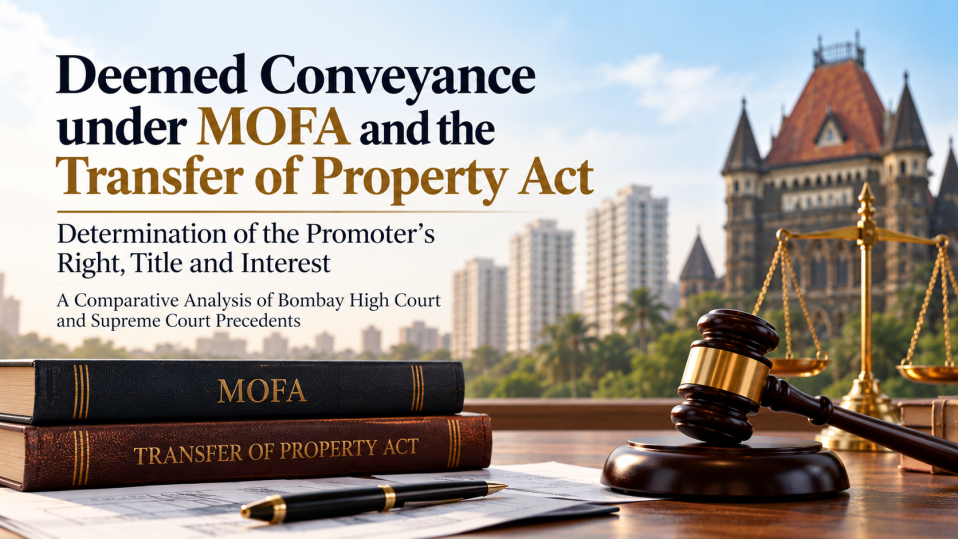
The Expanding Definition of “Promoter”: Impact on Landowners’ Rights. Need for parliamentary intervention?
NEED FOR AUTHORITATIVE CLARIFICATION BY THE BOMBAY HIGH COURT ON THE SCOPE OF SECTION 11 OF MOFA: GERALD MICHAEL MISQUITTA AND ROHINI GUPTA Gerald Michael Misquitta Vs State of Maharashtra ( “Gerald” ) Rohini Gupta & Anr. v. District Deputy Registrar, Co-operative Societies & Ors., WP No. 5991/2026, Bombay High Court, decided 8 September 2026, in which Mohini Gupta is the second petitioner. Indian Kanoon ( “Gupta” ) The two cases are quite closely connected because both concern Section 11 of MOFA, deemed conveyance, landowners/lessees, and the powers of the District Deputy Registrar (DDR). But there is an important difference: Gerald Misquitta is primarily a procedural/natural-justice case, whereas Gupta is substantially a Section 2(c)/Section 11 substantive-promoter case. Basic facts — side-by-side Sr No Particulars Gerald Michael Misquitta v. State of Maharashtra Rohini Gupta & Anr. v. DDR3 1 Court Bombay High Court Bombay High Court 2 Judgment date 25 Feb 2026 8 Sept 2026 3 Petition WP 1739/2022 WP 5991/2026 4 Ownership Misquitta family property, Vile Parle West Gupta family property, Juhu 5 Original owners Multiple Misquitta co-owners Late Kundanlal Laxmichand Gupta; petitioners were his heirs 6 Developer/lessee structure Owners → Rahejas → A.K. Associates/sub-lessee Owner → Raheja/Wadhwa lessees → developers 7 Society Name Priya Co-operative Housing Society Queens Park Premises Co-operative Society 8 Lease 98-year lease 98-year lease 9 Earlier transfer to society Society claimed/received only leasehold-related rights Society already received assignment of leasehold rights in 1978 10 DDR order 28 May 2014 23 June 2025 11 Main challenge Owners were not properly impleaded/heard; DDR did not conduct required enquiry Whether landowners themselves became “promoters” under MOFA Result DDR order + conveyance quashed and remanded Petition dismissed; DDR order upheld The Misquitta judgment records that the property was owned by several co-owners and that the society’s deemed-conveyance application proceeded without impleading all of them. Indian Kanoon The Gupta judgment records a 98-year lease from Kundanlal Gupta and subsequent construction of Queens Park by the lessees/developers. Indian Kanoon Paragraph-wise comparison This is the more useful way to read the judgments. Para 1–3 — What is being challenged? Gerald — paras 1–3 The petitioner challenged the DDR’s 28 May 2014 certificate permitting unilateral deemed conveyance and the subsequent registered deed of assignment/transfer dated 5 July 2014. The important factual feature was that the petitioner claimed to be a co-owner, but was not properly made a party to the deemed-conveyance proceedings. Indian Kanoon Gupta — paras 1–4 The petitioners were the legal heirs of the original landowner. They challenged the DDR’s order dated 23 June 2025 granting unilateral deemed conveyance of approximately 3,901.70 sq.m. to Queens Park Society. The Gupta petitioners said that their father had died in 1981 and that the DDR had proceeded on a notice issued in his name. Indian Kanoon Difference In Gerald, the central problem was: “Were all persons whose rights were affected actually heard?” In Gupta, the central question became: “Were these landowners themselves promoters under Section 2(c) MOFA?” Paragraphs 10–15 — Meaning of “promoter” This is the most important substantive difference. Gerald The Court did not finally determine the title/promoter controversy because […]
Read more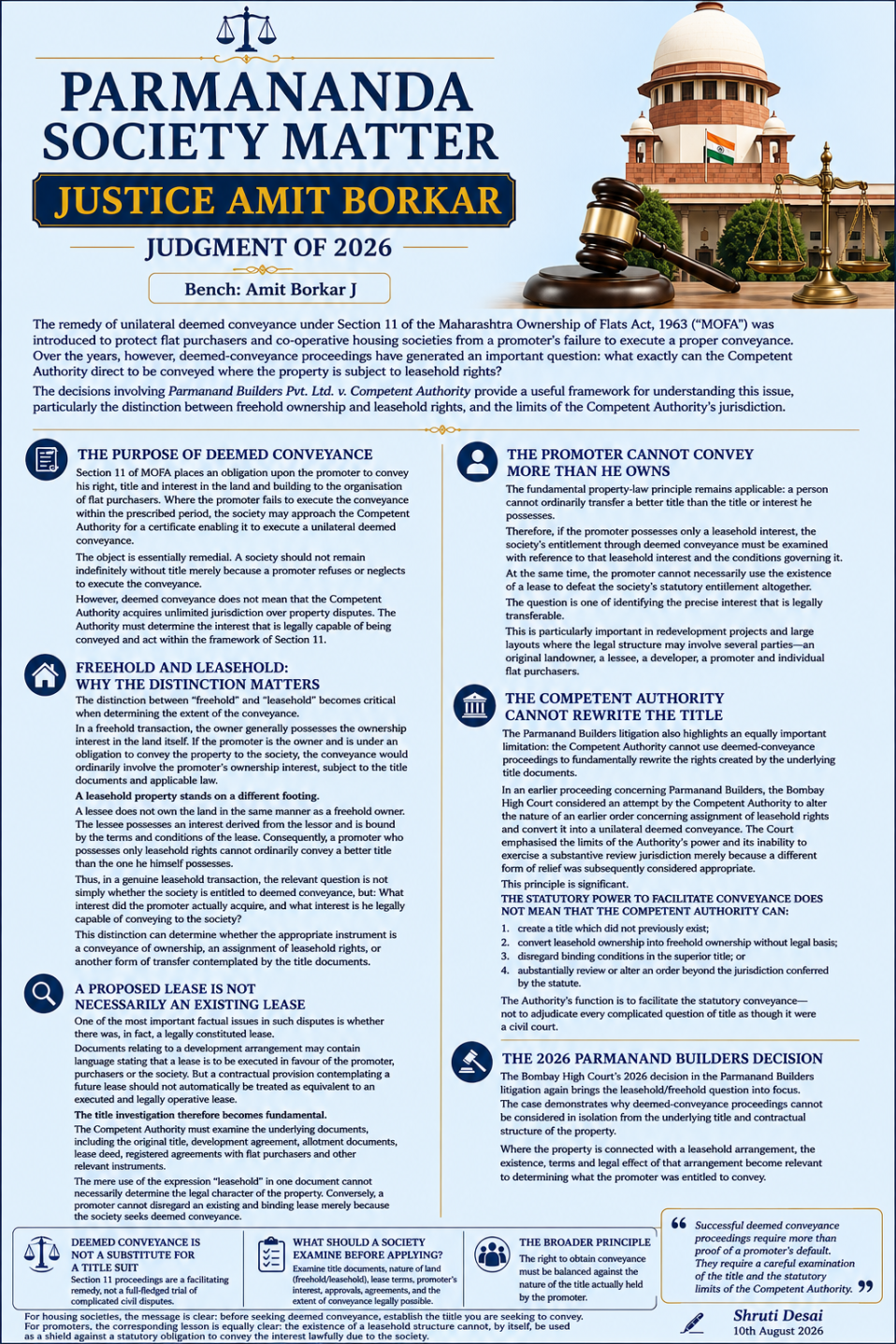
Unilateral Deemed Conveyance under MOFA: Leasehold, Freehold and the Limits of the Competent Authority Lessons from Parmanand Builders v. Competent Authority: 24 February, 2026
Bench: Amit Borkar J The remedy of unilateral deemed conveyance under Section 11 of the Maharashtra Ownership of Flats Act, 1963 (“MOFA”) was introduced to protect flat purchasers and co-operative housing societies from a promoter’s failure to execute a proper conveyance. Over the years, however, deemed-conveyance proceedings have generated an important question: what exactly can the Competent Authority direct to be conveyed where the property is subject to leasehold rights? The decisions involving Parmanand Builders Pvt. Ltd. v. Competent Authority provide a useful framework for understanding this issue, particularly the distinction between freehold ownership and leasehold rights, and the limits of the Competent Authority’s jurisdiction. The purpose of deemed conveyance Section 11 of MOFA places an obligation upon the promoter to convey his right, title and interest in the land and building to the organisation of flat purchasers. Where the promoter fails to execute the conveyance within the prescribed period, the society may approach the Competent Authority for a certificate enabling it to execute a unilateral deemed conveyance. The object is essentially remedial. A society should not remain indefinitely without title merely because a promoter refuses or neglects to execute the conveyance. However, deemed conveyance does not mean that the Competent Authority acquires unlimited jurisdiction over property disputes. The Authority must determine the interest that is legally capable of being conveyed and act within the framework of Section 11. Freehold and leasehold: why the distinction matters The distinction between “freehold” and “leasehold” becomes critical when determining the extent of the conveyance. In a freehold transaction, the owner generally possesses the ownership interest in the land itself. If the promoter is the owner and is under an obligation to convey the property to the society, the conveyance would ordinarily involve the promoter’s ownership interest, subject to the title documents and applicable law. A leasehold property stands on a different footing. A lessee does not own the land in the same manner as a freehold owner. The lessee possesses an interest derived from the lessor and is bound by the terms and conditions of the lease. Consequently, a promoter who possesses only leasehold rights cannot ordinarily convey a better title than the one he himself possesses. Thus, in a genuine leasehold transaction, the relevant question is not simply whether the society is entitled to deemed conveyance, but: What interest did the promoter actually acquire, and what interest is he legally capable of conveying to the society? This distinction can determine whether the appropriate instrument is a conveyance of ownership, an assignment of leasehold rights, or another form of transfer contemplated by the title documents. A proposed lease is not necessarily an existing lease ? One of the most important factual issues in such disputes is whether there was, in fact, a legally constituted lease. Documents relating to a development arrangement may contain language stating that a lease is to be executed in favour of the promoter, purchasers or the society. But a contractual provision contemplating a future lease should not automatically be treated as equivalent to an executed and legally operative lease. The title investigation therefore becomes fundamental. The Competent Authority must […]
Read more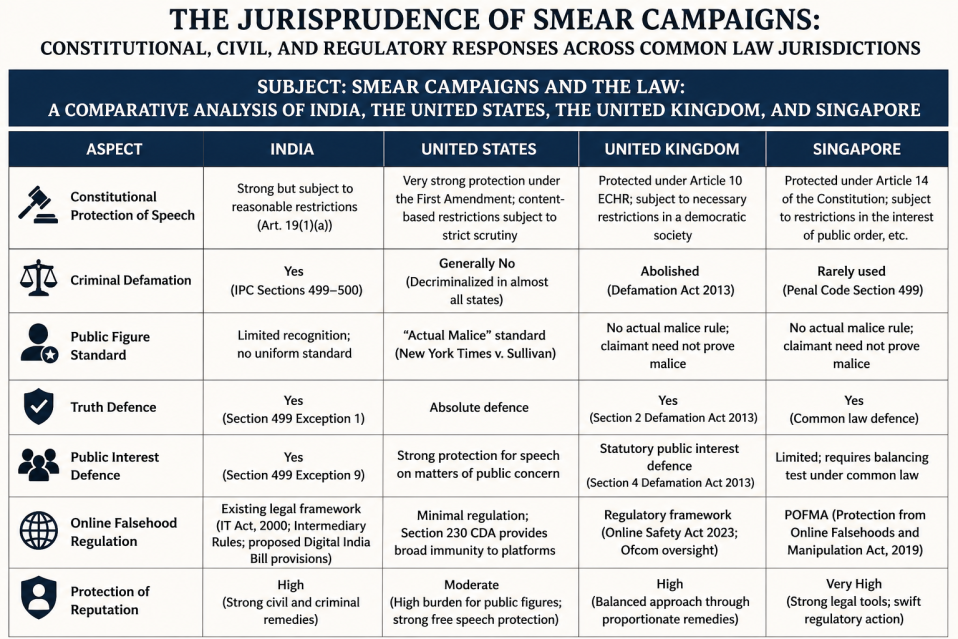
THE JURISPRUDENCE OF SMEAR CAMPAIGNS: CONSTITUTIONAL, CIVIL, AND REGULATORY RESPONSES ACROSS COMMON LAW JURISDICTIONS
SUBJECT: SMEAR CAMPAIGNS AND THE LAW: A COMPARATIVE ANALYSIS OF INDIA, THE UNITED STATES, THE UNITED KINGDOM, AND SINGAPORE It is obvious that, youths learn from what is talked in public. The icons are leaders, actors, politicians and those who are in public life. It’s easy in India to smear someone’s reputation. Reason is weak provisions. In India opposition leader who come from high profile family uses all his conveniences and power to disrepute and threaten all Competent Authorities. But he escapes without a scratch. Dialogues in Hindi movies like “kya karlega tera kanoon” also played important role. In my childhood we were taught by mothers not to say insulting or false about others. It was considered as sin. However it appears that deity of Karma is also tired of dealing with falsehood and false public allegations. There is a wait list for justice there too. A famous bhajan ” ninda a kare keni re” loved by Bapu is forgotten. With this common parlance discussion lets turn to the legal discussion. USA: UAE-Backed Dark PR (2023): The United Arab Emirates (UAE) hired Swiss firm Alp Services to conduct a covert, multi-year smear campaign targeting a US-based businessman, Hazim Nada, and his commodities-trading firm, Lord Energy. The campaign manipulated markets and successfully forced the company into liquidation by spreading false allegations of terrorist. ( check https://www.newyorker.com/news/news-desk/can-an-american-hold-the-united-arab-emirates-responsible-for-a-smear-campaign) Martin Luther King Jr. FBI Surveillance (1960s): The FBI under J. Edgar Hoover orchestrated a massive, covert operation to discredit Dr. Martin Luther King Jr., labelling him a subversive. The agency sent defamatory packages, wiretapped his communications, and urged him to commit suicide to silence his activism. ( check: https://www.aclu.org/press-releases/aclu-releases-report-fbi-crusade-against-martin-luther-king-jr-urges-ashcroft-not ) Planned Parenthood Foetal Tissue Controversy (2015): Anti-abortion groups released deceptively edited videos to accuse Planned Parenthood of illegally selling foetal tissue for profit. The healthcare organization denounced the effort as a fabricated smear campaign designed to cut off their federal funding. ( check https://www.bbc.com/news/world-us-canada-34396751) UNITED KINGDOM: The Sir David Attenborough Climate Campaign (2019–2023): Following the release of the Netflix documentary Our Planet, which featured footage of Pacific walruses falling to their deaths, climate change deniers initiated a widespread smear campaign against Attenborough. The attackers falsely alleged that he and the production crew fabricated the tragedy to artificially push climate change narratives. (https://www.lse.ac.uk/granthaminstitute/news/climate-change-deniers-continue-smear-campaign-against-sir-david-attenborough/) The Labour Together Corporate Intelligence Report (2024–2026): In a major political controversy, it was revealed that the UK think tank Labour Together commissioned a US public relations firm (APCO) to compile a 58-page report, codenamed “Operation Cannon”. The report targeted journalists at the Sunday Times who were investigating the group’s campaign funding and attempted to discredit them by alleging foreign interference and making personal attacks. SINGAPORE Singtel vs. Telco Rivals (2015) The Incident: Telecommunications giant Singtel and social media agency Gushcloud were exposed for running an orchestrated online smear campaign against rival telcos StarHub and M1. Details: Bloggers were paid and incentivized to fabricate complaints and criticize the network connections of the rival telcos. Resolution: Following whistleblowing by blogger Xiaxue, Singtel’s CEO publicly apologized, the responsible employees were fired, and the Infocomm Development Authority (IDA) issued a stern warning to the telco. (check https://www.campaignasia.com/article/ethical-crackdown-regulating-singapores-influencer-scene/2xnaatoej5nqkwmj28qr5s2lyl) […]
Read more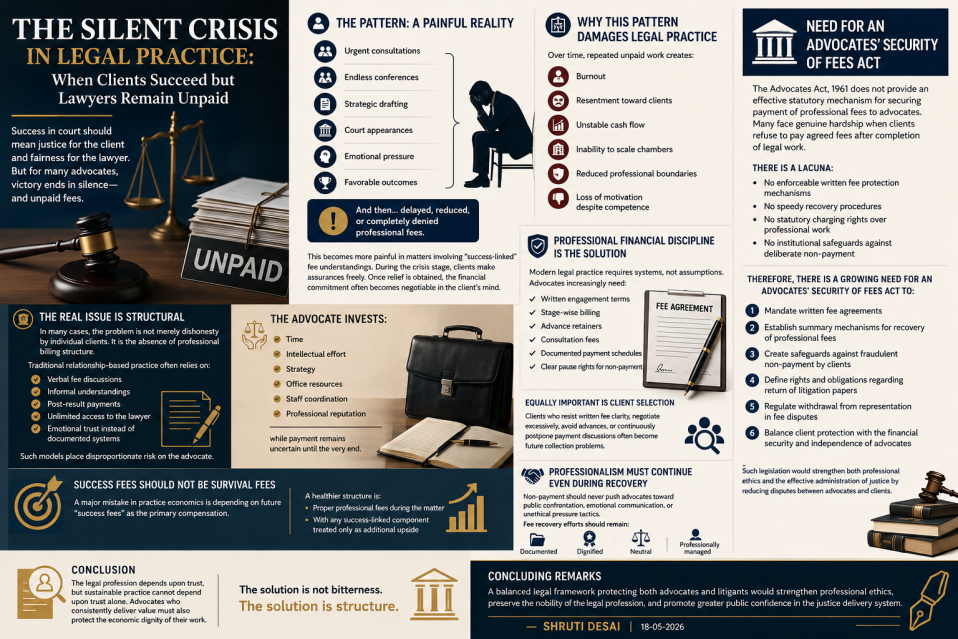
The Silent Crisis in Legal Practice: When Clients Succeed but Lawyers Remain Unpaid
The Silent Crisis in Legal Practice: When Clients Succeed but Lawyers Remain Unpaid For many advocates, the deepest professional frustration is not losing a case. It is succeeding for a client and still remaining unpaid. Across years of practice, many lawyers experience the same pattern repeatedly: urgent consultations, endless conferences, strategic drafting, court appearances, emotional pressure, favorable outcomes, and then delayed, reduced, or completely denied professional fees. This problem becomes more painful in matters involving “success-linked” fee understandings. During the crisis stage, clients make assurances freely. Once relief is obtained — settlement, injunction, bail, recovery, business advantage, or litigation success — the financial commitment often becomes negotiable in the client’s mind. The result is not only financial loss. It creates professional exhaustion and distrust within practice. The Real Issue Is Structural In many cases, the problem is not merely dishonesty by individual clients. It is the absence of professional billing structure. Traditional relationship-based practice often relies on: verbal fee discussions, informal understandings, post-result payments, unlimited access to the lawyer, and emotional trust instead of documented systems. Such models place disproportionate risk on the advocate. The lawyer invests: time, intellectual effort, strategy, office resources, staff coordination, and professional reputation, while payment remains uncertain until the very end. Why This Pattern Damages Legal Practice Over time, repeated unpaid work creates: burnout, resentment toward clients, unstable cash flow, inability to scale chambers, reduced professional boundaries, and loss of motivation despite competence. Many capable lawyers become financially strained not because they lack legal skill, but because they lack enforceable economic structure within practice management. The Need for Professional Financial Discipline Modern legal practice requires systems, not assumptions. Advocates increasingly need: * written engagement terms, * stage-wise billing, * advance retainers, * consultation fees, * documented payment schedules, * and clear pause rights for non-payment. Equally important is client selection. Clients who: * resist written fee clarity, * negotiate excessively, * avoid advances, * or continuously postpone payment discussions often become future collection problems. Success Fees Should Not Be Survival Fees A major mistake in practice economics is depending on future “success fees” as the primary compensation. A healthier structure is: * proper professional fees during the matter, * with any success-linked component treated only as additional upside. This protects the advocate from total economic loss even if the client later defaults. Professionalism Must Continue Even During Recovery Non-payment should never push advocates toward public confrontation, emotional communication, or unethical pressure tactics. Fee recovery efforts should remain: * Documented, * Dignified, * Neutral, * And professionally managed. Long-term reputation is more valuable than short-term anger. A major lacuna in the existing legal framework is the absence of a statutory mechanism securing payment of professional fees to advocates. While the Advocates Act, 1961 emphasizes professional ethics and duties toward clients, it does not adequately protect advocates from non-payment of legitimate fees after rendering legal services. Need for an Advocates’ Security of Fees Act The present legal framework under the Advocates Act, 1961 does not provide an effective statutory mechanism for securing payment of professional fees to advocates. Although advocates are ethically prohibited from abandoning clients unfairly […]
Read more
The Jungle, the Fairy, and the Ballot Box
“The Fairy and the Freebie: How Easy Comfort Weakens a Nation” As soon as Election comes every political party starts disbursing money to the voters. Some offer monthly Rs.70,000/- some offer. The taxpayer is a mute spectator. I will tell you story of a Jungle. The Story of the Jungle Once upon a time, there was a beautiful jungle where all the animals lived peacefully. They worked hard to find their food by hunting and gathering. They shared with one another and cared for each other. The jungle was full of love, cooperation, and happiness. All the animals helped one another and took responsibility for their lives. They were strong, active, and independent. One day, a fairy came to the jungle. She had a magic wand. By waving her wand, she started giving food and water to all the animals and birds. At first, everyone was happy. But slowly, the animals became lazy. Since food was easily available, they stopped working and hunting. They spent most of their time sleeping and eating. Over time, they even found it difficult to walk and run because they were no longer active. After a few months, a hunter entered the jungle. He began hunting the animals recklessly. Earlier, the animals were brave and skilled at escaping or fighting back. But now, because they were weak and lazy, many of them were easily caught in traps. Many animals were hunted. Fear spread throughout the jungle. The King of the Jungle called a meeting. All the animals gathered and discussed what had gone wrong. They realized that the fairy had been sent by the hunter to make them weak and dependent. Because of her magic, they had lost their strength and alertness. They decided to send the fairy away from the jungle. After the fairy was deported, the animals slowly returned to their old habits. They started working hard again, hunting, sharing, and taking care of one another. Soon, the jungle became peaceful and happy once more. Moral of the Story Easy comfort can make us weak. Hard work and self-reliance make us strong. ____________________________________________________________ Freebies and Constitution The legality of election “freebies” in India hinges on balancing Directive Principles (social welfare) with fiscal responsibility under the Constitution. While critics argue they constitute bribery and misuse public funds (violating Art. 266, 282), the Supreme Court in The S. Subramaniam Balaji v. Government of Tamil Nadu (2013) case is a landmark Supreme Court of India judgment regarding electoral freebies. The Court ruled that pre-poll promises in election manifestos do not constitute a “corrupt practice” under Section 123 of the Representation of People Act, 1951, as they are part of a party’s agenda, not individual bribery. The judgment established a distinction between election promises for public welfare and the direct bribery of voters. However, it has been criticized for failing to curb the growing culture of “freebie politics” that threatens state finances. Latest View of Supreme Court: TAMIL NADU POWER DISTRIBUTION CORPORATION LIMITED Vs UNION OF INDIA | W.P.(C) No. 158/2026 Currently the view of Supreme Court has changed its view. In the above matter CJI Suryakant said […]
Read more
CAN SUPREME COURT IMPOSE TIME LIMIT UPON PRESIDENT OF INDIA OR GOVERNOR OF STATE FOR SIGNING BILL? DISCUSSION AND SUGGESTIONS.
Background: The Legislature for the State of Tamil Nadu, between 13.01.2020 and 28.04.2023, enacted and forwarded 12 Bills to the Governor for the grant of assent as per Article 200 of the Constitution. Even though the present Governor took charge of the office with effect from 18.11.2021, he did not take the necessary action on any of the said Bills forwarded to his office till October 2023. The State of Tamil Nadu, being aggrieved by the inaction on the part of the Governor, had to ultimately file the present writ petition before Court. The same was filed on 31.10.2023. The State Legislature, on 18.11.2023, convened a special session and repassed the 10 bills which were returned by the Governor after withholding of assent. The bills were passed without any material change and were forwarded to the Governor’s Secretariat on the same day for his assent in accordance with the first proviso to Article 200. This Court, in its order dated 20.11.2023, noted that since the re-passed 10 bills were pending with the Governor, the hearing of the writ petition be adjourned to 01.12.2023 and issued directions that this Court shall be apprised of the progress in the matter. On 28.11.2023, the Governor, without the aid and advice of the Council of Ministers of the State, in exercise of his discretion, reserved the said re-passed Bills for the consideration of the President. The letter of the Governor to the Union Government referring the said Bills for the consideration of the President mentioned that the Bills were re-considered and passed again by the State Legislature. Interestingly, although the Governor noted that the Bills were intra-vires the competence of the State Legislature having been legislated under Entry 66 of List I, Entry 32 of List II and Entry 25 of List III, yet he reserved the said Bills for the consideration of the President in the second round on the ground that the Bills suffered from repugnancy on account of being contrary to Entry 66 of the Union List i.e., List I. These grounds have been taken by the Governor to reserve the 10 Bills for consideration of the President. In the premises Chief Minister asked the Governor to (i) Recall the 10 Bills reserved for the consideration of the President and grant assent expeditiously;(ii) In future, grant assent to Bills passed by the State Legislature within 30 days and avoid unnecessary reservation of the bills for the consideration of the President; (iii) Act in accordance with the aid and advice tendered by the Council of Ministers. Matter went up to the Supreme Court COMMENTS OF AUTHOR Before going into the details of the Judgement, it is not highlighted that even the state government of Tamil Nadu was playing mischief with provisions of the Constitution. Question arises, how? Article 200 of the Constitution provides that if the Bill is returned by the Governor, the State Assembly may re-pass the Bill with or without modification and the Governor cannot withhold the same. (The said Article text is given herein below) Here also, the State Assembly re-passed the Bills without any amendments and without implementing the suggestions […]
Read more