
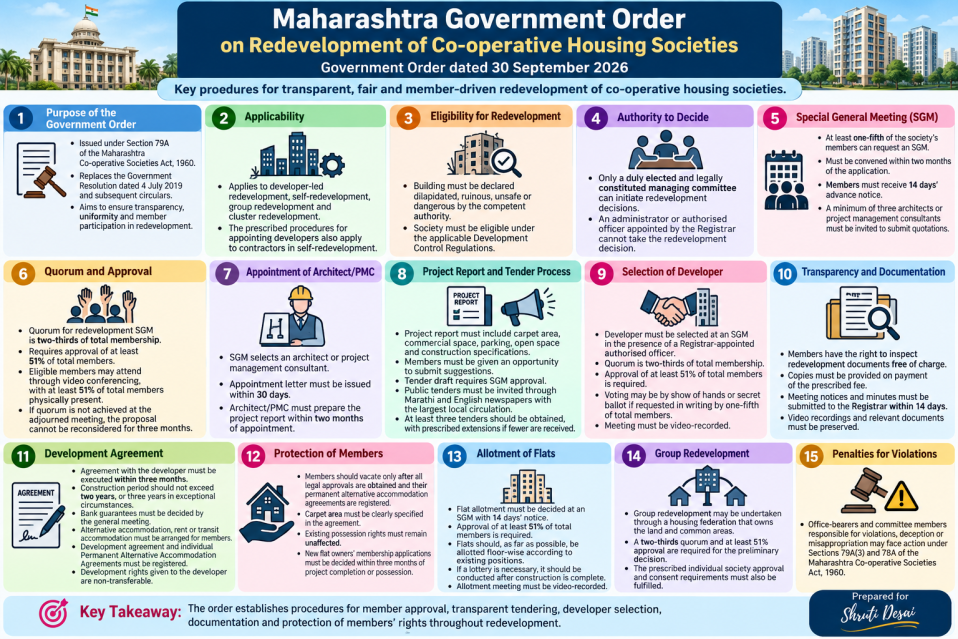
Maharashtra Government Order on Redevelopment of Co-operative Housing Societies (30 September 2026) made simpler for layman
Short Notes: Maharashtra Government Order on Redevelopment of Co-operative Housing Societies (30 September 2026) Government Order dated 30 September 2026 Redevelopment G.R. 30-09-2026 Redevelopment Govt Circular English-Marathi Short Notes: Maharashtra Government Order on Redevelopment of Co-operative Housing Societies (30 September 2026) Government Order dated 30 September 2026 Purpose of the Government Order Issued under Section 79A of the Maharashtra Co-operative Societies Act, 1960. Replaces the Government Resolution dated 4 July 2019 and subsequent circulars. Aims to ensure transparency, uniformity and member participation in redevelopment. Applicability Applies to developer-led redevelopment, self-redevelopment, group redevelopment and cluster redevelopment. The prescribed procedures for appointing developers also apply to contractors in self-redevelopment. Eligibility for Redevelopment The building must be declared dilapidated, ruinous, unsafe or dangerous by the competent authority. The society must be eligible under the applicable Development Control Regulations. Authority to Decide Only a duly elected and legally constituted managing committee can initiate redevelopment decisions. An administrator or authorised officer appointed by the Registrar cannot take the redevelopment decision. Special General Meeting (SGM) At least one-fifth of the society’s members can request an SGM. The SGM must be convened within two months of the application. Members must receive 14 days’ advance notice. A minimum of three architects or project management consultants must be invited to submit quotations. Quorum and Approval The quorum for the redevelopment SGM is two-thirds of the total membership. Redevelopment requires approval from at least 51% of the total members. Eligible members may attend through video conferencing, subject to the requirement that at least 51% of total members are physically present. If quorum is not achieved at the adjourned meeting, the proposal cannot be reconsidered for three months. Appointment of Architect/PMC The SGM selects an architect or project management consultant. The appointment letter must be issued within 30 days. The architect/PMC must prepare the project report within two months of appointment. Project Report and Tender Process The project report must include carpet area, commercial space, parking, open space and construction specifications. Members must be given an opportunity to submit suggestions. The tender draft requires SGM approval. Public tenders must be invited through Marathi and English newspapers with the largest local circulation. At least three tenders should be obtained, with prescribed extensions if fewer are received. Selection of Developer The developer must be selected at an SGM in the presence of a Registrar-appointed authorised officer. The quorum is two-thirds of total membership. Approval of at least 51% of total members is required. Voting may be by show of hands or secret ballot if requested in writing by one-fifth of total members. The meeting must be video-recorded. Transparency and Documentation Members have the right to inspect redevelopment documents free of charge. Copies must be provided on payment of the prescribed fee. Meeting notices and minutes must be submitted to the Registrar within 14 days. Video recordings and relevant documents must be preserved. Development Agreement The agreement with the developer must be executed within three months. The construction period should not exceed two years, or three years in exceptional circumstances. Bank guarantees must be decided by the general meeting. Alternative accommodation, rent or […]
Read moreROHINI GUPTA v. DISTRICT DEPUTY REGISTRAR: A CRITICAL LEGAL ANALYSIS OF THE SCOPE AND LIMITS OF DEEMED CONVEYANCE UNDER SECTION 11 OF MOFA
ROHINI GUPTA: CRITICAL LEGAL ANALYSIS AND FALLACIES The following analysis identifies potential issues in the reasoning of Rohini Gupta by comparing the judgment with the principles discussed in Ivory Properties, A.H. Wadia Trust and the other decisions referred to in the draft. The points below are arguable grounds for examination; they should not be treated as established findings of error without verification against the complete judgments and underlying documents. 1. Rohini Gupta v. District Deputy Registrar Bombay High Court | 8 September 2026 | Writ Petition No. 5991 of 2026 | Justice Sandeep V. Marne The judgment dismissed the original landowners’ writ petition and upheld the deemed conveyance of 3,901.70 sq. m. of land to the society. The principal issue is whether the Court correctly moved from its finding that the landowners were promoters to the conclusion that they were obliged to convey their reversionary ownership of the land. 2. The principal legal conflict The central issue is that Rohini Gupta recognises the principle that deemed conveyance cannot ordinarily exceed the promoter’s rights, but nevertheless upholds freehold conveyance on the particular facts before the Court. The comparison requires distinguishing between an error in interpreting Section 11 of MOFA, an error in appreciating the lease deed and registered agreements, and an error in exercising the competent authority’s jurisdiction. A different conclusion on the facts does not, by itself, establish an error of law. Legal issue Earlier legal position Rohini Gupta judgment Extent of rights under Section 11 Society ordinarily receives the rights the promoter is entitled and obliged to convey. The Court held that the landowners were also promoters and were obliged to convey their ownership interest. Leasehold versus freehold An authority cannot ordinarily substitute freehold ownership for an agreement expressly limited to leasehold rights. The Court upheld freehold conveyance, relying on the landowners’ participation in the project and the agreements concerning ownership. Effect of an existing lease assignment An assignment may fulfil the promoter’s obligation to transfer the leasehold interest. The Court held that the earlier assignment fulfilled only part of the statutory obligation because the landowners had a separate obligation. Jurisdiction under Section 11 Deemed conveyance requires failure to fulfil the statutory obligation. The Court found a continuing failure on the part of the landowners, notwithstanding the earlier assignment. Nature of proceedings Summary proceedings do not finally determine complicated title disputes. The Court upheld the order while preserving the parties’ right to pursue appropriate civil proceedings. The judgment relies on A.H. Wadia Trust, Haresh Vijaysinh Bhatia and other decisions to distinguish cases where the promoter is merely a lessee from cases where the landowner is also a promoter or has an independent statutory obligation to convey. 3. Possible errors in Rohini Gupta judgment The following are potential grounds for challenging the reasoning. They are arguable errors, not findings that the judgment is necessarily erroneous. Sr. No. Paragraph of Rohini Gupta Possible error in reasoning Legal significance 1 Paras 14–15, 21–24 Treating participation in construction as sufficient to establish an obligation to convey freehold ownership. The Court inferred that the landowners became promoters because they exercised control over construction […]
Read more
The Expanding Definition of “Promoter”: Impact on Landowners’ Rights. Need for parliamentary intervention?
NEED FOR AUTHORITATIVE CLARIFICATION BY THE BOMBAY HIGH COURT ON THE SCOPE OF SECTION 11 OF MOFA: GERALD MICHAEL MISQUITTA AND ROHINI GUPTA Gerald Michael Misquitta Vs State of Maharashtra ( “Gerald” ) Rohini Gupta & Anr. v. District Deputy Registrar, Co-operative Societies & Ors., WP No. 5991/2026, Bombay High Court, decided 8 September 2026, in which Mohini Gupta is the second petitioner. Indian Kanoon ( “Gupta” ) The two cases are quite closely connected because both concern Section 11 of MOFA, deemed conveyance, landowners/lessees, and the powers of the District Deputy Registrar (DDR). But there is an important difference: Gerald Misquitta is primarily a procedural/natural-justice case, whereas Gupta is substantially a Section 2(c)/Section 11 substantive-promoter case. Basic facts — side-by-side Sr No Particulars Gerald Michael Misquitta v. State of Maharashtra Rohini Gupta & Anr. v. DDR3 1 Court Bombay High Court Bombay High Court 2 Judgment date 25 Feb 2026 8 Sept 2026 3 Petition WP 1739/2022 WP 5991/2026 4 Ownership Misquitta family property, Vile Parle West Gupta family property, Juhu 5 Original owners Multiple Misquitta co-owners Late Kundanlal Laxmichand Gupta; petitioners were his heirs 6 Developer/lessee structure Owners → Rahejas → A.K. Associates/sub-lessee Owner → Raheja/Wadhwa lessees → developers 7 Society Name Priya Co-operative Housing Society Queens Park Premises Co-operative Society 8 Lease 98-year lease 98-year lease 9 Earlier transfer to society Society claimed/received only leasehold-related rights Society already received assignment of leasehold rights in 1978 10 DDR order 28 May 2014 23 June 2025 11 Main challenge Owners were not properly impleaded/heard; DDR did not conduct required enquiry Whether landowners themselves became “promoters” under MOFA Result DDR order + conveyance quashed and remanded Petition dismissed; DDR order upheld The Misquitta judgment records that the property was owned by several co-owners and that the society’s deemed-conveyance application proceeded without impleading all of them. Indian Kanoon The Gupta judgment records a 98-year lease from Kundanlal Gupta and subsequent construction of Queens Park by the lessees/developers. Indian Kanoon Paragraph-wise comparison This is the more useful way to read the judgments. Para 1–3 — What is being challenged? Gerald — paras 1–3 The petitioner challenged the DDR’s 28 May 2014 certificate permitting unilateral deemed conveyance and the subsequent registered deed of assignment/transfer dated 5 July 2014. The important factual feature was that the petitioner claimed to be a co-owner, but was not properly made a party to the deemed-conveyance proceedings. Indian Kanoon Gupta — paras 1–4 The petitioners were the legal heirs of the original landowner. They challenged the DDR’s order dated 23 June 2025 granting unilateral deemed conveyance of approximately 3,901.70 sq.m. to Queens Park Society. The Gupta petitioners said that their father had died in 1981 and that the DDR had proceeded on a notice issued in his name. Indian Kanoon Difference In Gerald, the central problem was: “Were all persons whose rights were affected actually heard?” In Gupta, the central question became: “Were these landowners themselves promoters under Section 2(c) MOFA?” Paragraphs 10–15 — Meaning of “promoter” This is the most important substantive difference. Gerald The Court did not finally determine the title/promoter controversy because […]
Read more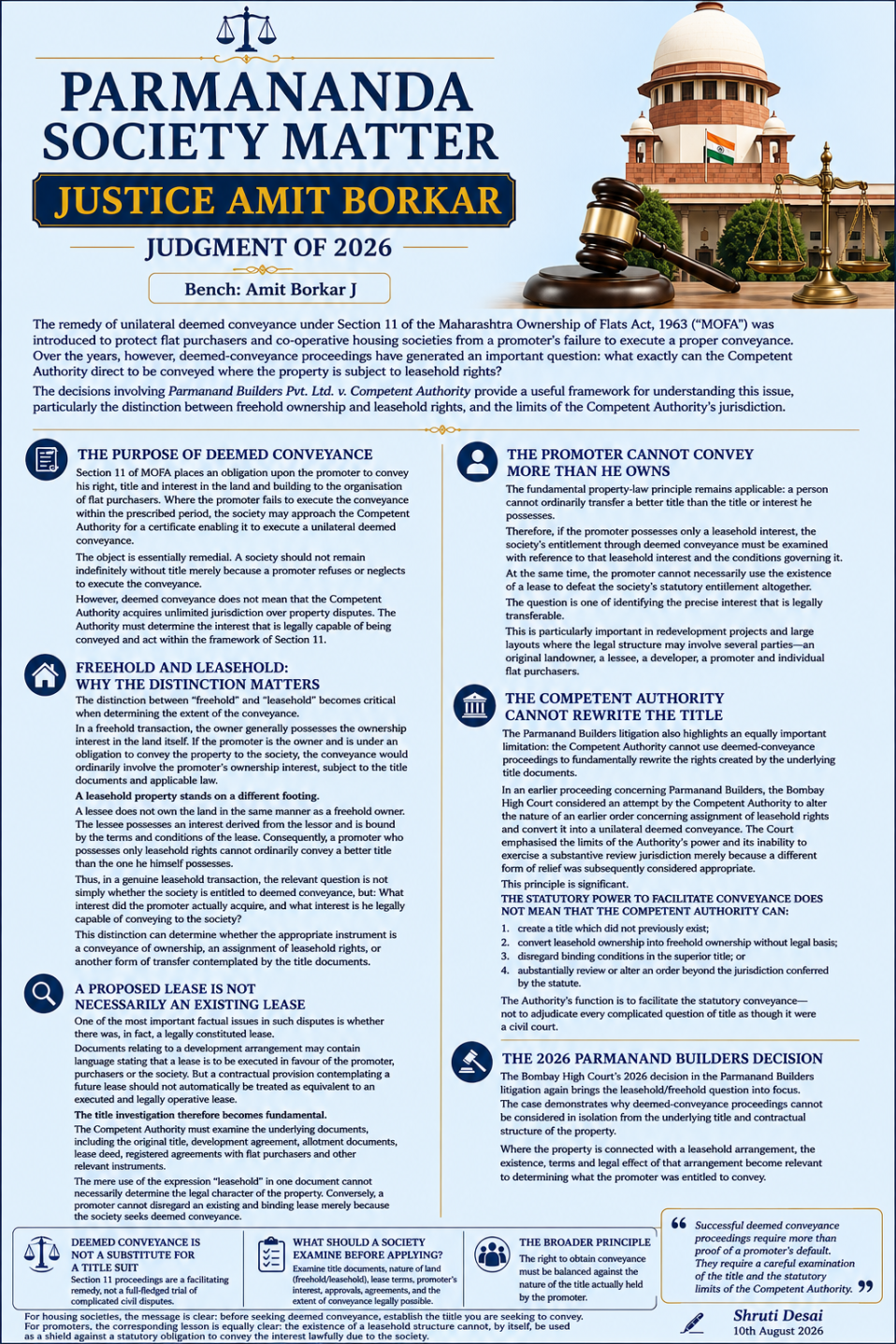
Unilateral Deemed Conveyance under MOFA: Leasehold, Freehold and the Limits of the Competent Authority Lessons from Parmanand Builders v. Competent Authority: 24 February, 2026
Bench: Amit Borkar J The remedy of unilateral deemed conveyance under Section 11 of the Maharashtra Ownership of Flats Act, 1963 (“MOFA”) was introduced to protect flat purchasers and co-operative housing societies from a promoter’s failure to execute a proper conveyance. Over the years, however, deemed-conveyance proceedings have generated an important question: what exactly can the Competent Authority direct to be conveyed where the property is subject to leasehold rights? The decisions involving Parmanand Builders Pvt. Ltd. v. Competent Authority provide a useful framework for understanding this issue, particularly the distinction between freehold ownership and leasehold rights, and the limits of the Competent Authority’s jurisdiction. The purpose of deemed conveyance Section 11 of MOFA places an obligation upon the promoter to convey his right, title and interest in the land and building to the organisation of flat purchasers. Where the promoter fails to execute the conveyance within the prescribed period, the society may approach the Competent Authority for a certificate enabling it to execute a unilateral deemed conveyance. The object is essentially remedial. A society should not remain indefinitely without title merely because a promoter refuses or neglects to execute the conveyance. However, deemed conveyance does not mean that the Competent Authority acquires unlimited jurisdiction over property disputes. The Authority must determine the interest that is legally capable of being conveyed and act within the framework of Section 11. Freehold and leasehold: why the distinction matters The distinction between “freehold” and “leasehold” becomes critical when determining the extent of the conveyance. In a freehold transaction, the owner generally possesses the ownership interest in the land itself. If the promoter is the owner and is under an obligation to convey the property to the society, the conveyance would ordinarily involve the promoter’s ownership interest, subject to the title documents and applicable law. A leasehold property stands on a different footing. A lessee does not own the land in the same manner as a freehold owner. The lessee possesses an interest derived from the lessor and is bound by the terms and conditions of the lease. Consequently, a promoter who possesses only leasehold rights cannot ordinarily convey a better title than the one he himself possesses. Thus, in a genuine leasehold transaction, the relevant question is not simply whether the society is entitled to deemed conveyance, but: What interest did the promoter actually acquire, and what interest is he legally capable of conveying to the society? This distinction can determine whether the appropriate instrument is a conveyance of ownership, an assignment of leasehold rights, or another form of transfer contemplated by the title documents. A proposed lease is not necessarily an existing lease ? One of the most important factual issues in such disputes is whether there was, in fact, a legally constituted lease. Documents relating to a development arrangement may contain language stating that a lease is to be executed in favour of the promoter, purchasers or the society. But a contractual provision contemplating a future lease should not automatically be treated as equivalent to an executed and legally operative lease. The title investigation therefore becomes fundamental. The Competent Authority must […]
Read moreTransfers Beyond Statutory Ceiling Limits: Supreme Court Explains the Scope of Section 154 Violations
Supreme Court Clarifies the Nature of Transfers Violating Section 154 of the U.P. Zamindari Abolition and Land Reforms Act: In Arafat Ali (Dead) Through LRs & Ors. v. Deputy Director of Consolidation, Haridwar & Ors. Introduction In a significant judgment delivered on 23 June 2026, the Supreme Court of India in Arafat Ali (Dead) Through Legal Representatives & Others v. Deputy Director of Consolidation, Haridwar & Others settled an important question concerning agricultural land transfers under the Uttar Pradesh Zamindari Abolition and Land Reforms Act, 1950 (“UPZA&LR Act”). The Court examined whether a transfer executed in violation of Section 154 of the Act is void from its inception or merely voidable through appropriate legal proceedings. The ruling provides much-needed clarity for landowners, purchasers, revenue authorities, and practitioners dealing with consolidation and agricultural land disputes in Uttar Pradesh. FACTS OF THE CASE The dispute arose during consolidation proceedings relating to agricultural land transfers allegedly made in contravention of Section 154 of the UPZA&LR Act. The provision restricts acquisition and transfer of agricultural land beyond prescribed statutory limits to prevent excessive concentration of landholdings. The central issue before the Court was whether such transfers automatically become legally non-existent (void ab initio) or continue to have legal effect unless and until challenged before a competent authority. LEGAL ISSUES INVOLVED The Supreme Court was called upon to determine: Whether a transfer of agricultural land made in violation of Section 154 of the UPZA&LR Act is void ab initio or merely voidable under the statutory framework. The answer to this question carries substantial consequences for land titles, mutation entries, consolidation proceedings, and rights of subsequent purchasers. SUPREME COURT’S FINDINGS The Supreme Court held that a transfer made in contravention of Section 154 is not void ab initio. Instead, such a transfer is voidable and remains effective unless it is challenged and set aside through legally prescribed procedures. THE COURT EMPHASIZED THE FOLLOWING PRINCIPLES: Violation of Section 154 Does Not Automatically Nullify the Transfer A transaction executed in breach of the statutory restriction does not cease to exist in the eyes of law merely because the provision has been violated. The transfer continues to operate unless competent proceedings are initiated to invalidate it. Distinction Between Void and Voidable Transactions The judgment reiterates the well-established legal distinction: Void Transaction: A transaction having no legal existence from the very beginning. Voidable Transaction: A transaction that remains valid and enforceable until annulled by a competent authority or court. By classifying transfers violating Section 154 as voidable, the Court protected the principle of legal certainty in property transactions. Applicability of Law Existing on the Date of Transfer The Court observed that the validity of a transfer must ordinarily be assessed with reference to the legal position prevailing on the date of execution of the sale deed or transfer instrument. Appropriate Statutory Remedies Must Be Invoked The Court clarified that challenges to such transfers must be pursued through the mechanisms contemplated under the statute, including proceedings that may be initiated by competent authorities or the Gaon Sabha where applicable. SIGNIFICANCE OF THE JUDGMENT […]
Read more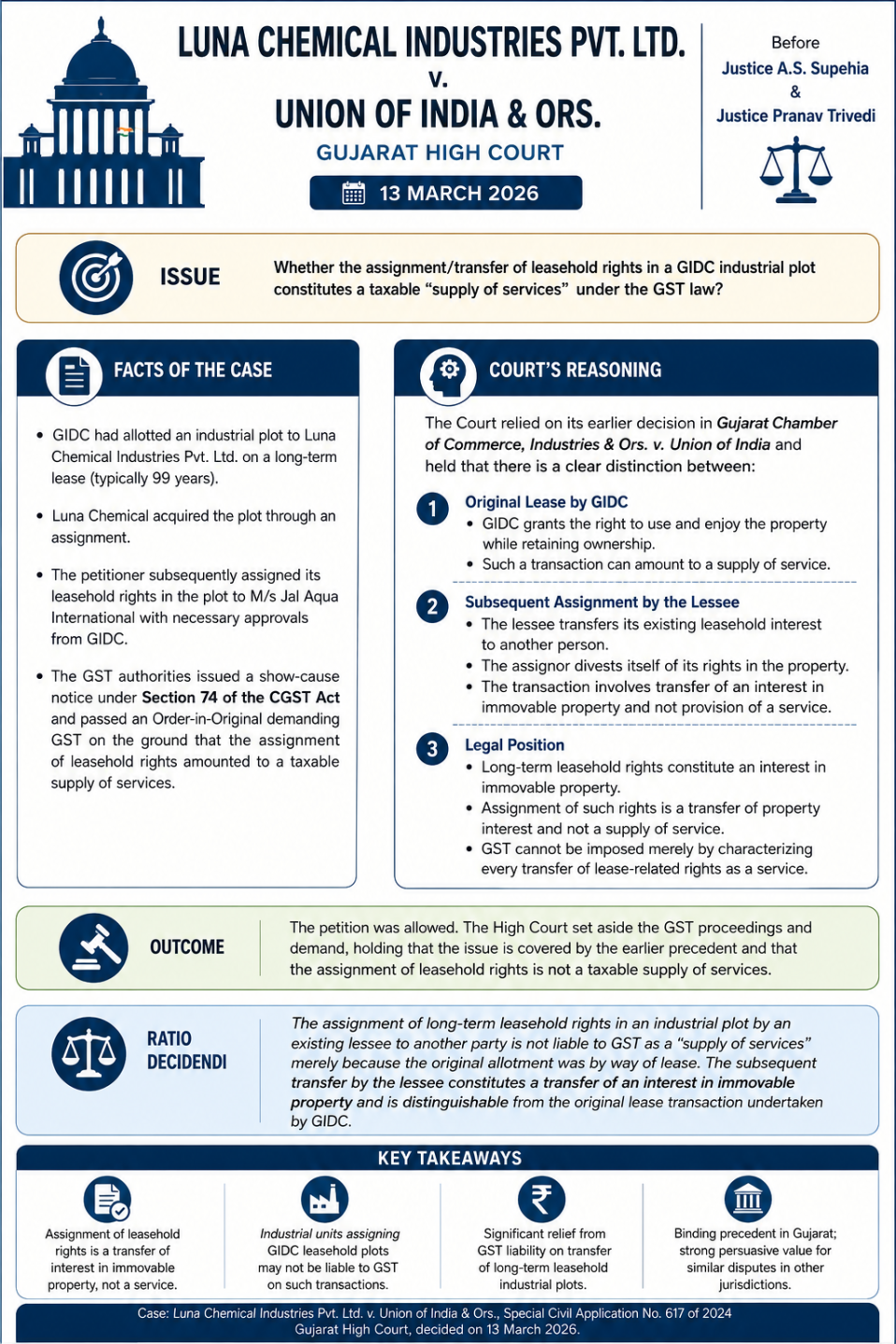
ASSIGNMENT OF LEASEHOLD RIGHTS UNDER GST: ANALYSIS OF LUNA CHEMICAL INDUSTRIES PVT. LTD. V. UNION OF INDIA (GUJARAT HIGH COURT)
Introduction The Gujarat High Court’s decision in Luna Chemical Industries Pvt. Ltd. v. Union of India has added another significant chapter to the ongoing debate concerning the GST implications of transfers of leasehold rights in industrial plots. The judgment reaffirms the principle that a transfer of leasehold rights by an existing lessee is fundamentally different from the original grant of lease by a statutory authority and cannot automatically be subjected to GST as a supply of service. The ruling is particularly relevant for industries operating in Gujarat Industrial Development Corporation (GIDC) estates and for taxpayers involved in the transfer of long-term leasehold interests in industrial land. Background of the Dispute Luna Chemical Industries Pvt. Ltd. held leasehold rights in an industrial plot allotted through the GIDC framework. Subsequently, the company assigned its leasehold rights to another entity after obtaining the requisite approvals from GIDC. The GST authorities initiated proceedings under Section 74 of the Central Goods and Services Tax Act, 2017, alleging that the assignment of leasehold rights constituted a taxable supply of services and consequently raised a demand for GST. The petitioner challenged the demand before the Gujarat High Court. CORE LEGAL ISSUE The principal question before the Court was: Whether the assignment of leasehold rights in an industrial plot by a lessee to a third party constitutes a taxable supply of services under the GST regime. The answer depended upon the characterization of the transaction. If the transaction represented a supply of service, GST would be leviable. Conversely, if it constituted a transfer of an interest in immovable property, it would fall outside the scope of taxable supplies. RATIO DECIDENDI The Court held that the transfer of leasehold rights by an existing lessee is legally distinct from the original lease granted by GIDC. The ratio of the decision may be summarized as follows: The assignment of long-term leasehold rights by a lessee results in the transfer of an existing interest in immovable property and does not amount to a taxable supply of services merely because the original allotment was made through a lease arrangement. Consequently, GST cannot be imposed on such assignment solely by treating it as a continuation of the original leasing transaction. Distinction between Lease and Assignment A key aspect of the judgment is the Court’s recognition of the legal distinction between: Original Lease by GIDC GIDC grants the right to use and enjoy immovable property while retaining ownership. Such a transaction may be characterized as a supply of service under GST. Subsequent Assignment by the Lessee The lessee transfers its existing leasehold interest to another person. The assignor divests itself of the rights held in the property. The transaction involves transfer of an interest in immovable property rather than provision of a service. The Court emphasized that these are two separate legal transactions and cannot be treated identically for GST purposes. Reliance on Earlier Precedent The judgment follows the Gujarat High Court’s earlier ruling in Gujarat Chamber of Commerce & Industry v. Union of India, where the Court had examined the GST treatment of leasehold interests in industrial plots. By relying on the principles laid […]
Read more