
Supreme Court Clarifies the Nature of Transfers Violating Section 154 of the U.P. Zamindari Abolition and Land Reforms Act: In Arafat Ali (Dead) Through LRs & Ors. v. Deputy Director of Consolidation, Haridwar & Ors.
Introduction
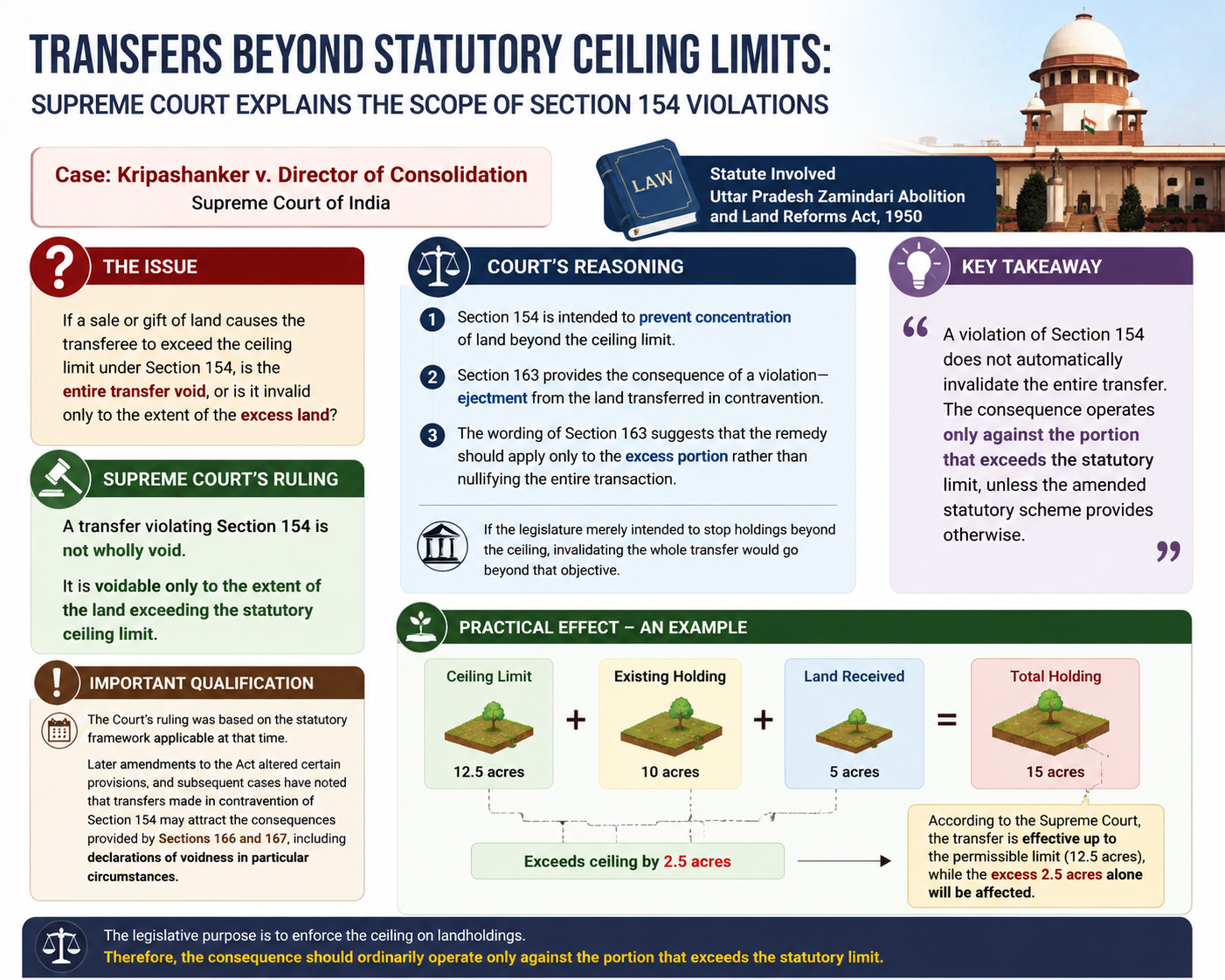
In a significant judgment delivered on 23 June 2026, the Supreme Court of India in Arafat Ali (Dead) Through Legal Representatives & Others v. Deputy Director of Consolidation, Haridwar & Others settled an important question concerning agricultural land transfers under the Uttar Pradesh Zamindari Abolition and Land Reforms Act, 1950 (“UPZA&LR Act”). The Court examined whether a transfer executed in violation of Section 154 of the Act is void from its inception or merely voidable through appropriate legal proceedings.
The ruling provides much-needed clarity for landowners, purchasers, revenue authorities, and practitioners dealing with consolidation and agricultural land disputes in Uttar Pradesh.
FACTS OF THE CASE
The dispute arose during consolidation proceedings relating to agricultural land transfers allegedly made in contravention of Section 154 of the UPZA&LR Act. The provision restricts acquisition and transfer of agricultural land beyond prescribed statutory limits to prevent excessive concentration of landholdings.
The central issue before the Court was whether such transfers automatically become legally non-existent (void ab initio) or continue to have legal effect unless and until challenged before a competent authority.
LEGAL ISSUES INVOLVED
The Supreme Court was called upon to determine:
- Whether a transfer of agricultural land made in violation of Section 154 of the UPZA&LR Act is void ab initio or merely voidable under the statutory framework.
The answer to this question carries substantial consequences for land titles, mutation entries, consolidation proceedings, and rights of subsequent purchasers.
SUPREME COURT’S FINDINGS
The Supreme Court held that a transfer made in contravention of Section 154 is not void ab initio. Instead, such a transfer is voidable and remains effective unless it is challenged and set aside through legally prescribed procedures.
THE COURT EMPHASIZED THE FOLLOWING PRINCIPLES:
- Violation of Section 154 Does Not Automatically Nullify the Transfer
A transaction executed in breach of the statutory restriction does not cease to exist in the eyes of law merely because the provision has been violated. The transfer continues to operate unless competent proceedings are initiated to invalidate it.
- Distinction Between Void and Voidable Transactions
The judgment reiterates the well-established legal distinction:
Void Transaction: A transaction having no legal existence from the very beginning.
Voidable Transaction: A transaction that remains valid and enforceable until annulled by a competent authority or court.
By classifying transfers violating Section 154 as voidable, the Court protected the principle of legal certainty in property transactions.
- Applicability of Law Existing on the Date of Transfer
The Court observed that the validity of a transfer must ordinarily be assessed with reference to the legal position prevailing on the date of execution of the sale deed or transfer instrument.
- Appropriate Statutory Remedies Must Be Invoked
The Court clarified that challenges to such transfers must be pursued through the mechanisms contemplated under the statute, including proceedings that may be initiated by competent authorities or the Gaon Sabha where applicable.
SIGNIFICANCE OF THE JUDGMENT
The judgment is significant because it brings doctrinal clarity and practical certainty to disputes involving agricultural land transfers under the UPZA&LR Act. By holding that a transfer made in breach of Section 154 is voidable and not void from inception, the Supreme Court has ensured that such transactions cannot be ignored or nullified casually without recourse to the procedure prescribed by law.
- Strengthening Stability of Land Titles
The ruling protects the stability of land titles by preventing automatic invalidation of transactions that may have remained uncontested for years. This is especially important in rural landholding patterns, where subsequent transfers, inheritance claims, mutations, and possession may all depend upon the continued legal recognition of earlier transactions.
- Ensuring Procedural Fairness
The decision reinforces that statutory violations must be examined through proper adjudicatory processes. Revenue or consolidation authorities cannot treat a transfer as non-existent merely on the assumption that Section 154 has been breached. A competent authority must first examine the facts, apply the statutory scheme, and pass an appropriate order.
- Protection Against Collateral and Arbitrary Challenges
By treating the transfer as voidable, the Court has limited the scope for collateral attacks on completed transactions. Parties seeking to challenge such transfers must do so in the manner and within the framework contemplated by law, thereby reducing uncertainty and discouraging arbitrary objections in consolidation or revenue proceedings.
- Clear Guidance for Future Land Disputes
The judgment provides a clear interpretative framework for courts, consolidation authorities, revenue officials, and legal practitioners dealing with land ceiling and transfer restrictions. It clarifies that the consequence of a statutory breach depends on the legislative scheme and that invalidation of a transfer must follow the procedure prescribed by the statute.
CONCLUSION
The Supreme Court’s decision in Arafat Ali (Dead) Through LRs & Ors. v. Deputy Director of Consolidation, Haridwar & Ors. marks an important development in agricultural land jurisprudence. By holding that transfers violating Section 154 of the UPZA&LR Act are voidable rather than void, the Court has reinforced the distinction between invalidity and challengeability while promoting certainty in property transactions.
The ruling is expected to influence future consolidation proceedings, revenue disputes, and land transfer litigation across Uttar Pradesh. For legal practitioners and stakeholders in land transactions, the judgment serves as a crucial precedent on the interpretation and enforcement of statutory restrictions governing agricultural land holdings.
Shruti Desai
25th June 2026

Post a comment