
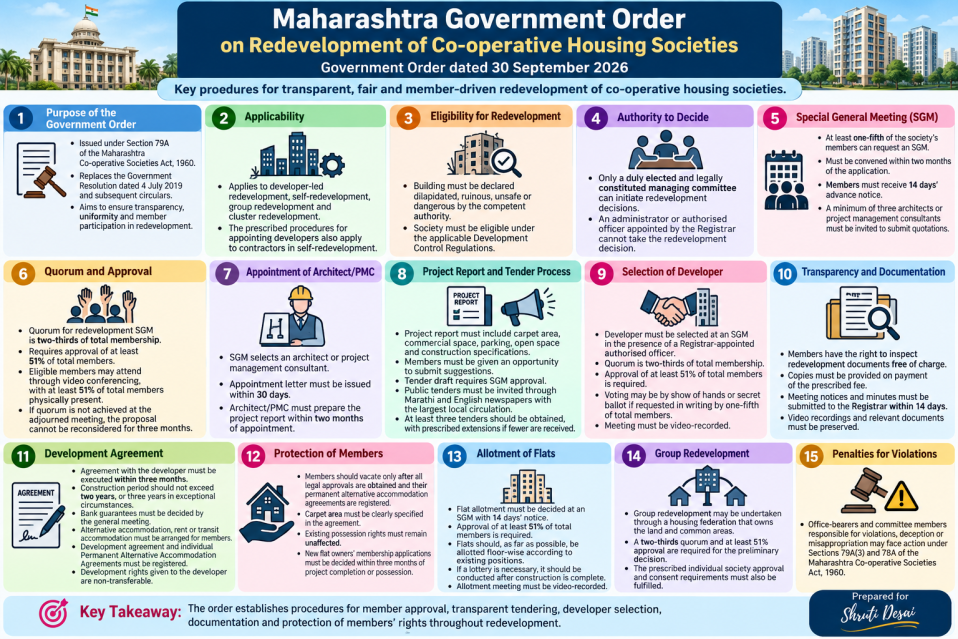
Maharashtra Government Order on Redevelopment of Co-operative Housing Societies (30 September 2026) made simpler for layman
Short Notes: Maharashtra Government Order on Redevelopment of Co-operative Housing Societies (30 September 2026) Government Order dated 30 September 2026 Redevelopment G.R. 30-09-2026 Redevelopment Govt Circular English-Marathi Short Notes: Maharashtra Government Order on Redevelopment of Co-operative Housing Societies (30 September 2026) Government Order dated 30 September 2026 Purpose of the Government Order Issued under Section 79A of the Maharashtra Co-operative Societies Act, 1960. Replaces the Government Resolution dated 4 July 2019 and subsequent circulars. Aims to ensure transparency, uniformity and member participation in redevelopment. Applicability Applies to developer-led redevelopment, self-redevelopment, group redevelopment and cluster redevelopment. The prescribed procedures for appointing developers also apply to contractors in self-redevelopment. Eligibility for Redevelopment The building must be declared dilapidated, ruinous, unsafe or dangerous by the competent authority. The society must be eligible under the applicable Development Control Regulations. Authority to Decide Only a duly elected and legally constituted managing committee can initiate redevelopment decisions. An administrator or authorised officer appointed by the Registrar cannot take the redevelopment decision. Special General Meeting (SGM) At least one-fifth of the society’s members can request an SGM. The SGM must be convened within two months of the application. Members must receive 14 days’ advance notice. A minimum of three architects or project management consultants must be invited to submit quotations. Quorum and Approval The quorum for the redevelopment SGM is two-thirds of the total membership. Redevelopment requires approval from at least 51% of the total members. Eligible members may attend through video conferencing, subject to the requirement that at least 51% of total members are physically present. If quorum is not achieved at the adjourned meeting, the proposal cannot be reconsidered for three months. Appointment of Architect/PMC The SGM selects an architect or project management consultant. The appointment letter must be issued within 30 days. The architect/PMC must prepare the project report within two months of appointment. Project Report and Tender Process The project report must include carpet area, commercial space, parking, open space and construction specifications. Members must be given an opportunity to submit suggestions. The tender draft requires SGM approval. Public tenders must be invited through Marathi and English newspapers with the largest local circulation. At least three tenders should be obtained, with prescribed extensions if fewer are received. Selection of Developer The developer must be selected at an SGM in the presence of a Registrar-appointed authorised officer. The quorum is two-thirds of total membership. Approval of at least 51% of total members is required. Voting may be by show of hands or secret ballot if requested in writing by one-fifth of total members. The meeting must be video-recorded. Transparency and Documentation Members have the right to inspect redevelopment documents free of charge. Copies must be provided on payment of the prescribed fee. Meeting notices and minutes must be submitted to the Registrar within 14 days. Video recordings and relevant documents must be preserved. Development Agreement The agreement with the developer must be executed within three months. The construction period should not exceed two years, or three years in exceptional circumstances. Bank guarantees must be decided by the general meeting. Alternative accommodation, rent or […]
Read moreROHINI GUPTA v. DISTRICT DEPUTY REGISTRAR: A CRITICAL LEGAL ANALYSIS OF THE SCOPE AND LIMITS OF DEEMED CONVEYANCE UNDER SECTION 11 OF MOFA
ROHINI GUPTA: CRITICAL LEGAL ANALYSIS AND FALLACIES The following analysis identifies potential issues in the reasoning of Rohini Gupta by comparing the judgment with the principles discussed in Ivory Properties, A.H. Wadia Trust and the other decisions referred to in the draft. The points below are arguable grounds for examination; they should not be treated as established findings of error without verification against the complete judgments and underlying documents. 1. Rohini Gupta v. District Deputy Registrar Bombay High Court | 8 September 2026 | Writ Petition No. 5991 of 2026 | Justice Sandeep V. Marne The judgment dismissed the original landowners’ writ petition and upheld the deemed conveyance of 3,901.70 sq. m. of land to the society. The principal issue is whether the Court correctly moved from its finding that the landowners were promoters to the conclusion that they were obliged to convey their reversionary ownership of the land. 2. The principal legal conflict The central issue is that Rohini Gupta recognises the principle that deemed conveyance cannot ordinarily exceed the promoter’s rights, but nevertheless upholds freehold conveyance on the particular facts before the Court. The comparison requires distinguishing between an error in interpreting Section 11 of MOFA, an error in appreciating the lease deed and registered agreements, and an error in exercising the competent authority’s jurisdiction. A different conclusion on the facts does not, by itself, establish an error of law. Legal issue Earlier legal position Rohini Gupta judgment Extent of rights under Section 11 Society ordinarily receives the rights the promoter is entitled and obliged to convey. The Court held that the landowners were also promoters and were obliged to convey their ownership interest. Leasehold versus freehold An authority cannot ordinarily substitute freehold ownership for an agreement expressly limited to leasehold rights. The Court upheld freehold conveyance, relying on the landowners’ participation in the project and the agreements concerning ownership. Effect of an existing lease assignment An assignment may fulfil the promoter’s obligation to transfer the leasehold interest. The Court held that the earlier assignment fulfilled only part of the statutory obligation because the landowners had a separate obligation. Jurisdiction under Section 11 Deemed conveyance requires failure to fulfil the statutory obligation. The Court found a continuing failure on the part of the landowners, notwithstanding the earlier assignment. Nature of proceedings Summary proceedings do not finally determine complicated title disputes. The Court upheld the order while preserving the parties’ right to pursue appropriate civil proceedings. The judgment relies on A.H. Wadia Trust, Haresh Vijaysinh Bhatia and other decisions to distinguish cases where the promoter is merely a lessee from cases where the landowner is also a promoter or has an independent statutory obligation to convey. 3. Possible errors in Rohini Gupta judgment The following are potential grounds for challenging the reasoning. They are arguable errors, not findings that the judgment is necessarily erroneous. Sr. No. Paragraph of Rohini Gupta Possible error in reasoning Legal significance 1 Paras 14–15, 21–24 Treating participation in construction as sufficient to establish an obligation to convey freehold ownership. The Court inferred that the landowners became promoters because they exercised control over construction […]
Read more
The Expanding Definition of “Promoter”: Impact on Landowners’ Rights. Need for parliamentary intervention?
NEED FOR AUTHORITATIVE CLARIFICATION BY THE BOMBAY HIGH COURT ON THE SCOPE OF SECTION 11 OF MOFA: GERALD MICHAEL MISQUITTA AND ROHINI GUPTA Gerald Michael Misquitta Vs State of Maharashtra ( “Gerald” ) Rohini Gupta & Anr. v. District Deputy Registrar, Co-operative Societies & Ors., WP No. 5991/2026, Bombay High Court, decided 8 September 2026, in which Mohini Gupta is the second petitioner. Indian Kanoon ( “Gupta” ) The two cases are quite closely connected because both concern Section 11 of MOFA, deemed conveyance, landowners/lessees, and the powers of the District Deputy Registrar (DDR). But there is an important difference: Gerald Misquitta is primarily a procedural/natural-justice case, whereas Gupta is substantially a Section 2(c)/Section 11 substantive-promoter case. Basic facts — side-by-side Sr No Particulars Gerald Michael Misquitta v. State of Maharashtra Rohini Gupta & Anr. v. DDR3 1 Court Bombay High Court Bombay High Court 2 Judgment date 25 Feb 2026 8 Sept 2026 3 Petition WP 1739/2022 WP 5991/2026 4 Ownership Misquitta family property, Vile Parle West Gupta family property, Juhu 5 Original owners Multiple Misquitta co-owners Late Kundanlal Laxmichand Gupta; petitioners were his heirs 6 Developer/lessee structure Owners → Rahejas → A.K. Associates/sub-lessee Owner → Raheja/Wadhwa lessees → developers 7 Society Name Priya Co-operative Housing Society Queens Park Premises Co-operative Society 8 Lease 98-year lease 98-year lease 9 Earlier transfer to society Society claimed/received only leasehold-related rights Society already received assignment of leasehold rights in 1978 10 DDR order 28 May 2014 23 June 2025 11 Main challenge Owners were not properly impleaded/heard; DDR did not conduct required enquiry Whether landowners themselves became “promoters” under MOFA Result DDR order + conveyance quashed and remanded Petition dismissed; DDR order upheld The Misquitta judgment records that the property was owned by several co-owners and that the society’s deemed-conveyance application proceeded without impleading all of them. Indian Kanoon The Gupta judgment records a 98-year lease from Kundanlal Gupta and subsequent construction of Queens Park by the lessees/developers. Indian Kanoon Paragraph-wise comparison This is the more useful way to read the judgments. Para 1–3 — What is being challenged? Gerald — paras 1–3 The petitioner challenged the DDR’s 28 May 2014 certificate permitting unilateral deemed conveyance and the subsequent registered deed of assignment/transfer dated 5 July 2014. The important factual feature was that the petitioner claimed to be a co-owner, but was not properly made a party to the deemed-conveyance proceedings. Indian Kanoon Gupta — paras 1–4 The petitioners were the legal heirs of the original landowner. They challenged the DDR’s order dated 23 June 2025 granting unilateral deemed conveyance of approximately 3,901.70 sq.m. to Queens Park Society. The Gupta petitioners said that their father had died in 1981 and that the DDR had proceeded on a notice issued in his name. Indian Kanoon Difference In Gerald, the central problem was: “Were all persons whose rights were affected actually heard?” In Gupta, the central question became: “Were these landowners themselves promoters under Section 2(c) MOFA?” Paragraphs 10–15 — Meaning of “promoter” This is the most important substantive difference. Gerald The Court did not finally determine the title/promoter controversy because […]
Read more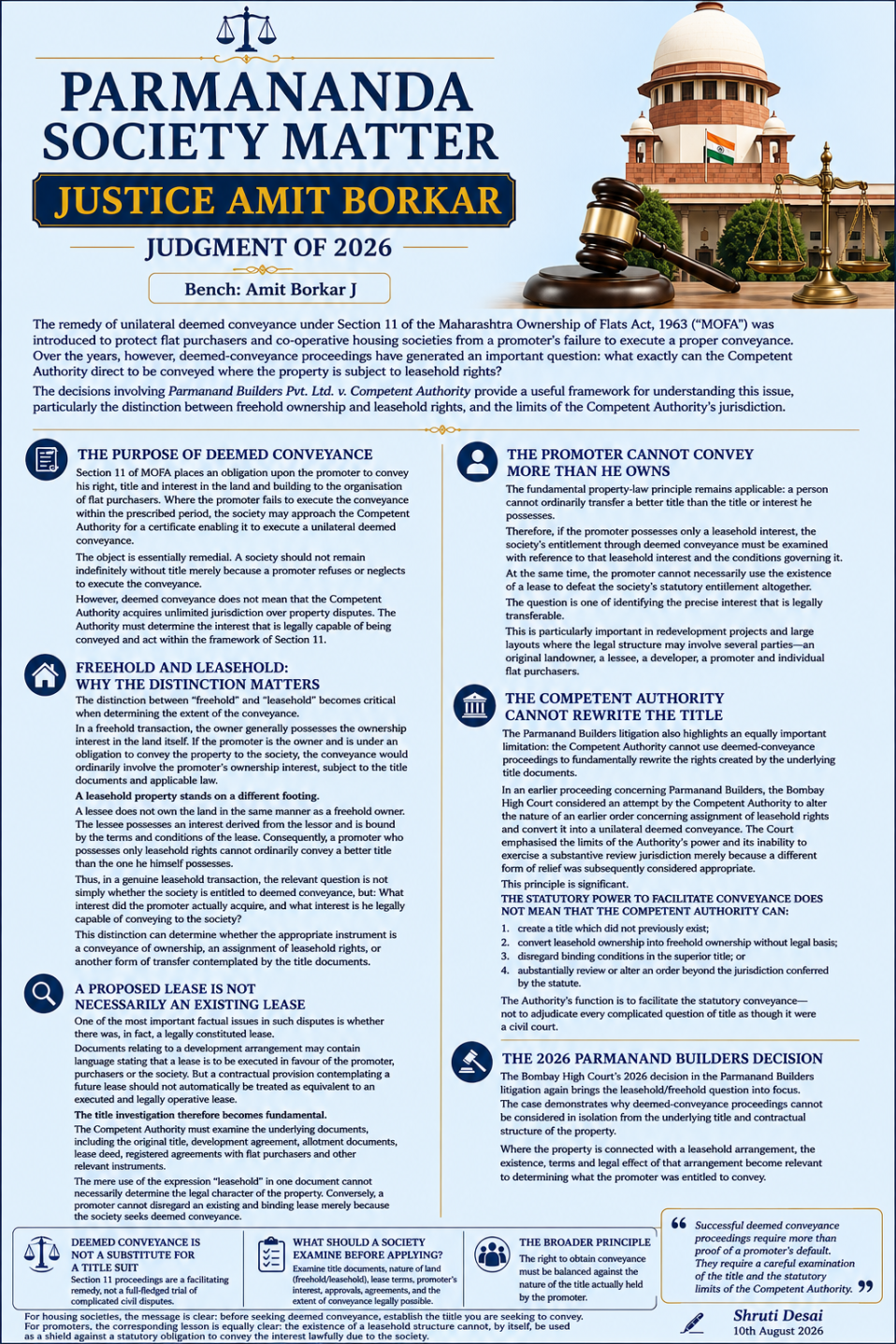
Unilateral Deemed Conveyance under MOFA: Leasehold, Freehold and the Limits of the Competent Authority Lessons from Parmanand Builders v. Competent Authority: 24 February, 2026
Bench: Amit Borkar J The remedy of unilateral deemed conveyance under Section 11 of the Maharashtra Ownership of Flats Act, 1963 (“MOFA”) was introduced to protect flat purchasers and co-operative housing societies from a promoter’s failure to execute a proper conveyance. Over the years, however, deemed-conveyance proceedings have generated an important question: what exactly can the Competent Authority direct to be conveyed where the property is subject to leasehold rights? The decisions involving Parmanand Builders Pvt. Ltd. v. Competent Authority provide a useful framework for understanding this issue, particularly the distinction between freehold ownership and leasehold rights, and the limits of the Competent Authority’s jurisdiction. The purpose of deemed conveyance Section 11 of MOFA places an obligation upon the promoter to convey his right, title and interest in the land and building to the organisation of flat purchasers. Where the promoter fails to execute the conveyance within the prescribed period, the society may approach the Competent Authority for a certificate enabling it to execute a unilateral deemed conveyance. The object is essentially remedial. A society should not remain indefinitely without title merely because a promoter refuses or neglects to execute the conveyance. However, deemed conveyance does not mean that the Competent Authority acquires unlimited jurisdiction over property disputes. The Authority must determine the interest that is legally capable of being conveyed and act within the framework of Section 11. Freehold and leasehold: why the distinction matters The distinction between “freehold” and “leasehold” becomes critical when determining the extent of the conveyance. In a freehold transaction, the owner generally possesses the ownership interest in the land itself. If the promoter is the owner and is under an obligation to convey the property to the society, the conveyance would ordinarily involve the promoter’s ownership interest, subject to the title documents and applicable law. A leasehold property stands on a different footing. A lessee does not own the land in the same manner as a freehold owner. The lessee possesses an interest derived from the lessor and is bound by the terms and conditions of the lease. Consequently, a promoter who possesses only leasehold rights cannot ordinarily convey a better title than the one he himself possesses. Thus, in a genuine leasehold transaction, the relevant question is not simply whether the society is entitled to deemed conveyance, but: What interest did the promoter actually acquire, and what interest is he legally capable of conveying to the society? This distinction can determine whether the appropriate instrument is a conveyance of ownership, an assignment of leasehold rights, or another form of transfer contemplated by the title documents. A proposed lease is not necessarily an existing lease ? One of the most important factual issues in such disputes is whether there was, in fact, a legally constituted lease. Documents relating to a development arrangement may contain language stating that a lease is to be executed in favour of the promoter, purchasers or the society. But a contractual provision contemplating a future lease should not automatically be treated as equivalent to an executed and legally operative lease. The title investigation therefore becomes fundamental. The Competent Authority must […]
Read more
CAN A HOUSING SOCIETY SELL TDR TO A PRIVATE MEMBER OF THE SOCIETY UNDER DOCUMENT OF MEMORANDUM OF UNDERSTANDING AND RESOLUTIONS?
JURISDICTION OF CO-OPERATIVE COURT AND BINDING NATURE OF SOCIETY RESOLUTIONS Let us first see what is TDR? Transferring Development Rights (TDR) by a housing society involves the society, as a landowner, generating extra buildable area (TDR) by surrendering land for public use (like roads, parks) to the municipality, receiving a TDR certificate (or Development Right Certificate – DRC), and then selling these rights to a developer or another party to build more than standard Floor Space Index (FSI) allows, benefiting both the society (compensation for land) and the buyer (extra construction rights). This process helps fund infrastructure projects and allows societies to get value for reserved plots, making TDR a crucial tool in urban development, especially in places like Mumbai. How it Works for a Society: Land Surrender: The housing society owns land, often designated for public amenities (e.g., a playground, road widening) by the city. TDR Generation: Instead of cash compensation, the Municipal Corporation (like MCGM in Mumbai) issues a TDR certificate (DRC) to the society, representing the Floor Space Index (FSI) potential of the surrendered land. Selling the Rights: The society can then sell this certificate to a builder or another property owner. Utilisation: The buyer uses the TDR to construct additional built-up area on their own plot, exceeding the normal FSI limits, often in a designated “receiving zone”. Benefits of TDR for Societies Financial Compensation: Provides funds for the society (often through developers) without the government paying cash, allowing land acquisition for public projects. Development Incentive: Encourages development and helps resolve land reservations, as owners get value for undevelopable land. Legal Avenue: Offers a way for societies and trusts to utilize or sell their development potential POINT OF CAUTION: A Housing Society cannot legally sell Transferable Development Rights (TDR) to a private member using only a Memorandum of Understanding (MoU) and Resolutions. TDR transactions must follow a formal, regulated process involving proper documentation and approval from the competent authorities to be legally valid. Legal Requirements for TDR Transfer : TDR is a formal legal instrument: TDR is an official development right issued by a municipal authority as a Development Right Certificate (DRC). This certificate is a tradeable commodity, similar to a stock, in a formal market. Formal Agreements are Required: Any transaction involving the sale or transfer of TDR requires a registered agreement, such as a formal TDR Sale Agreement, not just an MoU or simple resolutions. The agreement must be registered under the Registration Act, 1908. Statutory Compliance and Oversight: The transaction must comply with the relevant state laws, such as the Maharashtra Regional and Town Planning (MRTP) Act, 1966, and local Development Control Regulations (DCRs). Regulatory Approvals: The transfer must be registered with the Sub-Registrar and updated on the relevant municipal or urban local body’s (ULB) online TDR portal (if available). Authorities track the chain of ownership and usage of TDRs to prevent misuse and ensure transparency. Transparency and Fair Value: Transactions by a housing society, especially those involving a private member, are subject to scrutiny to ensure the society receives fair market value and to prevent irregularities or fraud. Risks of Using Only […]
Read more
CRITICAL ROLE OF TITLE CLEARANCE IN REDEVELOPMENT
In a redevelopment project, it is highly recommended to verify and clear the property’s title first before formally deciding on and appointing a builder. While a builder can be tentatively selected (e.g., via a Letter of Intent or a resolution in a Special General Body Meeting), formalizing the development agreement and starting the actual project activities (like demolition or construction) without a clear and marketable title creates significant legal and financial risks. Why Title Clearance is Crucial First Legal Requirement: For a builder to obtain necessary municipal approvals and a Commencement Certificate (CC) to begin construction, the society must generally have a clear and marketable title to the land. This is often achieved through a registered conveyance deed or “deemed conveyance”. Risk Mitigation: Unclear land titles are a common source of delays and litigation in redevelopment projects. Title disputes can halt the project indefinitely, leaving both the builder and the society members in a precarious situation (e.g., displaced and without their new homes). Financial Safeguard: A clear title ensures the project is legally sound and makes it easier for the builder to secure project financing and for future buyers in the free-sale component to get home loans. This financial stability is a key factor in a project’s success. Transparency and Trust: Conducting thorough legal due diligence, including title verification, at an early stage demonstrates transparency and helps build trust between the society members and the chosen developer. Recommended Order of Operations (General Steps) Initial Decisions & Structural Audit: The society discusses redevelopment and conducts a structural audit to determine feasibility. Appoint Professionals: An architect/Project Management Consultant (PMC) and a legal advisor are appointed to guide the process. Title Verification/Conveyance: The society’s legal team conducts comprehensive title verification and works to obtain a clear conveyance deed or deemed conveyance for the property. Builder Selection: Once the title is confirmed, a transparent tendering process is used to select a reputable builder with a proven track record, financial stability, and relevant experience. Formal Agreements: A detailed Development Agreement (DA) and individual Permanent Alternate Accommodation Agreements (PAAA) are meticulously drafted, vetted by legal experts, and registered. Project Commencement: The builder then seeks the required approvals (IOD, CC, etc.) and begins construction. Prioritizing title clearance helps safeguard the interests of all stakeholders and ensures a smoother, legally compliant redevelopment process. HOW FAR A CERTIFICATE OF TITLE BY A SOLICITOR/ ADVOCATE IS SIGNIFICANT? In Ramniklal Tulsidas Kotak And Others vs Varsha Builders And Others on 26 August, 1991 Equivalent citations: AIR1992BOM62, AIR 1992 BOMBAY 62, (1993) MAH LJ 323, (1992) 2 BANKCAS 441, (1992) 2 BOM CR 492 “(1) A Certificate of Title need not necessarily be unconditional or unqualified. It can be qualified to the limited extent of the implied statutory exception contained in Section 3(2)(b) of the Maharashtra Ownerships Flats Act, 1963, as interpreted above. The Format of the Certificate of Title prescribed by the rules is mandatory, subject only to a limited scope for adaptability as explained in the judgment. A qualified certificate of title must furnish all relevant information as set out in paragraph 19 of this judgment. (2) The Promoter must […]
Read more
FRAUDULENT RECORDS CREATED BY MANAGING COMMITTEE – EFFECT ON REVERSIONARY INTEREST- CONSEQUENCES
WHAT IS THE PROCESS OF PURCHASING REVERSIONARY INTEREST? IS DEEMED CONVEYANCE A FINAL TITLE WITHOUT CONVEYANCE OF REVERSIONARY INTEREST? DOES REVERSIONARY INTEREST EXTINGUISH AFTER GETTING DEEMED CONVEYANCE? WHAT ARE CONSEQUENCES OF FRAUD PLAYED BY THE COMMITTEE BY FABRICATING TITLE RECORDS? First let us see What is Lease? Under Transfer of Property Act 1882 its defined in Section 105 Lease defined. A lease of immoveable property is a transfer of a right to enjoy such property, made for a certain time, express or implied, or in perpetuity, in consideration of a price paid or promised, or of money, a share of crops, service or any other thing of value, to be rendered periodically or on specified occasions to the transferor by the transferee, who accepts the transfer on such terms. Lessor, lessee, premium and rent defined. — The transferor is called the lessor, the transferee is called the lessee, the price is called the premium, and the money, share, service or other thing to be so rendered is called the rent How is Lease determined? It is provided in the Transfer of Property Act 1882. Section 111 Determination of lease. — A lease of immoveable property determines—(a)by efflux of the time limited thereby;(b)where such time is limited conditionally on the happening of some event—by the happening of such event;(c)where the interest of the lessor in the property terminates on, or his power to dispose of the same extends only to, the happening of any event—by the happening of such event;(d)in case the interests of the lessee and the lessor in the whole of the property become vested at the same time in one person in the same right;(e)by express surrender; that is to say, in case the lessee yields up his interest under the lease to the lessor, by mutual agreement between them;(f)by implied surrender;(g)by forfeiture; that is to say, (1) in case the lessee breaks an express condition which provides that, on breach thereof, the lessor may re-enter; or (2)in case the lessee renounces his character as such by setting up a title in a third person or by claiming title in himself; or (3)the lessee is adjudicated an insolvent and the lease provides that the lessor may re-enter on the happening of such event; and in any of these cases the lessor or his transferee gives notice in writing to the lessee of his intention to determine the lease; (h)on the expiration of a notice to determine the lease, or to quit, or of intention to quit, the property leased, duly given by one party to the other. Illustration to clause (f)A lessee accepts from his lessor a new lease of the property leased, to take effect during the continuance of the existing lease. This is an implied surrender of the former lease, and such lease determines thereupon. DEEMED CONVEYANCE- REVERSIONARY INTEREST Buying private reversionary rights means, purchasing the right of an original owner (Reversioner) to get their property back after a temporary interest (like a lease or life estate) ends. This process involves a formal “Deed of Conveyance” to transfer these future ownership rights, allowing the buyer […]
Read moreSELF REDEVELOPMENT
SELF REDEVELOPMENT AUTHORITY PLANNED REDEVELOPMENT – SUGGESTIONSThe government of Maharashtra is actively pursuing the establishment of a dedicated Redevelopment Oversight Authority. This body would function as an independent authority to regulate, streamline, and monitor all types of redevelopment projects across the state, with a specific focus on increasing transparency and resolving disputes.A suggestion was floated by writer of this blog. It is now under consideration.Moving forward what are suggestions? Establishment of a judicial body with judicial powers to monitor and resolve issues including of title of land (which is not with RERA); If government is of the opinion that right of civil court will be ousted, then Development Authority must be empowered to refer the issue to Civil Court. Key Details and Objectives Scope: The proposed authority would have specialized jurisdiction over all redevelopment projects, including those initiated by private developers, self-redevelopment schemes by cooperative housing societies (CHS), cluster redevelopment, and Slum Rehabilitation Authority (SRA) projects. Aims: The primary goals are to accelerate project timelines, enhance accountability, and provide regulatory clarity, addressing common challenges like bureaucratic delays, opaque agreements, and litigation that often stall projects. Functions: Streamlined Approvals: Act as a single-window clearance mechanism to facilitate faster project sanctions. Monitoring and Compliance: Monitor project progress using technology-enabled reporting and enforce penalties for undue delays. Dispute Resolution: Serve as a quasi-judicial body to mediate and resolve conflicts between residents, developers, and planning authorities. Standardization: Standardize procedures for project planning, developer selection, and financial approvals Current StatusThe state government has already established a separate Self Redevelopment Authority (SRA, distinct from the Slum Rehabilitation Authority) to specifically promote and expedite projects undertaken by housing societies themselves, appointing a chairman for the new body. The broader, overarching Redevelopment Oversight Authority for all project types is currently in the planning stage, with high-level committees having submitted reports recommending its formation.This initiative is expected to have a significant impact on urban areas like Mumbai and Pune, where aging buildings and high demand make redevelopment a critical part of the urban growth strategy. Maharashtra’s Self-Redevelopment Rules, guided by Government Resolutions (GRs) from 2019 and subsequent amendments, enable housing societies to redevelop buildings over 30 years old, offering benefits like extra Floor Space Index (FSI) and incentives, requiring society ownership, member consent (typically 70%+), appointing experts (PMC, Architect), and securing loans via banks like MDCC Bank, streamlining approvals with a single-window system for transparency, but necessitate adherence to Maharashtra Cooperative Societies Act rules.Key Eligibility & Requirements: Age: Building must be 30+ years old. Ownership: Society must own the land (Conveyance Deed) or have a valid purchase agreement. Registration: Must be registered under the Maharashtra Cooperative Societies Act, 1960. Consent: At least 70% member consent is generally needed for major decisions. Audit: Societies need ‘A’ or ‘B’ audit class for loans. Benefits & Incentives: Extra FSI/TDR: Societies get 10% more FSI/incentive space than usual. Reduced Costs: Lower premiums, taxes, and charges. Single Window: Streamlined approvals via a nodal agency. Process Overview: Formation: Society decides on self-redevelopment. Appointment: Appoint Project Management Consultant (PMC), Architect, Legal Advisor. Approvals: Secure initial permissions (IOD/LOA) at society cost. Loan: Apply to banks like Mumbai […]
Read more
पुनर्विकास परियोजनाओं के लिए न्यायिक निकाय की आवश्यकता
पुनर्विकास परियोजनाओं के लिए न्यायिक निकाय की आवश्यकता आज हम बात करेंगे एक बहुत क्रिटिकल मुद्दा है रीडवलपमेंट। रीडवलपमेंट फंडामेंटल राइट, आर्टिकल 300 ए, गाइडलाइन 79 ए और मैनेजिंग कमेट। अब हम आगे बढ़ते हैं। उसके पहले मैं आपसे निवेदन करूंगी कि मेरे यह चैनल को लाइक, सब्सक्राइब और शेयर कीजिए क्योंकि यह फ्री ऑफ कॉस्ट है और आपको यह जो है मुद्दे वो आपके जनरल पब्लिक के काम में आते हैं वैसे मुद्दे हैं। चलो आगे बढ़ते हैं हम रीडवलपमेंट में। रीडवलपमेंट एक बहुत हॉट केक है और ये हर एक तीसरा बिल्डिंग रीडवलपमेंट में जा रहा है। सही बात है। जैसे हमारी लाइफ है तो हम यह जैसे हमारे हिंदू शास्त्रों में लिखा है कि हम शरीर छोड़ के हमारा आत्मा नए शरीर में जाता है और नया जन्म लेता है। तो जो इधर है उसको नया जन्म लेना ही पड़ता है। तो वैसे ही अगर बिल्डिंग पुराना हो जाए तो उसको नया बनाना पड़ता है। तो उसके लिए सबसे पहले जो मूवमेंट शुरू हुई थी वो आइलैंड सिटी ऑफ मुंबई से हुई थी क्योंकि सारे के सारे जो पुराने बिल्डिंग्स थे जो चॉल्स थी वो मसून के सीजन में कॉलेज हो जाती थी उसके लिए कोई कानून नहीं थे और मुरली देवरा जो हमारे बहुत वरिष्ठ नेता थे उन्होंने एक कानून लाया और रीडवलपमेंट ऑफ डाई लेपिटेटेड बिल्डिंग्स। तो इसके तहत उन लोगों को काफी सुविधा मिली और यह शुरुआत में जो थी वो सेस बिल्डिंग के लिए थी और वो चर्च गेट्स कुलाबा से लेके बैंड्रा तक एप्लीकेबल थी। धीरे-धीरे 1991 आया जो डीसीआर 1991 डेवलपमेंट कंट्रोल रेगुलेशन 1991 आया और उसके अंदर सारे प्रावधान किए गए। माड़ा की लैंड को रीडवलप कैसे किया जाए? स्लम को कैसे रीडवलप किया जाए? आर्मी वाली जो है पुलिस हेड क्वार्टर्स कैसे डेवलप किया जाए? बीएएमसी की जो प्रॉपर्टीज है उसको कैसे डेवलप किया जाए? और जो हाउसिंग सोसाइटी है उसे कैसे डेवलप किया जाए? यह सारे प्रावधान मैंने अपनी बुक कमेंट्री ऑन डेवलपमेंट कंट्रोल रेगुलेशन 1991 जिसकी 15 एडिशंस आ चुकी है आई थी वो उसके अंदर हमने मैंने डिस्कस किया है। आगे बढ़ते हैं 1991 के बाद क्या हुआ? इसके बाद 2009 के तहत एक 79 ए का गाइडलाइंस आया। यह गाइडलाइंस थी कोऑपरेटिव सोसाइटी क्योंकि मेजरिटी जो रीडवलपमेंट है वह कोऑपरेटिव हाउसिंग सोसाइटी जो अभी लागू होता है पूरे बंबई में और इसके तहत थर्ड जनवरी 2009 में एक गाइडलाइंस आई वो गाइडलाइंस के तहत रीडवलपमेंट के प्रोजेक्ट्स तैयार करने होते थे मैनेजिंग कमेट को इसके अंदर बहुत सारी कंप्लेंट्स आई कि जो मैनेजिंग कमेट है वह रीडवलपमेंट प्रोसेस में मेंबर्स को कॉन्फिडेंस में नहीं लेती। ट्रांसपेरेंसी नहीं है। आर्बिटरी अपॉइंटमेंट्स होती है। बिजनेस जो होता है वह कंडक्टिंग बिजनेस मतलब कि वह चाहे एजीएम हो, एसजीएम हो तो वो लोग सही जवाब नहीं देते हैं। ऐसे करली बिहेव करते हैं जैसे वो लोग जमींदार है और बाकी के जो फ्लैट ओनर्स हैं वो उनके स्लेव्स है, टेनेंट्स हैं। तो ऐसे भी बिहेव करते हैं और वो लोग वीडियो उतारते हैं तो वीडियो वो लोग शेयर नहीं करते हैं मेंबर्स के साथ में क्योंकि वो अपने पास ही रखते हैं। रजिस्ट्रार में जाते हैं तो वो […]
Read more
CONVEYANCE AND ASSIGNMENT THE DISTINCTION
ONCE THERE IS A DEED OF ASSIGNMENT EXECUTED BY THE LESSOR IN FAVOUR OF THE LESSEES CAN THERE BE DEEMED CONVEYANCE? Why am I writing this blog? You must be wondering! No noting without cause. Nowadays, in the name of redevelopment societies are collecting huge funds like 20-30 lakhs for Deemed Conveyance. But I am saying it’s wrong? The answer is this society already had a Deed of Assignment executed and registered in its name way back in 1970s. Now this is connivance or illiteracy of the committee that depends on documentary evidence. But this is no less serious offense. Why? It amounts to embezzlement of society funds by way of misrepresentation and fraud. ANALYSIS Let us analyse the question herein is to ascertain as to whether the deed in question is a deed of assignment of lease hold rights. Article 63 of Schedule 1-B of the Indian Stamp Act or would be an outright sale so as to be termed as ‘Conveyance” and would be covered by Article 23 of Schedule 1-B of the Indian Stamp Act. The word ‘sale’ has not been defined under the Indian Stamp Act, 1899. Section 2 (10) of the Act defines “Conveyance” as including a conveyance on sale and every instrument by which property, whether movable or immovable property is transferred inter vivos and which is not otherwise specifically provided for by Schedule 1-A or Schedule 1-B, as the case may be. Now let us see the difference in common parlance: Deed of Assignment: This document transfers interest in property from one person or entity to another. Purpose: It’s used when someone wants to transfer their interest in a property to someone else, such as in property sales or lease assignments. Nature of Transfer: It involves transferring existing property rights, not creating new ones. The Transfer is conditional subject to the terms of Lease Agreement and in case of breach the Lessor/Owner steps in. Execution: It requires the consent and signature of the person or entity giving up their rights. Stamp Duty and Registration: Depending on local laws, it may or may need to be stamped and registered with the land authority. Deed of Conveyance: This document transfers property ownership from a seller to a buyer. Purpose: Confirming Agreement for Sale to establish the buyer’s legal ownership. Nature of Transfer: It creates new property ownership and rights, transferring everything about the property to the new owner. Execution: Both the seller and the buyer must sign it. Requires to be stamped and registered mandatorily. Registration: It typically needs to be registered to show the change in property ownership. In short, Deeds of Assignment transfer existing property rights, while Deeds of Conveyance create new property rights and prove ownership. The word ‘Sale” has been defined under Section 54 of the Transfer of Property Act, 1882 which reads as under:- “Sale is a transfer of ownership in exchange for a price paid or promised or part-paid and part-promised.” “Lease” has been defined under Section 105 of the Transfer of Property Act, 1882 and also in sub-section (16) of Section 2 of the Stamp Act, 1899 which […]
Read more