
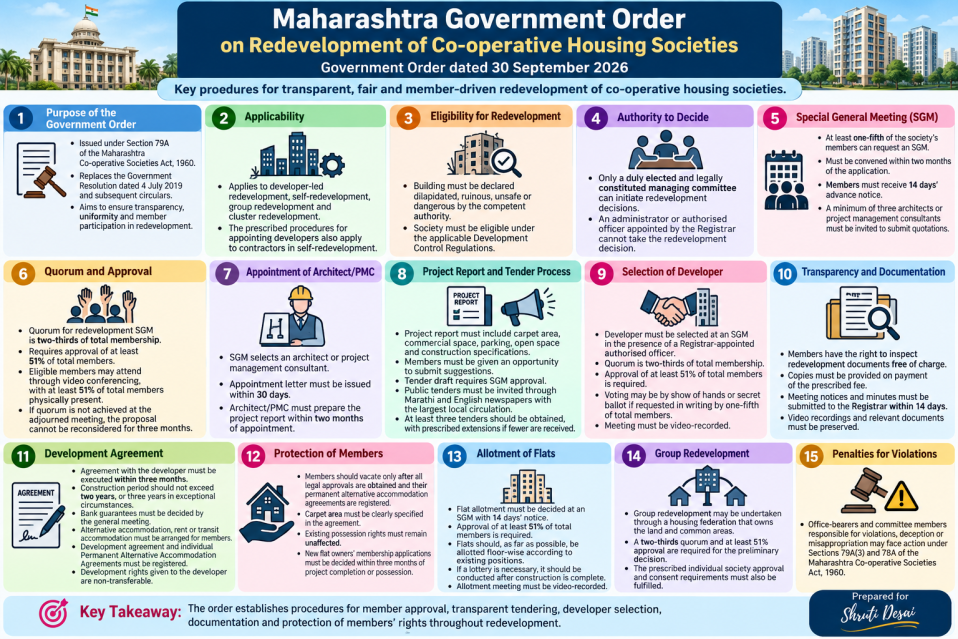
Maharashtra Government Order on Redevelopment of Co-operative Housing Societies (30 September 2026) made simpler for layman
Short Notes: Maharashtra Government Order on Redevelopment of Co-operative Housing Societies (30 September 2026) Government Order dated 30 September 2026 Redevelopment G.R. 30-09-2026 Redevelopment Govt Circular English-Marathi Short Notes: Maharashtra Government Order on Redevelopment of Co-operative Housing Societies (30 September 2026) Government Order dated 30 September 2026 Purpose of the Government Order Issued under Section 79A of the Maharashtra Co-operative Societies Act, 1960. Replaces the Government Resolution dated 4 July 2019 and subsequent circulars. Aims to ensure transparency, uniformity and member participation in redevelopment. Applicability Applies to developer-led redevelopment, self-redevelopment, group redevelopment and cluster redevelopment. The prescribed procedures for appointing developers also apply to contractors in self-redevelopment. Eligibility for Redevelopment The building must be declared dilapidated, ruinous, unsafe or dangerous by the competent authority. The society must be eligible under the applicable Development Control Regulations. Authority to Decide Only a duly elected and legally constituted managing committee can initiate redevelopment decisions. An administrator or authorised officer appointed by the Registrar cannot take the redevelopment decision. Special General Meeting (SGM) At least one-fifth of the society’s members can request an SGM. The SGM must be convened within two months of the application. Members must receive 14 days’ advance notice. A minimum of three architects or project management consultants must be invited to submit quotations. Quorum and Approval The quorum for the redevelopment SGM is two-thirds of the total membership. Redevelopment requires approval from at least 51% of the total members. Eligible members may attend through video conferencing, subject to the requirement that at least 51% of total members are physically present. If quorum is not achieved at the adjourned meeting, the proposal cannot be reconsidered for three months. Appointment of Architect/PMC The SGM selects an architect or project management consultant. The appointment letter must be issued within 30 days. The architect/PMC must prepare the project report within two months of appointment. Project Report and Tender Process The project report must include carpet area, commercial space, parking, open space and construction specifications. Members must be given an opportunity to submit suggestions. The tender draft requires SGM approval. Public tenders must be invited through Marathi and English newspapers with the largest local circulation. At least three tenders should be obtained, with prescribed extensions if fewer are received. Selection of Developer The developer must be selected at an SGM in the presence of a Registrar-appointed authorised officer. The quorum is two-thirds of total membership. Approval of at least 51% of total members is required. Voting may be by show of hands or secret ballot if requested in writing by one-fifth of total members. The meeting must be video-recorded. Transparency and Documentation Members have the right to inspect redevelopment documents free of charge. Copies must be provided on payment of the prescribed fee. Meeting notices and minutes must be submitted to the Registrar within 14 days. Video recordings and relevant documents must be preserved. Development Agreement The agreement with the developer must be executed within three months. The construction period should not exceed two years, or three years in exceptional circumstances. Bank guarantees must be decided by the general meeting. Alternative accommodation, rent or […]
Read moreROHINI GUPTA v. DISTRICT DEPUTY REGISTRAR: A CRITICAL LEGAL ANALYSIS OF THE SCOPE AND LIMITS OF DEEMED CONVEYANCE UNDER SECTION 11 OF MOFA
ROHINI GUPTA: CRITICAL LEGAL ANALYSIS AND FALLACIES The following analysis identifies potential issues in the reasoning of Rohini Gupta by comparing the judgment with the principles discussed in Ivory Properties, A.H. Wadia Trust and the other decisions referred to in the draft. The points below are arguable grounds for examination; they should not be treated as established findings of error without verification against the complete judgments and underlying documents. 1. Rohini Gupta v. District Deputy Registrar Bombay High Court | 8 September 2026 | Writ Petition No. 5991 of 2026 | Justice Sandeep V. Marne The judgment dismissed the original landowners’ writ petition and upheld the deemed conveyance of 3,901.70 sq. m. of land to the society. The principal issue is whether the Court correctly moved from its finding that the landowners were promoters to the conclusion that they were obliged to convey their reversionary ownership of the land. 2. The principal legal conflict The central issue is that Rohini Gupta recognises the principle that deemed conveyance cannot ordinarily exceed the promoter’s rights, but nevertheless upholds freehold conveyance on the particular facts before the Court. The comparison requires distinguishing between an error in interpreting Section 11 of MOFA, an error in appreciating the lease deed and registered agreements, and an error in exercising the competent authority’s jurisdiction. A different conclusion on the facts does not, by itself, establish an error of law. Legal issue Earlier legal position Rohini Gupta judgment Extent of rights under Section 11 Society ordinarily receives the rights the promoter is entitled and obliged to convey. The Court held that the landowners were also promoters and were obliged to convey their ownership interest. Leasehold versus freehold An authority cannot ordinarily substitute freehold ownership for an agreement expressly limited to leasehold rights. The Court upheld freehold conveyance, relying on the landowners’ participation in the project and the agreements concerning ownership. Effect of an existing lease assignment An assignment may fulfil the promoter’s obligation to transfer the leasehold interest. The Court held that the earlier assignment fulfilled only part of the statutory obligation because the landowners had a separate obligation. Jurisdiction under Section 11 Deemed conveyance requires failure to fulfil the statutory obligation. The Court found a continuing failure on the part of the landowners, notwithstanding the earlier assignment. Nature of proceedings Summary proceedings do not finally determine complicated title disputes. The Court upheld the order while preserving the parties’ right to pursue appropriate civil proceedings. The judgment relies on A.H. Wadia Trust, Haresh Vijaysinh Bhatia and other decisions to distinguish cases where the promoter is merely a lessee from cases where the landowner is also a promoter or has an independent statutory obligation to convey. 3. Possible errors in Rohini Gupta judgment The following are potential grounds for challenging the reasoning. They are arguable errors, not findings that the judgment is necessarily erroneous. Sr. No. Paragraph of Rohini Gupta Possible error in reasoning Legal significance 1 Paras 14–15, 21–24 Treating participation in construction as sufficient to establish an obligation to convey freehold ownership. The Court inferred that the landowners became promoters because they exercised control over construction […]
Read morePrinciples of Statutory Interpretation, Precedence and Limitations
Limitation of Special Laws to Override Common Statute The general principle of statutory interpretation is that a special law (lex specialis) generally prevails over a general or common statute (lex generalis) when both deal with the same subject matter and contain conflicting provisions. This principle is expressed by the Latin maxim Generalia specialibus non derogant, meaning that general provisions do not derogate from special provisions. Meaning A special law is enacted to regulate a particular subject, class of persons or specific situation, whereas a general statute applies more broadly. When both laws apply to the same matter, the special law ordinarily takes precedence over the general statute, provided that the legislature has not indicated a contrary intention. Limitations on the overriding effect of special laws The overriding effect of a special law is subject to several limitations. Legislative intention: A special law does not automatically override a general statute in every situation. The intention of the legislature must be considered. Absence of conflict: If the provisions of the special law and the general statute can operate harmoniously, both should ordinarily be given effect. Express overriding provisions: If the general statute contains an express non obstante clause, such as “notwithstanding anything inconsistent therewith in any other law,” the court must examine its scope and the legislative intention behind it. Subsequent legislation: A later general statute may override an earlier special law if the legislature clearly intends to do so. However, a general amendment does not ordinarily repeal a special law by implication. Different fields of operation: Where the special law and general statute govern different aspects of a matter, the special law does not necessarily displace the general statute altogether. Constitutional supremacy: Neither a special law nor a general statute can override the Constitution. Both remain subject to constitutional limitations. Important judicial decisions LIC v. D.J. Bahadur (1981) The Supreme Court of India explained the relationship between special and general laws and recognized that a special statute ordinarily prevails over a general statute dealing with the same subject. The Court also considered whether a subsequent general enactment was intended to override the special legislation. LIC v. D.J. Bahadur establishes that the special-versus-general distinction is contextual, not absolute. A special statute does not automatically override every other statute, and the courts must examine legislative intention, inconsistency and the possibility of harmonious construction. Applied to MOFA, the decision supports a careful examination of the limits of Section 11. It does not, on its own, establish that freehold deemed conveyance is impermissible. Solidaire India Ltd. v. Fairgrowth Financial Services Ltd. (2001) Solidaire India establishes that a later special statute may prevail over an earlier special statute where their overriding provisions conflict and the legislative intention supports that result. It does not establish that Section 11 of MOFA automatically overrides leasehold restrictions or independently authorises conversion into freehold ownership. Its relevance to a MOFA dispute is principally interpretive: the court must identify the actual statutory conflict, consider legislative intention and distinguish statutory priority from the separate question of whether the society has a substantive right to freehold title. The Supreme Court considered the conflict between […]
Read more
The Expanding Definition of “Promoter”: Impact on Landowners’ Rights. Need for parliamentary intervention?
NEED FOR AUTHORITATIVE CLARIFICATION BY THE BOMBAY HIGH COURT ON THE SCOPE OF SECTION 11 OF MOFA: GERALD MICHAEL MISQUITTA AND ROHINI GUPTA Gerald Michael Misquitta Vs State of Maharashtra ( “Gerald” ) Rohini Gupta & Anr. v. District Deputy Registrar, Co-operative Societies & Ors., WP No. 5991/2026, Bombay High Court, decided 8 September 2026, in which Mohini Gupta is the second petitioner. Indian Kanoon ( “Gupta” ) The two cases are quite closely connected because both concern Section 11 of MOFA, deemed conveyance, landowners/lessees, and the powers of the District Deputy Registrar (DDR). But there is an important difference: Gerald Misquitta is primarily a procedural/natural-justice case, whereas Gupta is substantially a Section 2(c)/Section 11 substantive-promoter case. Basic facts — side-by-side Sr No Particulars Gerald Michael Misquitta v. State of Maharashtra Rohini Gupta & Anr. v. DDR3 1 Court Bombay High Court Bombay High Court 2 Judgment date 25 Feb 2026 8 Sept 2026 3 Petition WP 1739/2022 WP 5991/2026 4 Ownership Misquitta family property, Vile Parle West Gupta family property, Juhu 5 Original owners Multiple Misquitta co-owners Late Kundanlal Laxmichand Gupta; petitioners were his heirs 6 Developer/lessee structure Owners → Rahejas → A.K. Associates/sub-lessee Owner → Raheja/Wadhwa lessees → developers 7 Society Name Priya Co-operative Housing Society Queens Park Premises Co-operative Society 8 Lease 98-year lease 98-year lease 9 Earlier transfer to society Society claimed/received only leasehold-related rights Society already received assignment of leasehold rights in 1978 10 DDR order 28 May 2014 23 June 2025 11 Main challenge Owners were not properly impleaded/heard; DDR did not conduct required enquiry Whether landowners themselves became “promoters” under MOFA Result DDR order + conveyance quashed and remanded Petition dismissed; DDR order upheld The Misquitta judgment records that the property was owned by several co-owners and that the society’s deemed-conveyance application proceeded without impleading all of them. Indian Kanoon The Gupta judgment records a 98-year lease from Kundanlal Gupta and subsequent construction of Queens Park by the lessees/developers. Indian Kanoon Paragraph-wise comparison This is the more useful way to read the judgments. Para 1–3 — What is being challenged? Gerald — paras 1–3 The petitioner challenged the DDR’s 28 May 2014 certificate permitting unilateral deemed conveyance and the subsequent registered deed of assignment/transfer dated 5 July 2014. The important factual feature was that the petitioner claimed to be a co-owner, but was not properly made a party to the deemed-conveyance proceedings. Indian Kanoon Gupta — paras 1–4 The petitioners were the legal heirs of the original landowner. They challenged the DDR’s order dated 23 June 2025 granting unilateral deemed conveyance of approximately 3,901.70 sq.m. to Queens Park Society. The Gupta petitioners said that their father had died in 1981 and that the DDR had proceeded on a notice issued in his name. Indian Kanoon Difference In Gerald, the central problem was: “Were all persons whose rights were affected actually heard?” In Gupta, the central question became: “Were these landowners themselves promoters under Section 2(c) MOFA?” Paragraphs 10–15 — Meaning of “promoter” This is the most important substantive difference. Gerald The Court did not finally determine the title/promoter controversy because […]
Read more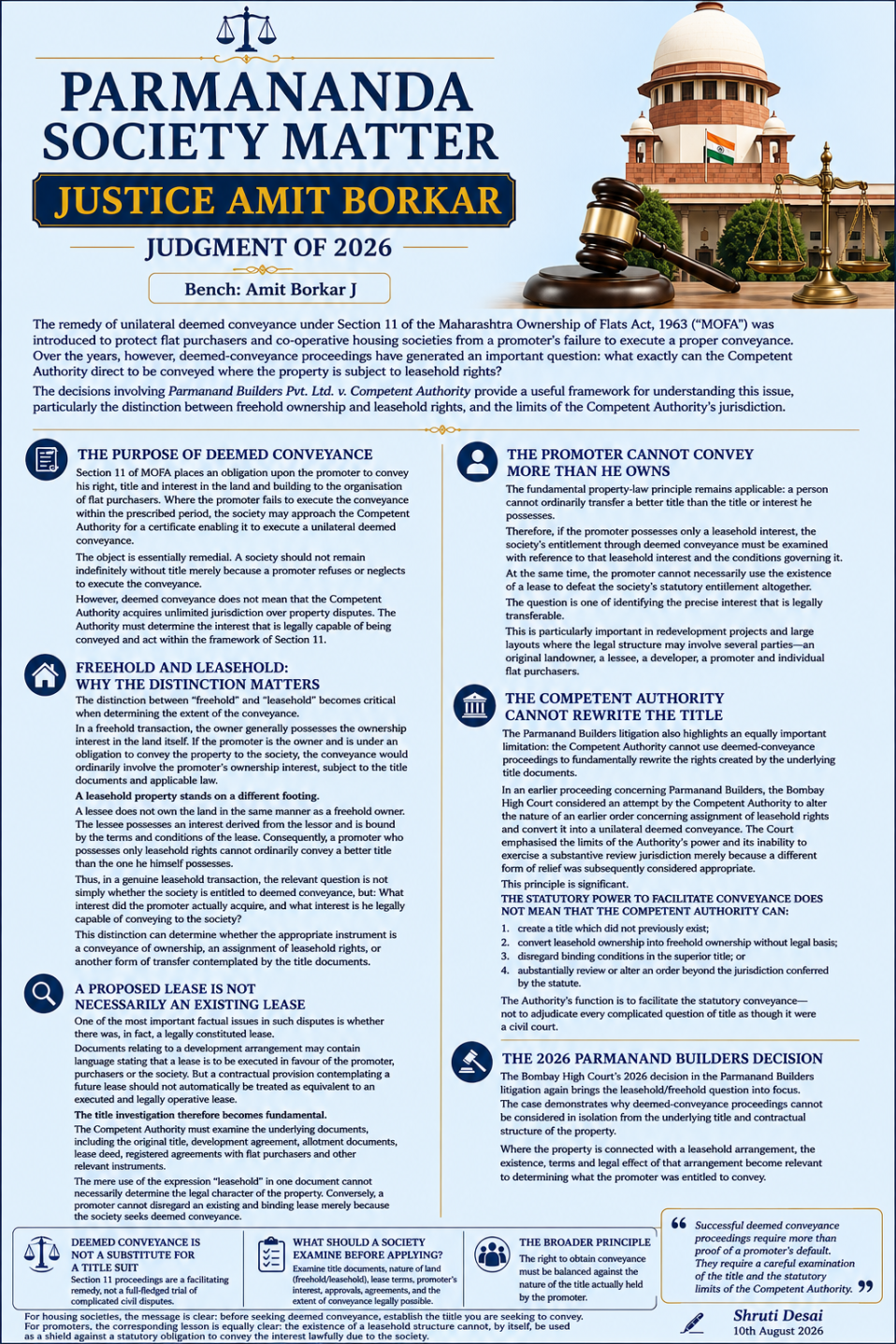
Unilateral Deemed Conveyance under MOFA: Leasehold, Freehold and the Limits of the Competent Authority Lessons from Parmanand Builders v. Competent Authority: 24 February, 2026
Bench: Amit Borkar J The remedy of unilateral deemed conveyance under Section 11 of the Maharashtra Ownership of Flats Act, 1963 (“MOFA”) was introduced to protect flat purchasers and co-operative housing societies from a promoter’s failure to execute a proper conveyance. Over the years, however, deemed-conveyance proceedings have generated an important question: what exactly can the Competent Authority direct to be conveyed where the property is subject to leasehold rights? The decisions involving Parmanand Builders Pvt. Ltd. v. Competent Authority provide a useful framework for understanding this issue, particularly the distinction between freehold ownership and leasehold rights, and the limits of the Competent Authority’s jurisdiction. The purpose of deemed conveyance Section 11 of MOFA places an obligation upon the promoter to convey his right, title and interest in the land and building to the organisation of flat purchasers. Where the promoter fails to execute the conveyance within the prescribed period, the society may approach the Competent Authority for a certificate enabling it to execute a unilateral deemed conveyance. The object is essentially remedial. A society should not remain indefinitely without title merely because a promoter refuses or neglects to execute the conveyance. However, deemed conveyance does not mean that the Competent Authority acquires unlimited jurisdiction over property disputes. The Authority must determine the interest that is legally capable of being conveyed and act within the framework of Section 11. Freehold and leasehold: why the distinction matters The distinction between “freehold” and “leasehold” becomes critical when determining the extent of the conveyance. In a freehold transaction, the owner generally possesses the ownership interest in the land itself. If the promoter is the owner and is under an obligation to convey the property to the society, the conveyance would ordinarily involve the promoter’s ownership interest, subject to the title documents and applicable law. A leasehold property stands on a different footing. A lessee does not own the land in the same manner as a freehold owner. The lessee possesses an interest derived from the lessor and is bound by the terms and conditions of the lease. Consequently, a promoter who possesses only leasehold rights cannot ordinarily convey a better title than the one he himself possesses. Thus, in a genuine leasehold transaction, the relevant question is not simply whether the society is entitled to deemed conveyance, but: What interest did the promoter actually acquire, and what interest is he legally capable of conveying to the society? This distinction can determine whether the appropriate instrument is a conveyance of ownership, an assignment of leasehold rights, or another form of transfer contemplated by the title documents. A proposed lease is not necessarily an existing lease ? One of the most important factual issues in such disputes is whether there was, in fact, a legally constituted lease. Documents relating to a development arrangement may contain language stating that a lease is to be executed in favour of the promoter, purchasers or the society. But a contractual provision contemplating a future lease should not automatically be treated as equivalent to an executed and legally operative lease. The title investigation therefore becomes fundamental. The Competent Authority must […]
Read more
Maharashtra Co-operative Societies (Amendment) Act, 2026 – Key Amendments Explained Q and A
Description: Learn about the Maharashtra Co-operative Societies (Amendment) Act, 2026, including changes to Sections 73AAA, 73B, 73C, 73CB, 73F, 81 and 157, their legal implications, and what co-operative societies need to do to comply. Maharashtra Co-operative Societies (Amendment) Act, 2026: What Every Co-operative Society Should Know The Maharashtra Co-operative Societies (Amendment) Act, 2026 has introduced several important changes to the Maharashtra Co-operative Societies Act, 1960. Although the amendments are limited to a few provisions, they significantly impact the governance, election process, committee administration, and regulatory compliance of co-operative societies across Maharashtra. The amendments primarily strengthen the role of the State Co-operative Election Authority (SCEA), streamline the procedure for filling committee vacancies, update audit thresholds, and improve transparency in the management of co-operative societies. Whether you are a committee member, housing society office bearer, director of a credit society, auditor, advocate, chartered accountant, or consultant, understanding these amendments is essential for ensuring statutory compliance. Why Was the Amendment Necessary? The co-operative sector in Maharashtra is one of the largest in India, comprising housing societies, credit societies, consumer societies, agricultural societies, industrial co-operatives, and numerous other institutions. Over the years, practical issues emerged relating to: delays in filling committee vacancies; disputes concerning multiple-seat elections; lack of uniform supervision during committee proceedings; ambiguity regarding election authorities; and outdated financial thresholds. The Amendment Act addresses these concerns by introducing clearer procedures and strengthening institutional oversight. Key Amendments Introduced by the 2026 Amendment Act Amendment to Section 73AAA – Exemption for Type “A” Societies The first proviso to Section 73AAA(3) has been deleted. Further, the second proviso has been amended to exclude committees of Type “A” Societies prescribed under Rule 4 of the Maharashtra Co-operative Societies (Election to Committee) Rules, 2014. Practical Impact The amendment differentiates Type “A” societies from other classes of co-operative societies for the purpose of this provision. Societies falling within this category should carefully examine whether the amended provision applies to them before initiating committee-related actions. Amendments to Sections 73B and 73C – Greater Election Supervision Sections 73B and 73C deal with representation of reserved categories on the managing committee. The Amendment Act now provides that whenever vacancies are filled under these provisions, the committee meeting must be presided over by an officer authorized by the State Co-operative Election Authority (SCEA). Why This Matters Earlier, committee meetings were conducted internally, which occasionally resulted in procedural disputes. Independent supervision by an authorized election officer is expected to: improve transparency; reduce allegations of bias; ensure procedural compliance; and increase confidence in the election process. Amendment to Section 73CB – Clarification of Election Authorities Section 73CB contains provisions relating to election administration. The Explanation has now been amended by specifically referring to: Divisional Co-operative Election Officers; District Co-operative Election Officers; Taluka Co-operative Election Officers; Ward Co-operative Election Officers; Observers; and Zonal Officers. Importance The amendment removes ambiguity by expressly identifying the authorities responsible for election-related functions. This provides greater administrative certainty during election proceedings. Complete Substitution of Section 73F – Election to Multiple Committee Seats One of the most significant amendments is the complete substitution of Section 73F. Earlier Position The earlier provision did […]
Read more
“RERA in India: Repeal or Reform?
SHOULD RERA BE REPEALED? Why we are discussing this topic? The Supreme Court in THE STATE OF HIMACHAL PRADESH vs. NARESH SHARMA| SLP(C) No. 005835 – / 2026 CJI Surya Kant said It is high time that all the states should revisit and rethink constituting this authority,” The CJI further remarked that the RERA was not doing any other services except to facilitate builders in default. Let’s study pros and Cons. RERA is useful and effective: The Real Estate (Regulation and Development) Act, 2016 (RERA) brings accountability, transparency, and efficiency to the Indian real estate sector, primarily protecting homebuyers. Key benefits include mandatory project registration, standardized carpet area definitions, 70% of funds kept in an escrow account to prevent diversion, guaranteed timely delivery, and a 5-year defect liability period. Major Positive Points of RERA: Transparency and Disclosure: Promoters must disclose project plans, layout, land title status, and timeline on the RERA website, giving buyers access to verified information. Protection of Funds: Developers are required to deposit 70% of all project funds into a dedicated bank account, ensuring money is only used for that specific project, reducing insolvency risk. Standardized Carpet Area: RERA eliminates confusion by defining “carpet area” clearly, ensuring buyers pay only for the actual usable space, not for common areas or super built-up areas. Builders were selling units/galas/flats even on Super Built Up basis. Timely Delivery and Penalties: Projects must be completed on time. If a developer delays possession, they are liable to pay interest on the amount paid by the buyer, matching the interest rate for buyer default. Defect Liability Period: Builders are responsible for rectifying any structural defects or quality issues reported within 5 years of possession at no extra cost. Reduced Fraud and Misleading Ads: All advertising must adhere to the registered project details. False promises or misleading marketing can lead to penalties. Redressal Mechanism: RERA authorities provide a fast-track, organized, and legal mechanism for settling disputes between buyers, developers, and agents. Consent for Changes: Developers cannot change plans or structure without the consent of two-thirds of the homebuyers. Concluding Notes: RERA has significantly improved buyer confidence, increased project efficiency, and bYes—**before the introduction of RERA in India**, this kind of malpractice was unfortunately quite common in the real estate sector. ROLE OF REAL ESTATE REGULATORY AUTHORITY (INDIA) Before RERA came into force (around 2016–2017), there was no strong centralized regulator, which allowed many builders to exploit buyers. What Used to Happen Before RERA Blank or Incomplete Agreements Builders often made buyers sign blank or partially filled agreements Later, terms were changed without the buyer’s consent. Buyers had little legal protection. Multiple Sales of the Same Flat. Blank document was signed and genuine buyer in possession was not aware of the same. Some builders sold **one flat to 5–10 people** using: Duplicate allotment letters Fake agreements Backdated documents Especially common when buyers paid in cash or instalments. Mix of Investors and Loan Buyers: Builder was taking loans from investors in cash against blank agreement. Such funds were cash. Investors were given early “soft bookings” without registration. Genuine buyers took bank loans […]
Read more
India’s Emerging AI Hub
Vizag: India’s Emerging Metro City of Opportunity Narendra Modi, the Prime Minister of India, recently inaugurated the world’s largest AI Impact Summit, attended by global leaders in artificial intelligence and advanced technologies. The summit highlighted India’s growing leadership in AI, semiconductors, and high-performance computing. Among India’s rising technology hubs, Visakhapatnam (Vizag) is rapidly transforming into a global center for artificial intelligence and data infrastructure. 🌐 Vizag’s Transformation into a Global Data City Located in Andhra Pradesh, Vizag is emerging as one of the world’s largest AI data center hubs, driven by an estimated $15 billion investment from Google and other major industry leaders. This ambitious “Data City” initiative aims to build more than 2.5 GW+ of digital infrastructure capacity, positioning Vizag as a cornerstone of India’s digital economy. 🔹 Key Partners and Investments Google Developing its largest AI data center outside the United States in Vizag. AdaniConnex A joint venture between Adani Enterprises and EdgeConneX, focused on creating a 1GW+ AI-driven data center ecosystem. Reliance–BrookfieldPlatform A collaboration between Reliance Industries and Brookfield Asset Management, contributing to large-scale infrastructure development. 📍 Location and Scope Project Area: Madhurawada–Kapuluppada corridor Land Area: ~500 acres Purpose: Dedicated technology and data center cluster This region is being developed as a future-ready digital and innovation zone. ⚡ Capacity, Timeline, and Vision Target Capacity: 2.5 GW+ Implementation Period: 2026–2030 Goal: Establish Vizag as a leading global AI and cloud computing hub The initiative will significantly strengthen India’s digital sovereignty and computing capabilities. 🌱 Advanced Features Integration of renewable and green energy systems Subsea cable landing stations for global connectivity High-performance AI and machine learning infrastructure Smart grid and cooling technologies These features ensure sustainability and global competitiveness. 👩💼 Economic and Employment Impact Creation of thousands of direct and indirect jobs Growth in IT services, construction, logistics, and support industries Boost to local entrepreneurship and skill development Increased foreign direct investment Vizag is set to become a major employment and innovation hub for the region. 🌍 Global Competitiveness With these developments, Vizag is positioning itself to compete with established global data center clusters such as Northern Virginia, one of the world’s largest digital infrastructure hubs. 🚀 Conclusion The Vizag Data City initiative represents a landmark step in India’s journey toward technological leadership. Backed by global corporations, strong government support, and sustainable infrastructure, Visakhapatnam is poised to become: Shruti Desai 17th February 2026
Read more
CAN A HOUSING SOCIETY SELL TDR TO A PRIVATE MEMBER OF THE SOCIETY UNDER DOCUMENT OF MEMORANDUM OF UNDERSTANDING AND RESOLUTIONS?
JURISDICTION OF CO-OPERATIVE COURT AND BINDING NATURE OF SOCIETY RESOLUTIONS Let us first see what is TDR? Transferring Development Rights (TDR) by a housing society involves the society, as a landowner, generating extra buildable area (TDR) by surrendering land for public use (like roads, parks) to the municipality, receiving a TDR certificate (or Development Right Certificate – DRC), and then selling these rights to a developer or another party to build more than standard Floor Space Index (FSI) allows, benefiting both the society (compensation for land) and the buyer (extra construction rights). This process helps fund infrastructure projects and allows societies to get value for reserved plots, making TDR a crucial tool in urban development, especially in places like Mumbai. How it Works for a Society: Land Surrender: The housing society owns land, often designated for public amenities (e.g., a playground, road widening) by the city. TDR Generation: Instead of cash compensation, the Municipal Corporation (like MCGM in Mumbai) issues a TDR certificate (DRC) to the society, representing the Floor Space Index (FSI) potential of the surrendered land. Selling the Rights: The society can then sell this certificate to a builder or another property owner. Utilisation: The buyer uses the TDR to construct additional built-up area on their own plot, exceeding the normal FSI limits, often in a designated “receiving zone”. Benefits of TDR for Societies Financial Compensation: Provides funds for the society (often through developers) without the government paying cash, allowing land acquisition for public projects. Development Incentive: Encourages development and helps resolve land reservations, as owners get value for undevelopable land. Legal Avenue: Offers a way for societies and trusts to utilize or sell their development potential POINT OF CAUTION: A Housing Society cannot legally sell Transferable Development Rights (TDR) to a private member using only a Memorandum of Understanding (MoU) and Resolutions. TDR transactions must follow a formal, regulated process involving proper documentation and approval from the competent authorities to be legally valid. Legal Requirements for TDR Transfer : TDR is a formal legal instrument: TDR is an official development right issued by a municipal authority as a Development Right Certificate (DRC). This certificate is a tradeable commodity, similar to a stock, in a formal market. Formal Agreements are Required: Any transaction involving the sale or transfer of TDR requires a registered agreement, such as a formal TDR Sale Agreement, not just an MoU or simple resolutions. The agreement must be registered under the Registration Act, 1908. Statutory Compliance and Oversight: The transaction must comply with the relevant state laws, such as the Maharashtra Regional and Town Planning (MRTP) Act, 1966, and local Development Control Regulations (DCRs). Regulatory Approvals: The transfer must be registered with the Sub-Registrar and updated on the relevant municipal or urban local body’s (ULB) online TDR portal (if available). Authorities track the chain of ownership and usage of TDRs to prevent misuse and ensure transparency. Transparency and Fair Value: Transactions by a housing society, especially those involving a private member, are subject to scrutiny to ensure the society receives fair market value and to prevent irregularities or fraud. Risks of Using Only […]
Read more
UNTRACEABLE MEMBERS AND PROPERTY RIGHTS IN COOPERATIVE HOUSING SOCIETIES: PROCEDURES AND PRECEDENTS
In the model bye-laws of a cooperative housing society (such as those in Maharashtra), a member is deemed to have ceased membership if their whereabouts are unknown for a continuous period of seven years and their shares and interest in the property are unclaimed by anyone else. This cessation allows the society to take further action regarding the property. Procedures and Provisions While specific actions for handling the property itself require legal procedures beyond just the society’s internal rules, the bye-laws provide a framework for managing the situation and ultimately dealing with the ownership: Cessation of Membership: Bye-law No. 55(f) (in the Maharashtra Model Bye-laws) explicitly states that a person shall cease to be a member if their whereabouts are not known for seven continuous years and no claim is made on their interest in the property. However, the associate member shall not cease to be Associate Member when the First Member ceases to be the member of the society if Associate Member holds title and interest in the property jointly with the member. The Committee shall take further action in the matter as indicated in the Bye-law No. 62. Vesting of Shares/Interest: If, after a member’s death or disappearance, there is no claimant (nominee, heir, or legal representative), their shares and interest in the capital/property of the society will vest in the society itself. Nominations and Legal Heirs: The bye-laws heavily emphasize the importance of nomination (Bye-law No. 32-34). If an owner is untraceable and has no nominee, the committee would typically ask for a legal representative or heir to come forward. Payment of Dues: The untraceable owner’s account would likely accumulate unpaid maintenance charges and other dues, incurring interest (up to 21% per annum in some model bye-laws). These liabilities must typically be cleared before any transfer of interest can occur. Formal Communication: The society uses formal communication methods, such as registered post to the last known address or displaying notices on the society’s notice board, which are considered valid service of notice even if the member is untraceable. The society must maintain records of all sent notices as proof. Committee Action: The managing committee has the power to manage the society’s affairs (Bye-law No. 111), which includes dealing with non-compliance and cessation of membership. They are responsible for initiating the process of addressing the untraceable owner’s status. Registrar and Courts: The final authority in serious disputes or complex situations, such as an untraceable owner with no clear legal path forward, ultimately lies with the Registrar of Cooperative Societies or a Cooperative Court. The society would likely need to approach these legal bodies for formal orders to take control of or dispose of the property. DISCUSSION: A is member and have signed Conveyance. A is not traceable for more than 40 years. Taking advantage of situation widow of promoter applies for membership. It was rejected. During course of arguments she sell the flat. After two decades the flat goes for redevelopment. The purchaser of the flat sells flat to the third party. Society refuses all a membership, In a recent ruling of Supreme Court of India K, Gopi […]
Read more