
ROHINI GUPTA v. DISTRICT DEPUTY REGISTRAR: A CRITICAL LEGAL ANALYSIS OF THE SCOPE AND LIMITS OF DEEMED CONVEYANCE UNDER SECTION 11 OF MOFA
ROHINI GUPTA: CRITICAL LEGAL ANALYSIS AND FALLACIES The following analysis identifies potential issues in the reasoning of Rohini Gupta by comparing the judgment with the principles discussed in Ivory Properties, A.H. Wadia Trust and the other decisions referred to in the draft. The points below are arguable grounds for examination; they should not be treated as established findings of error without verification against the complete judgments and underlying documents. 1. Rohini Gupta v. District Deputy Registrar Bombay High Court | 8 September 2026 | Writ Petition No. 5991 of 2026 | Justice Sandeep V. Marne The judgment dismissed the original landowners’ writ petition and upheld the deemed conveyance of 3,901.70 sq. m. of land to the society. The principal issue is whether the Court correctly moved from its finding that the landowners were promoters to the conclusion that they were obliged to convey their reversionary ownership of the land. 2. The principal legal conflict The central issue is that Rohini Gupta recognises the principle that deemed conveyance cannot ordinarily exceed the promoter’s rights, but nevertheless upholds freehold conveyance on the particular facts before the Court. The comparison requires distinguishing between an error in interpreting Section 11 of MOFA, an error in appreciating the lease deed and registered agreements, and an error in exercising the competent authority’s jurisdiction. A different conclusion on the facts does not, by itself, establish an error of law. Legal issue Earlier legal position Rohini Gupta judgment Extent of rights under Section 11 Society ordinarily receives the rights the promoter is entitled and obliged to convey. The Court held that the landowners were also promoters and were obliged to convey their ownership interest. Leasehold versus freehold An authority cannot ordinarily substitute freehold ownership for an agreement expressly limited to leasehold rights. The Court upheld freehold conveyance, relying on the landowners’ participation in the project and the agreements concerning ownership. Effect of an existing lease assignment An assignment may fulfil the promoter’s obligation to transfer the leasehold interest. The Court held that the earlier assignment fulfilled only part of the statutory obligation because the landowners had a separate obligation. Jurisdiction under Section 11 Deemed conveyance requires failure to fulfil the statutory obligation. The Court found a continuing failure on the part of the landowners, notwithstanding the earlier assignment. Nature of proceedings Summary proceedings do not finally determine complicated title disputes. The Court upheld the order while preserving the parties’ right to pursue appropriate civil proceedings. The judgment relies on A.H. Wadia Trust, Haresh Vijaysinh Bhatia and other decisions to distinguish cases where the promoter is merely a lessee from cases where the landowner is also a promoter or has an independent statutory obligation to convey. 3. Possible errors in Rohini Gupta judgment The following are potential grounds for challenging the reasoning. They are arguable errors, not findings that the judgment is necessarily erroneous. Sr. No. Paragraph of Rohini Gupta Possible error in reasoning Legal significance 1 Paras 14–15, 21–24 Treating participation in construction as sufficient to establish an obligation to convey freehold ownership. The Court inferred that the landowners became promoters because they exercised control over construction […]
Read more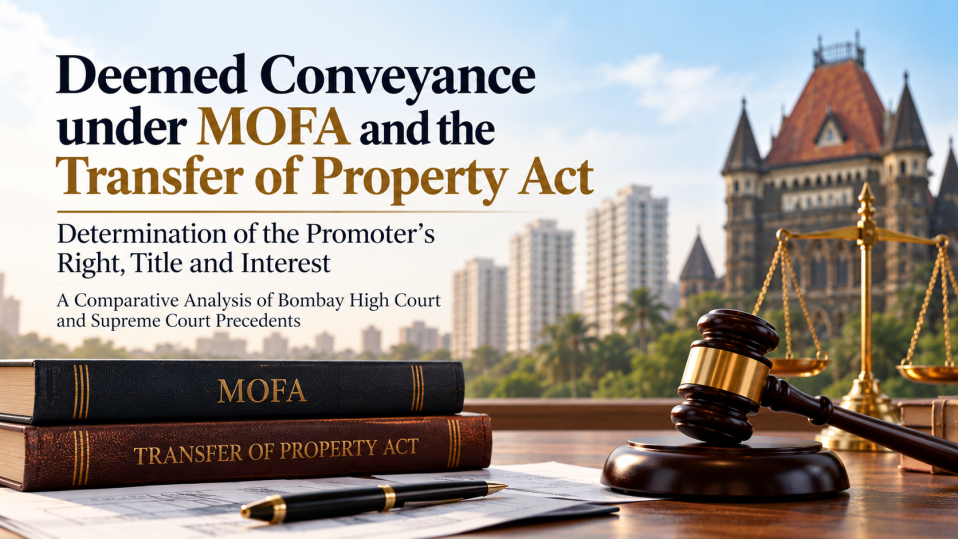
The Expanding Definition of “Promoter”: Impact on Landowners’ Rights. Need for parliamentary intervention?
NEED FOR AUTHORITATIVE CLARIFICATION BY THE BOMBAY HIGH COURT ON THE SCOPE OF SECTION 11 OF MOFA: GERALD MICHAEL MISQUITTA AND ROHINI GUPTA Gerald Michael Misquitta Vs State of Maharashtra ( “Gerald” ) Rohini Gupta & Anr. v. District Deputy Registrar, Co-operative Societies & Ors., WP No. 5991/2026, Bombay High Court, decided 8 September 2026, in which Mohini Gupta is the second petitioner. Indian Kanoon ( “Gupta” ) The two cases are quite closely connected because both concern Section 11 of MOFA, deemed conveyance, landowners/lessees, and the powers of the District Deputy Registrar (DDR). But there is an important difference: Gerald Misquitta is primarily a procedural/natural-justice case, whereas Gupta is substantially a Section 2(c)/Section 11 substantive-promoter case. Basic facts — side-by-side Sr No Particulars Gerald Michael Misquitta v. State of Maharashtra Rohini Gupta & Anr. v. DDR3 1 Court Bombay High Court Bombay High Court 2 Judgment date 25 Feb 2026 8 Sept 2026 3 Petition WP 1739/2022 WP 5991/2026 4 Ownership Misquitta family property, Vile Parle West Gupta family property, Juhu 5 Original owners Multiple Misquitta co-owners Late Kundanlal Laxmichand Gupta; petitioners were his heirs 6 Developer/lessee structure Owners → Rahejas → A.K. Associates/sub-lessee Owner → Raheja/Wadhwa lessees → developers 7 Society Name Priya Co-operative Housing Society Queens Park Premises Co-operative Society 8 Lease 98-year lease 98-year lease 9 Earlier transfer to society Society claimed/received only leasehold-related rights Society already received assignment of leasehold rights in 1978 10 DDR order 28 May 2014 23 June 2025 11 Main challenge Owners were not properly impleaded/heard; DDR did not conduct required enquiry Whether landowners themselves became “promoters” under MOFA Result DDR order + conveyance quashed and remanded Petition dismissed; DDR order upheld The Misquitta judgment records that the property was owned by several co-owners and that the society’s deemed-conveyance application proceeded without impleading all of them. Indian Kanoon The Gupta judgment records a 98-year lease from Kundanlal Gupta and subsequent construction of Queens Park by the lessees/developers. Indian Kanoon Paragraph-wise comparison This is the more useful way to read the judgments. Para 1–3 — What is being challenged? Gerald — paras 1–3 The petitioner challenged the DDR’s 28 May 2014 certificate permitting unilateral deemed conveyance and the subsequent registered deed of assignment/transfer dated 5 July 2014. The important factual feature was that the petitioner claimed to be a co-owner, but was not properly made a party to the deemed-conveyance proceedings. Indian Kanoon Gupta — paras 1–4 The petitioners were the legal heirs of the original landowner. They challenged the DDR’s order dated 23 June 2025 granting unilateral deemed conveyance of approximately 3,901.70 sq.m. to Queens Park Society. The Gupta petitioners said that their father had died in 1981 and that the DDR had proceeded on a notice issued in his name. Indian Kanoon Difference In Gerald, the central problem was: “Were all persons whose rights were affected actually heard?” In Gupta, the central question became: “Were these landowners themselves promoters under Section 2(c) MOFA?” Paragraphs 10–15 — Meaning of “promoter” This is the most important substantive difference. Gerald The Court did not finally determine the title/promoter controversy because […]
Read more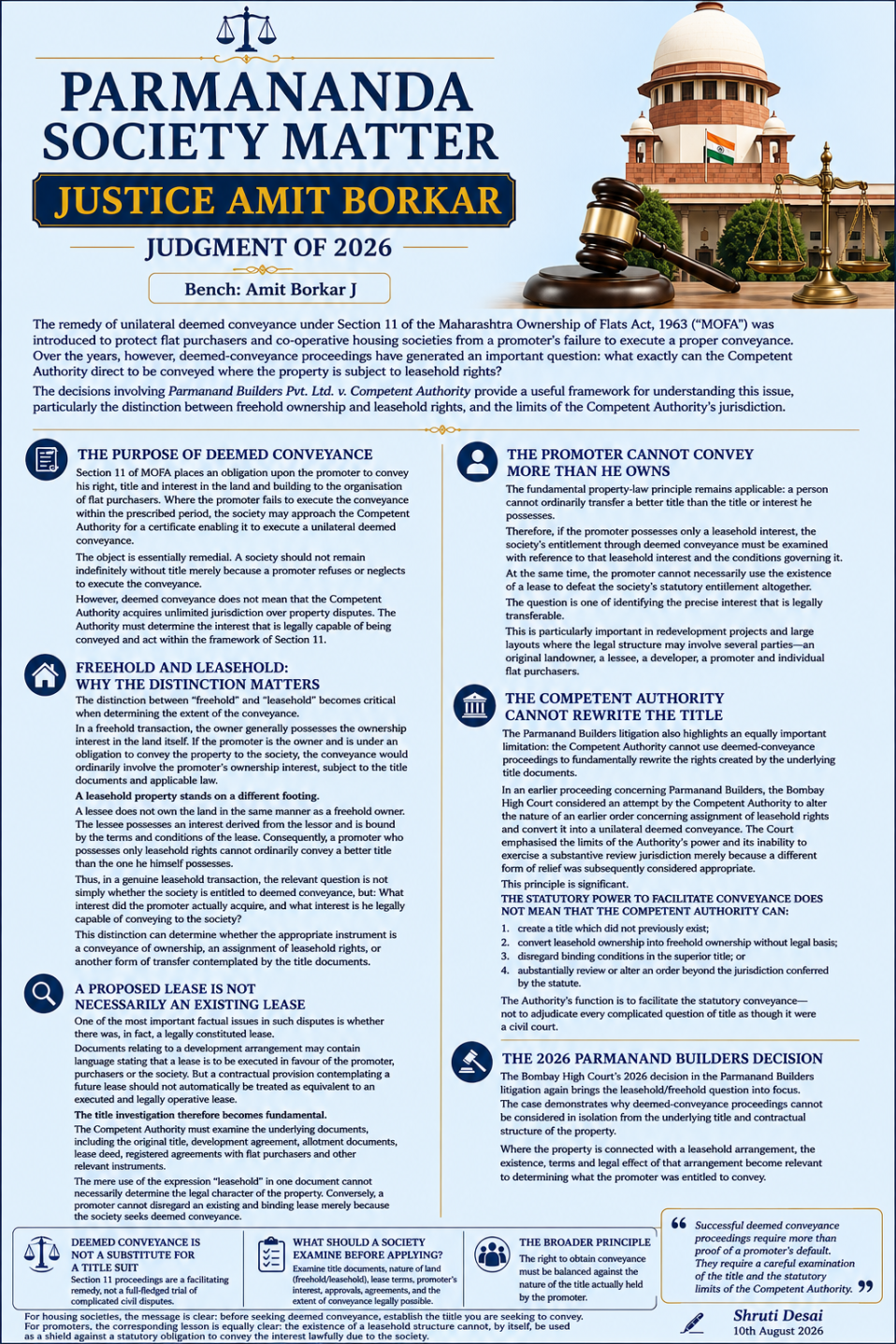
Unilateral Deemed Conveyance under MOFA: Leasehold, Freehold and the Limits of the Competent Authority Lessons from Parmanand Builders v. Competent Authority: 24 February, 2026
Bench: Amit Borkar J The remedy of unilateral deemed conveyance under Section 11 of the Maharashtra Ownership of Flats Act, 1963 (“MOFA”) was introduced to protect flat purchasers and co-operative housing societies from a promoter’s failure to execute a proper conveyance. Over the years, however, deemed-conveyance proceedings have generated an important question: what exactly can the Competent Authority direct to be conveyed where the property is subject to leasehold rights? The decisions involving Parmanand Builders Pvt. Ltd. v. Competent Authority provide a useful framework for understanding this issue, particularly the distinction between freehold ownership and leasehold rights, and the limits of the Competent Authority’s jurisdiction. The purpose of deemed conveyance Section 11 of MOFA places an obligation upon the promoter to convey his right, title and interest in the land and building to the organisation of flat purchasers. Where the promoter fails to execute the conveyance within the prescribed period, the society may approach the Competent Authority for a certificate enabling it to execute a unilateral deemed conveyance. The object is essentially remedial. A society should not remain indefinitely without title merely because a promoter refuses or neglects to execute the conveyance. However, deemed conveyance does not mean that the Competent Authority acquires unlimited jurisdiction over property disputes. The Authority must determine the interest that is legally capable of being conveyed and act within the framework of Section 11. Freehold and leasehold: why the distinction matters The distinction between “freehold” and “leasehold” becomes critical when determining the extent of the conveyance. In a freehold transaction, the owner generally possesses the ownership interest in the land itself. If the promoter is the owner and is under an obligation to convey the property to the society, the conveyance would ordinarily involve the promoter’s ownership interest, subject to the title documents and applicable law. A leasehold property stands on a different footing. A lessee does not own the land in the same manner as a freehold owner. The lessee possesses an interest derived from the lessor and is bound by the terms and conditions of the lease. Consequently, a promoter who possesses only leasehold rights cannot ordinarily convey a better title than the one he himself possesses. Thus, in a genuine leasehold transaction, the relevant question is not simply whether the society is entitled to deemed conveyance, but: What interest did the promoter actually acquire, and what interest is he legally capable of conveying to the society? This distinction can determine whether the appropriate instrument is a conveyance of ownership, an assignment of leasehold rights, or another form of transfer contemplated by the title documents. A proposed lease is not necessarily an existing lease ? One of the most important factual issues in such disputes is whether there was, in fact, a legally constituted lease. Documents relating to a development arrangement may contain language stating that a lease is to be executed in favour of the promoter, purchasers or the society. But a contractual provision contemplating a future lease should not automatically be treated as equivalent to an executed and legally operative lease. The title investigation therefore becomes fundamental. The Competent Authority must […]
Read more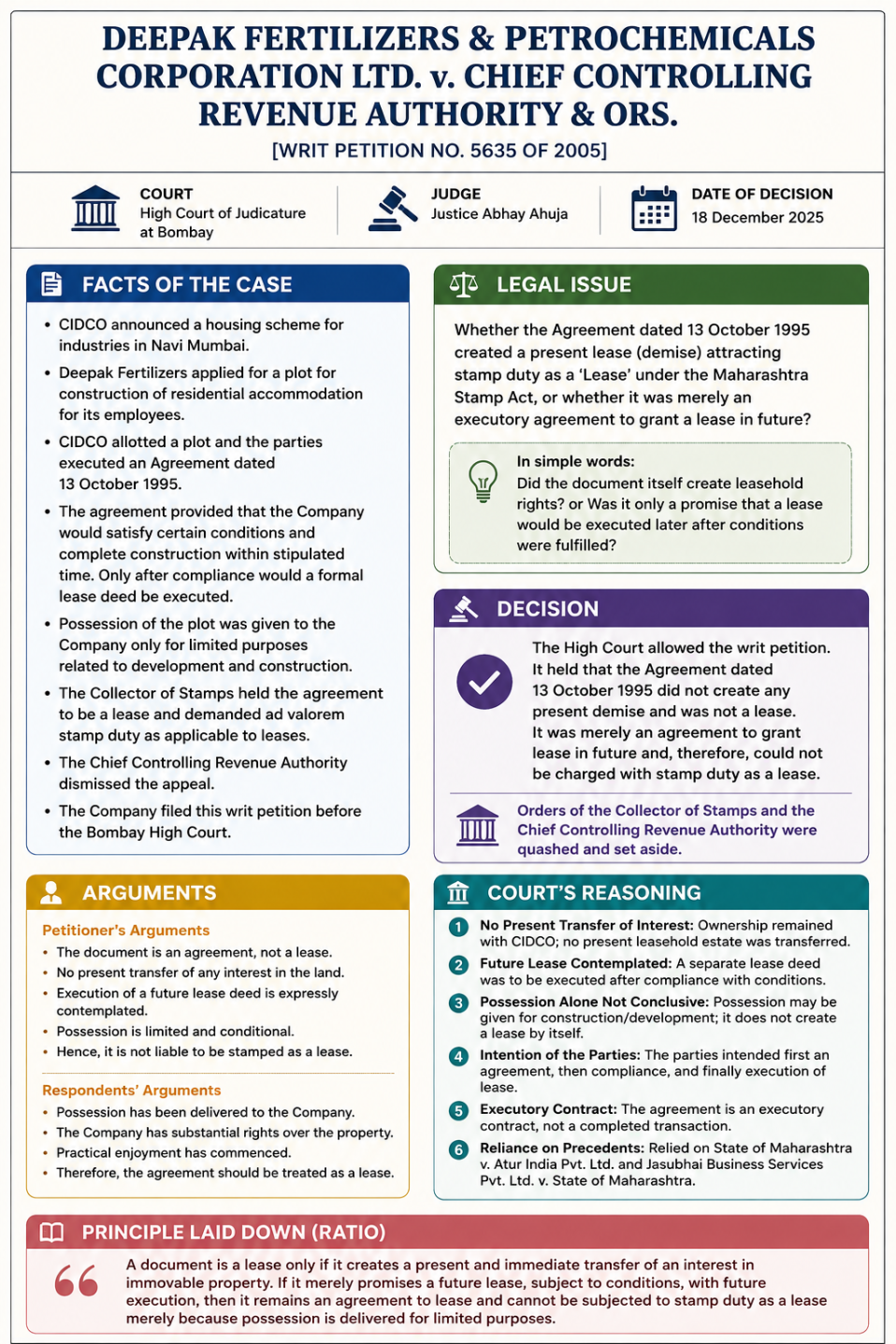
Lease or Agreement to Lease? A Case Analysis of Deepak Fertilizers v. Chief Controlling Revenue Authority
Deepak Fertilizers and Petrochemicals Corporation Ltd. v. Chief Controlling Revenue Authority & Ors., Writ Petition No. 5635 of 2005, decided on 18 December 2025 by Justice Abhay Ahuja. (Verdictum) Background and Facts The dispute arose from an agreement executed on 13 October 1995 between Deepak Fertilizers and CIDCO under a scheme through which CIDCO allotted developed residential plots to industries for construction of staff housing. The material facts were: CIDCO announced a housing scheme for industries in Navi Mumbai. Deepak Fertilizers applied for a plot for construction of residential accommodation for its employees. CIDCO allotted a plot and the parties executed an Agreement dated 13 October 1995. The agreement contemplated that: the company would satisfy several conditions; construction had to be completed within stipulated time; only after compliance would a formal lease deed be executed. Possession given to the company was only for limited purposes connected with development and construction under the agreement. The Collector of Stamps held that the agreement itself amounted to a lease and demanded ad valorem stamp duty as applicable to leases. The Chief Controlling Revenue Authority dismissed the company’s appeal. Deepak Fertilizers challenged those orders before the Bombay High Court. (Verdictum) Procedural History Authority Decision Collector of Stamps Held the agreement was a lease and liable to stamp duty as a lease Chief Controlling Revenue Authority Confirmed Collector’s order Bombay High Court Allowed the writ petition and set aside both orders Legal Issue The central legal issue was: Whether the Agreement dated 13 October 1995 created a present lease (demise) attracting stamp duty as a “Lease” under the Maharashtra Stamp Act, or whether it was merely an executory agreement to grant a lease in future. In simple words: Did the document itself create leasehold rights? or Was it only a promise that a lease would be executed later after conditions were fulfilled? Petitioner’s Arguments Deepak Fertilizers argued that: the document repeatedly described itself as an Agreement; it did not transfer any present interest in land; no leasehold estate came into existence immediately; execution of a future lease deed was expressly contemplated; possession was limited and conditional; therefore the agreement could not be stamped as a lease. The company relied upon earlier Bombay High Court decisions distinguishing between: agreement to lease actual lease Respondents’ Arguments The Revenue and CIDCO contended that: possession had already been handed over; the company had substantial rights over the property; practical enjoyment had commenced; therefore the agreement should be treated as a lease for stamp purposes. Core Legal Question Considered by the Court The Court examined a classical property law distinction: Does the document itself create a present demise? If yes → it is a lease. If no → it is merely an agreement to lease. This distinction has existed in Indian property law for decades. Court’s Reasoning Justice Abhay Ahuja analysed the document clause-by-clause. The Court emphasized that the substance of the document—not merely possession or nomenclature—determines its legal character. (Verdictum) No Present Transfer of Interest The Court observed that: ownership remained with CIDCO; no present leasehold estate was transferred; the agreement only created contractual obligations. This is the most important […]
Read more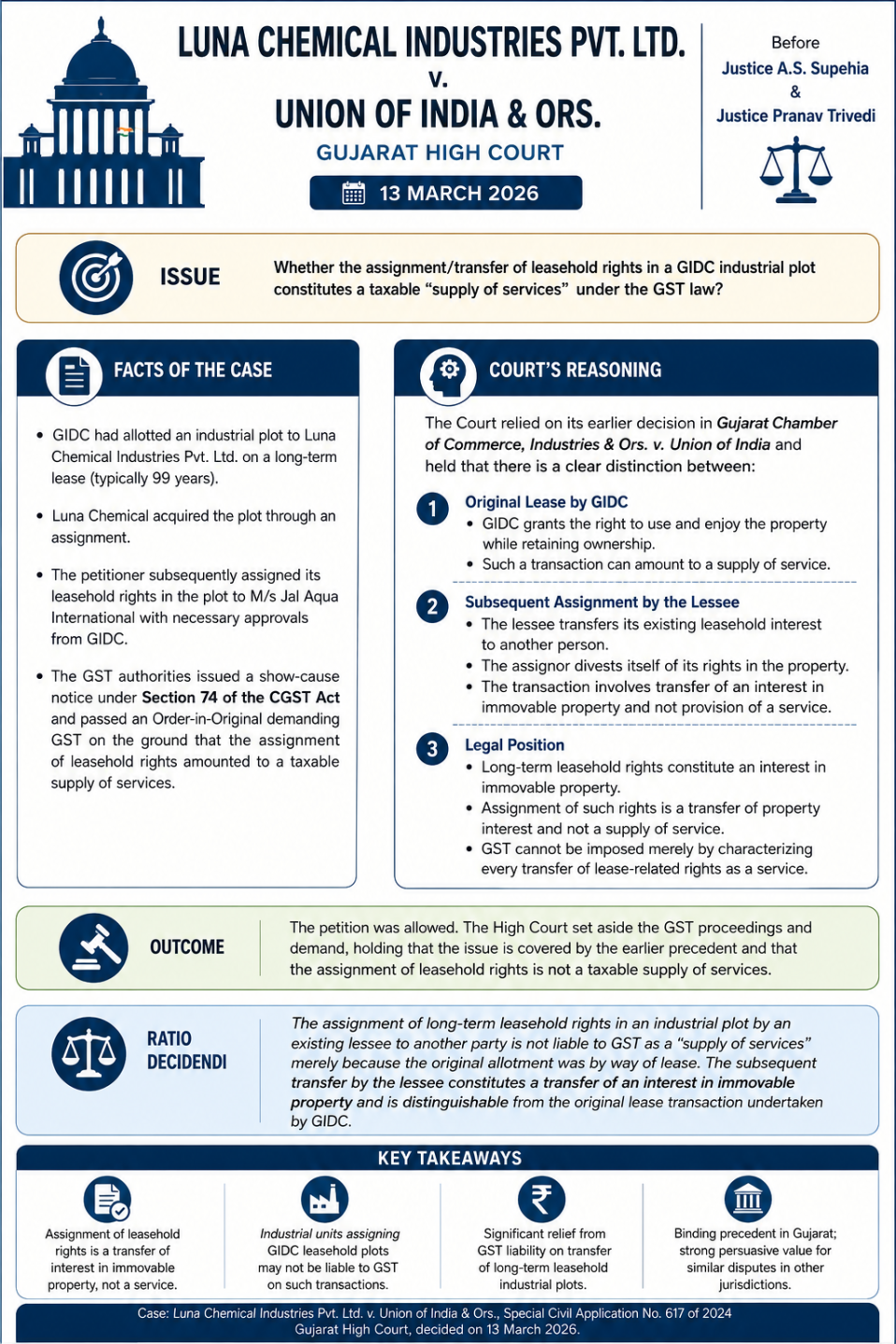
ASSIGNMENT OF LEASEHOLD RIGHTS UNDER GST: ANALYSIS OF LUNA CHEMICAL INDUSTRIES PVT. LTD. V. UNION OF INDIA (GUJARAT HIGH COURT)
Introduction The Gujarat High Court’s decision in Luna Chemical Industries Pvt. Ltd. v. Union of India has added another significant chapter to the ongoing debate concerning the GST implications of transfers of leasehold rights in industrial plots. The judgment reaffirms the principle that a transfer of leasehold rights by an existing lessee is fundamentally different from the original grant of lease by a statutory authority and cannot automatically be subjected to GST as a supply of service. The ruling is particularly relevant for industries operating in Gujarat Industrial Development Corporation (GIDC) estates and for taxpayers involved in the transfer of long-term leasehold interests in industrial land. Background of the Dispute Luna Chemical Industries Pvt. Ltd. held leasehold rights in an industrial plot allotted through the GIDC framework. Subsequently, the company assigned its leasehold rights to another entity after obtaining the requisite approvals from GIDC. The GST authorities initiated proceedings under Section 74 of the Central Goods and Services Tax Act, 2017, alleging that the assignment of leasehold rights constituted a taxable supply of services and consequently raised a demand for GST. The petitioner challenged the demand before the Gujarat High Court. CORE LEGAL ISSUE The principal question before the Court was: Whether the assignment of leasehold rights in an industrial plot by a lessee to a third party constitutes a taxable supply of services under the GST regime. The answer depended upon the characterization of the transaction. If the transaction represented a supply of service, GST would be leviable. Conversely, if it constituted a transfer of an interest in immovable property, it would fall outside the scope of taxable supplies. RATIO DECIDENDI The Court held that the transfer of leasehold rights by an existing lessee is legally distinct from the original lease granted by GIDC. The ratio of the decision may be summarized as follows: The assignment of long-term leasehold rights by a lessee results in the transfer of an existing interest in immovable property and does not amount to a taxable supply of services merely because the original allotment was made through a lease arrangement. Consequently, GST cannot be imposed on such assignment solely by treating it as a continuation of the original leasing transaction. Distinction between Lease and Assignment A key aspect of the judgment is the Court’s recognition of the legal distinction between: Original Lease by GIDC GIDC grants the right to use and enjoy immovable property while retaining ownership. Such a transaction may be characterized as a supply of service under GST. Subsequent Assignment by the Lessee The lessee transfers its existing leasehold interest to another person. The assignor divests itself of the rights held in the property. The transaction involves transfer of an interest in immovable property rather than provision of a service. The Court emphasized that these are two separate legal transactions and cannot be treated identically for GST purposes. Reliance on Earlier Precedent The judgment follows the Gujarat High Court’s earlier ruling in Gujarat Chamber of Commerce & Industry v. Union of India, where the Court had examined the GST treatment of leasehold interests in industrial plots. By relying on the principles laid […]
Read more
AUTHORS’ RIGHTS AGAINST PUBLISHERS IN INDIA: NEED FOR TRANSPARENCY, ROYALTY PROTECTION AND LEGAL ACCOUNTABILITY
AUTHORS’ RIGHTS AGAINST PUBLISHERS IN INDIA: NEED FOR TRANSPARENCY, ROYALTY PROTECTION AND LEGAL ACCOUNTABILITY BY SHRUTI DESAI Abstract The Indian publishing industry has witnessed growing concerns regarding non-payment of royalties, suppression of sales figures, denial of accounts, unauthorized reprints, and exploitative copyright assignments. Many authors, particularly academic and regional-language writers, suffer financial loss because publishers often maintain opaque accounting systems and one-sided publishing agreements. This article examines the legal rights of authors under the Copyright Act, 1957, discusses the right to royalties and rendition of accounts, and analyses important judicial precedents protecting authors against unfair publishing practices. The article also highlights the urgent need for statutory reforms ensuring transparency, accountability, and equitable sharing of publishing revenues. Keywords #Copyright, #royalty, #publishing #agreements, #rendition of #accounts, $authors’rights, #copyright #assignment, #literary works, #publishing industry, #moralrights, #transparency. INTRODUCTION The relationship between an author and a publisher is traditionally founded on trust, transparency, and mutual commercial benefit. However, in India, numerous authors — particularly academic writers, regional-language writers, educational authors, and first-time authors — have repeatedly complained of unfair publishing practices. These include non-payment or delayed payment of royalties, refusal to furnish proper sales statements, under-reporting of print runs, unauthorised reprints, misuse of digital rights, and one-sided copyright assignments. Many authors are compelled to sign standard-form publishing agreements without bargaining power. In several instances, publishers continue commercially exploit literary works while withholding accurate accounts of sales. Such practices not only amount to breach of contract but may also constitute infringement of statutory and moral rights under the Copyright Act, 1957. Indian courts have recognised that authors possess enforceable rights against publishers and licensees, including the right to rendition of accounts and protection against unauthorised exploitation of copyright. Legal Framework Under Indian Copyright Law The principal legislation governing literary rights in India is the Copyright Act, 1957. The Act recognises copyright as a valuable proprietary right and protects authors against unauthorised use of their works. Ownership of Copyright Section 17 of the Copyright Act recognises the author as the first owner of copyright, subject to limited exceptions. Assignment of Copyright Sections 18 and 19 regulate the assignment of copyright. An assignment must: • be in writing; • identify the specific rights assigned; • specify duration and territorial extent; • mention royalty and consideration. Where the duration is not specified, the assignment is deemed to be for five years. If the territorial extent is not specified, it is presumed to extend only within India. The 2012 amendments to the Copyright Act significantly strengthened author protection, especially concerning royalty rights. Royalty Rights of Authors The concept of royalty is central to publishing contracts. Royalty constitutes the author’s share in commercial exploitation of the literary work. Unfortunately, many publishers fail to disclose: • actual print quantities; • reprints; • warehouse stock; • digital sales; • export sales; • online platform sales; • discount structures; • destruction of unsold stock. This results in substantial financial loss to authors. The law increasingly recognizes that authors cannot be deprived of equitable royalty participation. In a significant development, the Calcutta High Court observed that the Copyright Act now recognizes the right of equal […]
Read more
The Silent Crisis in Legal Practice: When Clients Succeed but Lawyers Remain Unpaid
The Silent Crisis in Legal Practice: When Clients Succeed but Lawyers Remain Unpaid For many advocates, the deepest professional frustration is not losing a case. It is succeeding for a client and still remaining unpaid. Across years of practice, many lawyers experience the same pattern repeatedly: urgent consultations, endless conferences, strategic drafting, court appearances, emotional pressure, favorable outcomes, and then delayed, reduced, or completely denied professional fees. This problem becomes more painful in matters involving “success-linked” fee understandings. During the crisis stage, clients make assurances freely. Once relief is obtained — settlement, injunction, bail, recovery, business advantage, or litigation success — the financial commitment often becomes negotiable in the client’s mind. The result is not only financial loss. It creates professional exhaustion and distrust within practice. The Real Issue Is Structural In many cases, the problem is not merely dishonesty by individual clients. It is the absence of professional billing structure. Traditional relationship-based practice often relies on: verbal fee discussions, informal understandings, post-result payments, unlimited access to the lawyer, and emotional trust instead of documented systems. Such models place disproportionate risk on the advocate. The lawyer invests: time, intellectual effort, strategy, office resources, staff coordination, and professional reputation, while payment remains uncertain until the very end. Why This Pattern Damages Legal Practice Over time, repeated unpaid work creates: burnout, resentment toward clients, unstable cash flow, inability to scale chambers, reduced professional boundaries, and loss of motivation despite competence. Many capable lawyers become financially strained not because they lack legal skill, but because they lack enforceable economic structure within practice management. The Need for Professional Financial Discipline Modern legal practice requires systems, not assumptions. Advocates increasingly need: * written engagement terms, * stage-wise billing, * advance retainers, * consultation fees, * documented payment schedules, * and clear pause rights for non-payment. Equally important is client selection. Clients who: * resist written fee clarity, * negotiate excessively, * avoid advances, * or continuously postpone payment discussions often become future collection problems. Success Fees Should Not Be Survival Fees A major mistake in practice economics is depending on future “success fees” as the primary compensation. A healthier structure is: * proper professional fees during the matter, * with any success-linked component treated only as additional upside. This protects the advocate from total economic loss even if the client later defaults. Professionalism Must Continue Even During Recovery Non-payment should never push advocates toward public confrontation, emotional communication, or unethical pressure tactics. Fee recovery efforts should remain: * Documented, * Dignified, * Neutral, * And professionally managed. Long-term reputation is more valuable than short-term anger. A major lacuna in the existing legal framework is the absence of a statutory mechanism securing payment of professional fees to advocates. While the Advocates Act, 1961 emphasizes professional ethics and duties toward clients, it does not adequately protect advocates from non-payment of legitimate fees after rendering legal services. Need for an Advocates’ Security of Fees Act The present legal framework under the Advocates Act, 1961 does not provide an effective statutory mechanism for securing payment of professional fees to advocates. Although advocates are ethically prohibited from abandoning clients unfairly […]
Read more
“Can Sons Restrain a Mother from Transferring Property? A Legal Analysis under Hindu Law”
CAN SONS FILE SUIT AGAINST MOTHER (HINDU) FOR STAY AGAINST TRANSFER OF SHARES / PROPERTY HELD BY MOTHER IN A FAMILY PROPERTY/ PRIVATE COMPANY ABSOLUTELY TO DAUGHTER? Hindu law prohibits dowry. But dowry is given in one form or another. Hindu Law after 2004 amendment gave equal right to married daughter in father’s property. View of Author Equal property rights for married daughters are an important step toward fairness and gender equality. However, in some families this can also create tensions in relationships. After marriage, daughters may be influenced by their husband or in-laws, and when disputes over property arise, disagreements can escalate into legal battles or serious family conflicts. While the intention behind laws like the Hindu Succession (Amendment) Act, 2005 is to ensure justice and equal rights, the practical implementation sometimes leads to strained family ties when expectations about property are unclear or contested. In such situations, disagreements over inheritance may even end up in court or cause long-lasting rifts within families. Therefore, along with legal equality, maintaining open communication, clear property planning, and mutual understanding within families is important to prevent conflicts and preserve relationships. Law makers must prevent this situation resulting into strained relationships. Broken relations makes society psychologically weaker. Continue… with article… Let us see Section 14 of the Hindu Succession Act 1956. Property of a female Hindu to be her absolute property.―(1)Any property possessed by a female Hindu, whether acquired before or after the commencement of this Act, shall be held by her as full owner thereof and not as a limited owner. Explanation.―In this sub-section, “property” includes both movable and immovable property acquired by a female Hindu by inheritance or devise, or at a partition, or in lieu of maintenance or arrears of maintenance, or by gift from any person, whether a relative or not, before, at or after her marriage, or by her own skill or exertion, or by purchase or by prescription, or in any other manner whatsoever, and also any such property held by her as stridhana immediately before the commencement of this Act. (2) Nothing contained in sub-section (1) shall apply to any property acquired by way of gift or under a will or any other instrument or under a decree or order of a civil court or under an award where the terms of the gift, will or other instrument or the decree, order or award prescribe a restricted estate in such property. If the shares are the mother’s self-acquired property (bought by her or gifted to her), she has absolute authority to transfer them to anyone she wishes, and the sons have no legal standing to stop her during her lifetime. Section 5 of the said Act provides for exception: Act not to apply to certain properties. ―This Act shall not apply to― (i) any property succession to which is regulated by the Indian Succession Act, 1925 ( 39 of 1925), by reason of the provisions contained in section 21 of the Special Marriage Act, 1954 (43 of 1954); (ii) any estate which descends to a single heir by the terms of any covenant or agreement entered […]
Read more
“No Privilege in the Machine: A Case Study in AI-Assisted Defense”
AI DOCUMENTS ARE PRIVILEGED DOCUMENTS? ARE AI‑GENERATED LEGAL DOCUMENTS PRIVILEGED? A COMPARATIVE LEGAL PERSPECTIVE To understand the nuances of the issue under discussion we must know the provisions of the Indian laws. The two main laws applicable during evidence and cross examination oof a witness are the Bharatiya Sakshya Adhiniyam (BSA), 2023, and Code of Civil Procedure 1908. Prior to Bharatiya Sakshya Adhiniyam (BSA), 2023, it was The Evidence Act 1872. Professional Communications (Section 126-128, Evidence Act): Attorneys, pleaders, and their employees cannot disclose any communication made by a client, or documents shared, in the course of professional employment without the client’s express consent. Confidentiality Requirement: Privilege only applies to communications made to seek legal advice; it does not protect advice sought for illegal purposes. Client Protection (Section 129, Evidence Act): Clients cannot be compelled to disclose confidential communications with their legal advisors. Spousal Privilege (Section 122, Evidence Act): Communications between husband and wife during marriage are protected, with exceptions like suits between them. Official Communications (Sections 123-124, Evidence Act): Public officers cannot be compelled to disclose communications made in official confidence if it harms public interest. CPC Application: Under the Code of Civil Procedure, if a party is asked to produce a document that is privileged under the Evidence Act, they can object to its production. If a document loses its confidentiality, the privilege is lost. The Query: So, a question arises when a document is drafted by an Artificial Intelligence Application, whether such document or a draft is a privileged document and exempted from cross examination? Now issue arose before a Court in USA. United States v. Heppner in which said that when documents prepared by an AI application same is not a privileged document? If we talk of India, there is no law. However, a warning is issued by the Supreme Court of India not to rely on AI. It was an incident where a lawyer cited Judgements during his arguments, were never passed by any court of law in India. Factual Background On November 4, 2025, Bradley Heppner was arrested on the charges of securities and wire fraud. Pursuant to a search warrant, federal agents searched his residence and seized electronic devices. A forensic review revealed approximately thirty-one documents generated through Heppner’s interactions with “Claude,” a generative AI system operated by an application called Anthropic. The documents contained AI-generated analyses addressing potential defences, legal theories, and litigation strategy related to Heppner’s criminal case. After receiving a grand jury subpoena and retaining counsel, Heppner continued to use Claude independently to analyse the charges, evaluate defences, and draft strategy memoranda. He saved the AI-generated materials on his personal devices and later shared them with his attorneys. During discovery disputes, defence counsel conceded that they neither directed nor supervised Heppner’s use of the AI system and had no role in creating the documents. The government moved to compel production, arguing that the materials were not privileged because they were created through communications with a third-party AI platform without attorney involvement. Judge Jed Rakoff of the U.S. District Court for the Southern District of New York granted the motion, holding […]
Read more
CAN A HOUSING SOCIETY SELL TDR TO A PRIVATE MEMBER OF THE SOCIETY UNDER DOCUMENT OF MEMORANDUM OF UNDERSTANDING AND RESOLUTIONS?
JURISDICTION OF CO-OPERATIVE COURT AND BINDING NATURE OF SOCIETY RESOLUTIONS Let us first see what is TDR? Transferring Development Rights (TDR) by a housing society involves the society, as a landowner, generating extra buildable area (TDR) by surrendering land for public use (like roads, parks) to the municipality, receiving a TDR certificate (or Development Right Certificate – DRC), and then selling these rights to a developer or another party to build more than standard Floor Space Index (FSI) allows, benefiting both the society (compensation for land) and the buyer (extra construction rights). This process helps fund infrastructure projects and allows societies to get value for reserved plots, making TDR a crucial tool in urban development, especially in places like Mumbai. How it Works for a Society: Land Surrender: The housing society owns land, often designated for public amenities (e.g., a playground, road widening) by the city. TDR Generation: Instead of cash compensation, the Municipal Corporation (like MCGM in Mumbai) issues a TDR certificate (DRC) to the society, representing the Floor Space Index (FSI) potential of the surrendered land. Selling the Rights: The society can then sell this certificate to a builder or another property owner. Utilisation: The buyer uses the TDR to construct additional built-up area on their own plot, exceeding the normal FSI limits, often in a designated “receiving zone”. Benefits of TDR for Societies Financial Compensation: Provides funds for the society (often through developers) without the government paying cash, allowing land acquisition for public projects. Development Incentive: Encourages development and helps resolve land reservations, as owners get value for undevelopable land. Legal Avenue: Offers a way for societies and trusts to utilize or sell their development potential POINT OF CAUTION: A Housing Society cannot legally sell Transferable Development Rights (TDR) to a private member using only a Memorandum of Understanding (MoU) and Resolutions. TDR transactions must follow a formal, regulated process involving proper documentation and approval from the competent authorities to be legally valid. Legal Requirements for TDR Transfer : TDR is a formal legal instrument: TDR is an official development right issued by a municipal authority as a Development Right Certificate (DRC). This certificate is a tradeable commodity, similar to a stock, in a formal market. Formal Agreements are Required: Any transaction involving the sale or transfer of TDR requires a registered agreement, such as a formal TDR Sale Agreement, not just an MoU or simple resolutions. The agreement must be registered under the Registration Act, 1908. Statutory Compliance and Oversight: The transaction must comply with the relevant state laws, such as the Maharashtra Regional and Town Planning (MRTP) Act, 1966, and local Development Control Regulations (DCRs). Regulatory Approvals: The transfer must be registered with the Sub-Registrar and updated on the relevant municipal or urban local body’s (ULB) online TDR portal (if available). Authorities track the chain of ownership and usage of TDRs to prevent misuse and ensure transparency. Transparency and Fair Value: Transactions by a housing society, especially those involving a private member, are subject to scrutiny to ensure the society receives fair market value and to prevent irregularities or fraud. Risks of Using Only […]
Read more