
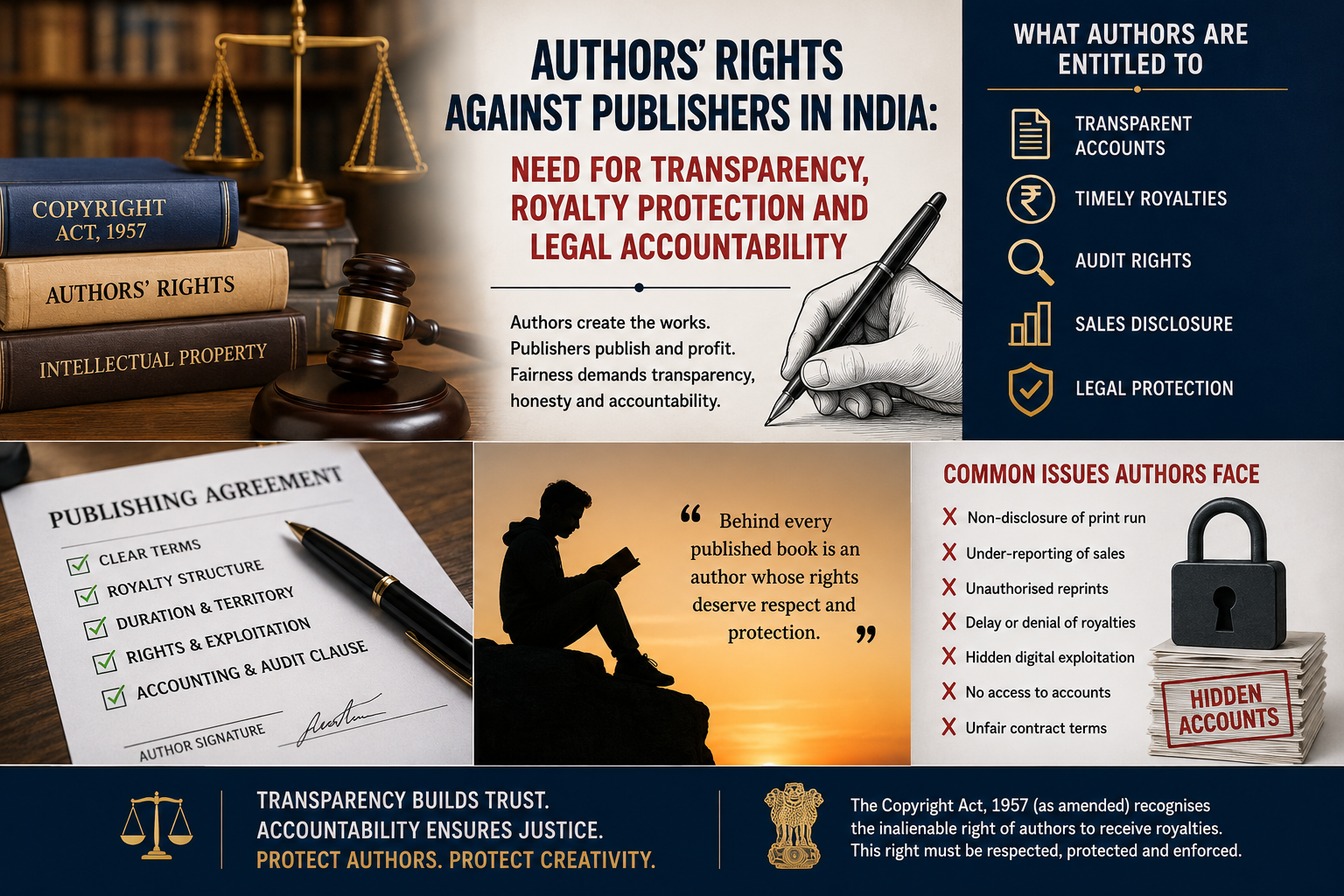
AUTHORS’ RIGHTS AGAINST PUBLISHERS IN INDIA: NEED FOR TRANSPARENCY, ROYALTY PROTECTION AND LEGAL ACCOUNTABILITY
BY SHRUTI DESAI
Abstract
The Indian publishing industry has witnessed growing concerns regarding non-payment of royalties, suppression of sales figures, denial of accounts, unauthorized reprints, and exploitative copyright assignments. Many authors, particularly academic and regional-language writers, suffer financial loss because publishers often maintain opaque accounting systems and one-sided publishing agreements. This article examines the legal rights of authors under the Copyright Act, 1957, discusses the right to royalties and rendition of accounts, and analyses important judicial precedents protecting authors against unfair publishing practices. The article also highlights the urgent need for statutory reforms ensuring transparency, accountability, and equitable sharing of publishing revenues.
Keywords
#Copyright, #royalty, #publishing #agreements, #rendition of #accounts, $authors’rights, #copyright #assignment, #literary works, #publishing industry, #moralrights, #transparency.
INTRODUCTION
The relationship between an author and a publisher is traditionally founded on trust, transparency, and mutual commercial benefit. However, in India, numerous authors — particularly academic writers, regional-language writers, educational authors, and first-time authors — have repeatedly complained of unfair publishing practices. These include non-payment or delayed payment of royalties, refusal to furnish proper sales statements, under-reporting of print runs, unauthorised reprints, misuse of digital rights, and one-sided copyright assignments.
Many authors are compelled to sign standard-form publishing agreements without bargaining power. In several instances, publishers continue commercially exploit literary works while withholding accurate accounts of sales. Such practices not only amount to breach of contract but may also constitute infringement of statutory and moral rights under the Copyright Act, 1957.
Indian courts have recognised that authors possess enforceable rights against publishers and licensees, including the right to rendition of accounts and protection against unauthorised exploitation of copyright.
Legal Framework Under Indian Copyright Law
The principal legislation governing literary rights in India is the Copyright Act, 1957. The Act recognises copyright as a valuable proprietary right and protects authors against unauthorised use of their works.
Ownership of Copyright
Section 17 of the Copyright Act recognises the author as the first owner of copyright, subject to limited exceptions.
Assignment of Copyright
Sections 18 and 19 regulate the assignment of copyright. An assignment must:
• be in writing;
• identify the specific rights assigned;
• specify duration and territorial extent;
• mention royalty and consideration.
Where the duration is not specified, the assignment is deemed to be for five years. If the territorial extent is not specified, it is presumed to extend only within India.
The 2012 amendments to the Copyright Act significantly strengthened author protection, especially concerning royalty rights.
Royalty Rights of Authors
The concept of royalty is central to publishing contracts. Royalty constitutes the author’s share in commercial exploitation of the literary work.
Unfortunately, many publishers fail to disclose:
• actual print quantities;
• reprints;
• warehouse stock;
• digital sales;
• export sales;
• online platform sales;
• discount structures;
• destruction of unsold stock.
This results in substantial financial loss to authors.
The law increasingly recognizes that authors cannot be deprived of equitable royalty participation.
In a significant development, the Calcutta High Court observed that the Copyright Act now recognizes the right of equal royalty sharing for authors of literary and musical works.
The Court in Vodafone Idea Ltd. v. Saregama India Ltd. emphasized that the amendments to the Copyright Act create enforceable royalty entitlements in favour of authors.
Right to Rendition of Accounts
One of the most important protections available to authors is the right to seek rendition of accounts.
Royalty Suppression and Authors’ Rights in India:
The Need for Transparency and Reform
Rendition of accounts means that the publisher can be compelled by a court to disclose:
number of copies printed;
copies sold;
stock position;
• income received;
• royalty calculations;
• invoices and ledgers;
• GST and tax records.
Indian courts have repeatedly recognised that a publisher or licensee holding sales information occupies a fiduciary position toward the author.
Mishra Bandhu Karyalaya v. Shivratanlal Koshal :
In this important decision, the court held that an author has a clear right to true accounts of sales and royalties from the publisher-licensee. The Court observed that the right to inspection of accounts exists inherently in publishing relationships.
The Court held:
“The right to rendition of a true account of the sales on which royalties are payable exists in the very nature of things.” This judgment remains highly relevant in modern publishing disputes where publishers refuse transparency.
The judgment of the Court of Appeal on this point was affirmed in the House of Lords. These decisions have throughout been followed in India. See W. B. Yeats v. Eric Dickinson, AIR 1938 Lah 173; Dharam Dutt Dhawan v. Ramlal, AIR 1957 Punj 161 and Associated Publishers v. K. Bachyan, AIR 1961 Mad 114.
Green, L. J. in Sutherland Publishing Co. v. Caxton Publishing Co., 1936 Ch 323 at p. 342 as follows:
“As an example of what I mean by overlapping, let me take the following case. The owner of a copyright in a book proves that, whereas if it had not been for the infringement, he could have sold 1,000 copies, he has only been able to sell 500, the infringer having printed and sold 500 copies. It is obvious that as the possible market for the book is limited to 1,000 copies, if the damages for infringement under Section 6 are fixed on the basis that the copyright owner would have sold 1,000 copies but for the infringement, and at the same time the value of the 500 copies sold by the infringer is fixed for the purposes of Section 7 at the amount for which they were sold, the result will be that the copyright owner will have recovered damages on the footing that there was an available market for 1,500 copies only. If he had sold 1,000 copies, there would have been no market for the 500 copies made by the infringer, which would accordingly have had no value. Conversely, if the 500 copies sold by the infringer were worth what they were sold for, this could only be so on the basis that the copyright owner was only going to sell 500. In such a case, it appears to me that to award to the copyright owner damages for infringement based on his inability to sell 500 copies and at the same time to award him damages based on the sale price of the 500 copies sold by the infringer would not be permissible.”
Publishing Agreements and Abuse of Dominant Bargaining Position
Many publishing contracts in India are heavily tilted in favour of publishers. Common unfair clauses include:
• perpetual assignment of copyright;
• assignment of all future works;
• no audit rights;
• unilateral pricing power;
• no minimum royalty guarantee;
• vague accounting obligations;
• transfer of digital rights without separate compensation.
Courts have increasingly scrutinised such agreements.
Jaypee Brothers Medical Publishers Pvt. Ltd. v. Dr. Ramya Raghu
The Delhi High Court examined the nature of publishing rights and clarified that the assignment of publishing rights does not necessarily amount to a complete transfer of copyright ownership.
The Court emphasised careful interpretation of publishing agreements and recognised the continuing proprietary interests of authors.
This decision is important because many publishers wrongly treat limited publishing rights as absolute ownership over the author’s work.
Copyright Ownership and Publisher Claims
Disputes frequently arise where publishers claim exclusive ownership over works even after the expiry or termination of agreements.
Deshmukh and Company (Publishers) Pvt. Ltd. v. Anil Mehta
The Bombay High Court examined competing claims concerning publishing rights in literary works of noted author V.S. Khandekar.
The case demonstrates that publishers cannot automatically assume perpetual rights merely because they once published the work.
The judgment reflects judicial recognition that literary works fundamentally originate from the creative labour of authors.
Moral Rights of Authors
Apart from economic rights, Indian law also protects moral rights under Section 57 of the Copyright Act.
Authors possess:
i. right of attribution,
ii. right against distortion or mutilation,
iii. right to protect the integrity of the work.
Even after the assignment of copyright, moral rights remain with the author.
This becomes important where:
• publishers alter texts without consent;
• abridged editions distort the work;
• authors are not credited;
• works are commercially exploited in a derogatory form.
Digital Publishing and Emerging Challenges
The digital publishing ecosystem has intensified concerns relating to transparency.
Today, books are sold through:
• ebooks;
• Kindle platforms;
• educational portals;
• PDFs;
• audiobook platforms;
• subscription services;
• online learning applications.
Authors often receive no independent data regarding:
downloads;
subscriptions;
international access;
institutional licensing;
digital reproductions.
Many old agreements signed before the digital era are now used by publishers to claim sweeping digital rights.
This raises serious issues concerning:
• unconscionable contracts;
• unjust enrichment;
• unfair commercial exploitation.
Need for Statutory Reform
India urgently requires stronger statutory protection for authors.
POSSIBLE REFORMS INCLUDE:
1. Mandatory Royalty Statements
Publishers should be legally required to furnish annual audited royalty statements.
2. Statutory Audit Rights
Authors should possess enforceable rights to inspect accounts through Chartered Accountants.
3. Digital Sales Transparency
Online sales and digital exploitation must be disclosed separately.
4. Automatic Reversion of Rights
Copyright should revert to authors if books go out of print for a specified period.
5. Penalties for Suppression of Sales
Deliberate under-reporting and concealment of sales should attract statutory damages.
6. Collective Protection Bodies
Authors’ guilds and copyright societies should be strengthened.
International Perspective
Several countries provide stronger institutional safeguards for authors.
Organizations such as the Authors Guild (United States) and the Society of Authors (United Kingdom) actively negotiate fair publishing standards.
INDIA ALSO REQUIRES:
• standard-form fair publishing contracts;
• model royalty clauses;
• dispute resolution mechanisms;
• publishing ombudsman systems.
CONCLUSION
Authors are the foundation of the publishing industry. Without writers, there can be no publishing commerce.
Yet many Indian authors continue suffering from opaque accounting systems, unfair contracts, royalty suppression, and commercial exploitation.
Indian courts have repeatedly recognised that authors possess enforceable rights, including:
• ownership of copyright;
• right to royalties;
• right to rendition of accounts;
• moral rights;
• protection against unauthorised exploitation.
However, litigation is expensive and time-consuming. Therefore, stronger statutory safeguards and collective institutional mechanisms are urgently needed.
The future of Indian publishing must rest upon transparency, accountability, fair royalty sharing, and respect for the creative labour of authors.
Important Judgments Referred
1. Mishra Bandhu Karyalaya v. Shivratanlal Koshal
2. Jaypee Brothers Medical Publishers Pvt. Ltd. v. Dr. Ramya Raghu
3. Deshmukh and Company (Publishers) Pvt. Ltd. v. Anil Mehta
4. Vodafone Idea Ltd. v. Saregama India Ltd.
5. Eastern Book Company v. D.B. Modak
References
• Copyright Act, 1957
• Copyright (Amendment) Act, 2012
• Indian judicial precedents on copyright and publishing rights
SHRUTI DESAI
21-MAY-2026
Post a comment