
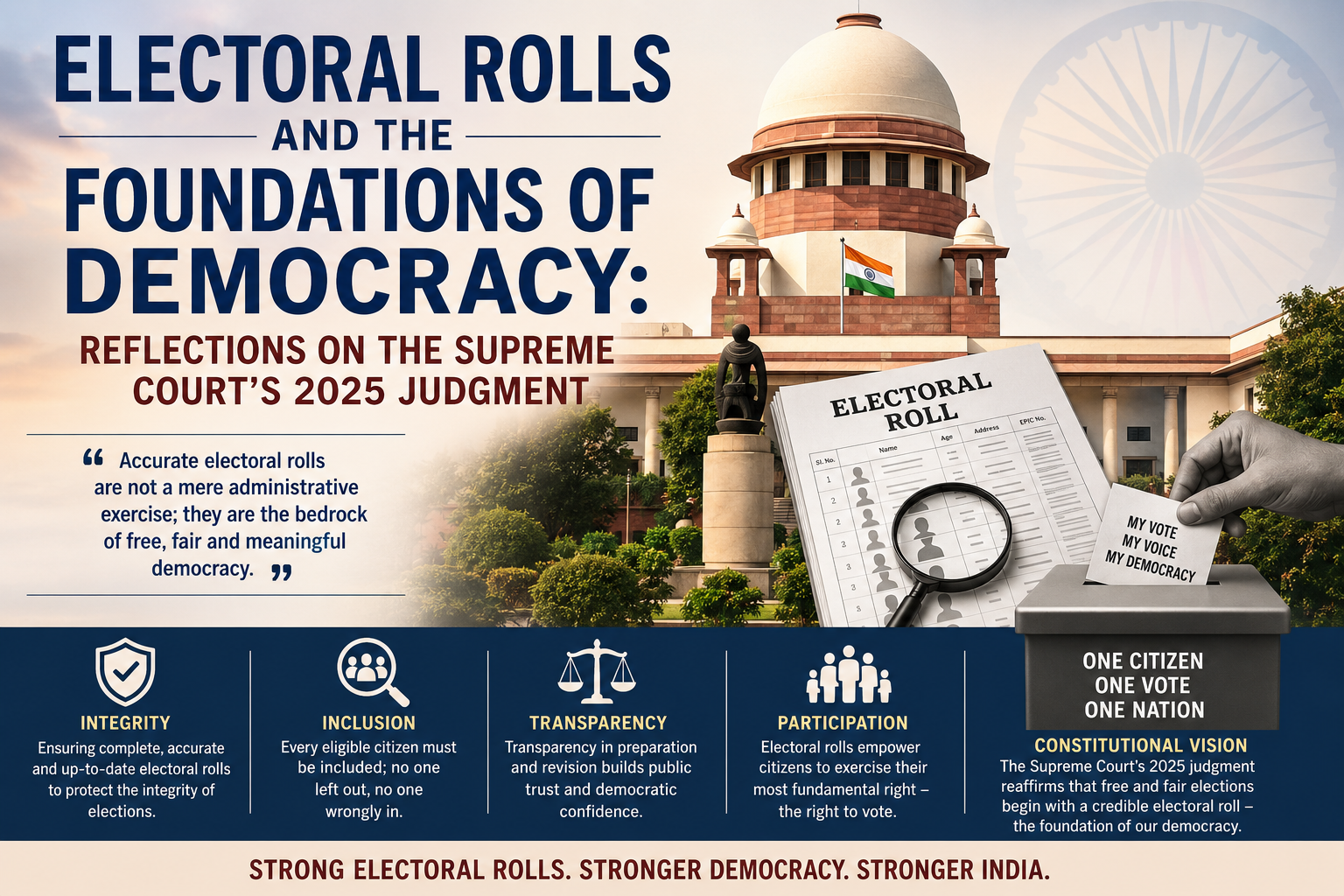
INTRODUCTORY REMARKS:
The Supreme Court of India’s 2025 judgment in Association for Democratic Reforms v. Election Commission of India begins not with procedural technicalities, but with a profound constitutional question: who constitutes the political community of a democracy? Before a state can count votes, the Court observes, it must first determine whose votes are entitled to be counted. In this framing, the electoral roll emerges not as a routine administrative document, but as the legal foundation of representative government itself.
Chief Justice Surya Kant, writing for the Court, situates the controversy within a long historical and philosophical tradition. The judgment emphasizes that disputes concerning electoral rolls are inseparable from the legitimacy of democratic governance. Every democracy must define the body of citizens who may participate in collective political decision-making. Electoral registration, therefore, becomes an issue of constitutional identity rather than mere bureaucracy.
What makes the introduction especially striking is its historical sweep. The Court traces India’s democratic inheritance back to the ancient republics of the Gangetic plains, particularly the Vajji confederacy centered around Vaishali in present-day Bihar. During the Mahajanapada period, approximately the sixth and fifth centuries BCE, the region witnessed both monarchies and non-monarchical political systems. While Magadha and Anga represented kingship, the Vajji polity embodied forms of collective governance and assembly-based decision-making.
Drawing upon the *Mahāparinibbāna Sutta*, the judgment describes the Vajjis as conducting frequent assemblies, deliberating in concord, and operating according to established institutions. Although these republics did not practice universal adult suffrage in the modern constitutional sense, they nonetheless required mechanisms to determine who could participate in governance. Participation was often restricted by lineage, rank, or status, yet the central political problem remained familiar: defining membership within the governing community.

( CURTSY wikipidea) ( The Mahāparinibbāna Sutta is Sutta 16 in the Dīgha Nikāya, a scripture belonging to the Sutta Piṭaka of Theravāda Buddhism. It concerns the end of Gautama Buddha’s life – his parinibbāna – and is the longest sutta of the Pāli Canon. Because of its attention to detail, it has been resorted to as the principal source of reference in most standard accounts of the Buddha’s death)
This historical exploration serves an important constitutional purpose. By invoking ancient republican traditions, the Court underscores that the question of political inclusion has deep roots in Indian civilization. The legitimacy of governance has long depended upon recognized procedures for identifying participants in public affairs. Modern electoral rolls are therefore part of a much older democratic continuum, though transformed by constitutional principles of equality and universal suffrage.
The judgment’s introductory reasoning also reflects a broader philosophy of constitutional democracy. Representative government does not begin at the polling booth; it begins with inclusion in the electoral process itself. Errors, exclusions, or manipulations in electoral rolls can alter the composition of the electorate and thereby affect democratic legitimacy. In this sense, voter registration is not peripheral to democracy—it is constitutive of it.
By grounding its analysis in history, political theory, and constitutional values, the Supreme Court elevates the debate over electoral rolls beyond procedural administration. The judgment reminds us that democracy depends not only on free elections, but also on fair and lawful recognition of the people entitled to participate in them. The integrity of the electoral roll, therefore, is inseparable from the integrity of the republic itself.
DETAILED DISCUSSION:
DEMOCRACY BEGINS BEFORE VOTING:
The Supreme Court’s 2025 judgment in Association for Democratic Reforms v. Election Commission of India may ultimately be remembered not merely as a case about electoral rolls, but as a constitutional meditation on the meaning of democracy itself. At first glance, the dispute appears administrative: who gets included in electoral rolls, how voter lists are prepared, and what safeguards govern the identification of eligible electors. Yet the Court transforms this seemingly technical controversy into a larger inquiry into political membership, constitutional legitimacy, and the architecture of representative government.
The opening line of the judgment captures its philosophical depth: before a democracy can count votes, it must first determine whose votes may be counted. In one sentence, the Court reframes the entire debate. Elections are not simply about polling day mechanics. They begin much earlier—with the creation of the electorate itself.
ELECTORAL ROLLS AS CONSTITUTIONAL INSTRUMENTS
Modern democracies often treat voter registration as a bureaucratic exercise. Names are added, corrected, deleted, or verified through administrative procedures. But the Supreme Court insists that electoral rolls are far more than administrative records. They are legal declarations of political belonging.
This distinction matters profoundly. The electoral roll determines who is recognized by the State as a participant in collective self-government. Inclusion grants political agency; exclusion silences it. In constitutional democracies founded upon universal adult suffrage, the process of voter identification becomes inseparable from the legitimacy of governance itself.
The Court’s reasoning reflects an important democratic principle: representative institutions derive authority only from a properly constituted electorate. Any distortion in voter registration therefore affects not only electoral outcomes, but also the democratic character of the State.
THE JUDGMENT’S MOST STRIKING FEATURE:
History :
Perhaps the most remarkable aspect of the judgment is its historical imagination. Instead of limiting itself to constitutional provisions and statutory interpretation, the Court journeys back to ancient India—particularly Bihar during the Mahajanapada period.
The judgment invokes the Vajji confederacy cantered around Vaishali, often described by historians as one of the earliest republican or quasi-republican political formations in the subcontinent. Drawing from Buddhist texts such as the Mahāparinibbāna Sutta, the Court notes that the Vajjis held assemblies, deliberated collectively, and acted through institutional procedures rather than unilateral monarchical command.
This historical discussion serves a larger constitutional purpose. The Court appears intent on demonstrating that the idea of collective political participation is not alien to Indian civilization. Democracy in India is not portrayed as a purely modern or imported constitutional arrangement; instead, it is linked to deeper indigenous traditions of organized public deliberation.
At the same time, the Court carefully avoids romanticizing the past. Ancient republics, it acknowledges, were not democratic in the modern egalitarian sense. Participation was often restricted by lineage, rank, or social status. Yet even these systems faced the same foundational question confronting modern democracies today: who belongs to the political community?
THE POLITICS OF INCLUSION
The judgment arrives at a moment when democracies worldwide are grappling with questions of citizenship, migration, identity, and electoral legitimacy. Across jurisdictions, disputes over voter registration increasingly reflect larger anxieties about belonging and representation.
Seen in this context, the Court’s emphasis on electoral rolls carries contemporary significance. It implicitly recognizes that democratic exclusion can occur not only through overt disenfranchisement, but also through administrative opacity, procedural barriers, or flawed verification mechanisms.
By elevating electoral rolls to constitutional importance, the judgment strengthens the principle that access to democratic participation must remain fair, transparent, and legally accountable. The process of determining eligibility cannot become arbitrary or politically manipulative.
BEYOND PROCEDURE: A CONSTITUTIONAL PHILOSOPHY
The judgment also reflects a deeper constitutional philosophy about the relationship between the individual and the State. Democracies are sustained not solely through institutions, but through recognition. Citizens must be acknowledged as members of the political community before they can exercise sovereign power through voting.
This understanding aligns with broader constitutional values embedded in the Indian Constitution—equality, dignity, participation, and political freedom. Universal adult franchise was one of independent India’s boldest constitutional commitments, particularly in a society marked by deep social and economic inequalities. By treating voter registration as foundational rather than incidental, the Court reaffirms the transformative character of that constitutional promise.
The judgment therefore operates on two levels simultaneously. Legally, it addresses electoral administration and voter identification. Philosophically, it asks what makes democratic authority legitimate in the first place.
A REMINDER ABOUT DEMOCRACY
One of the enduring strengths of the Indian constitutional tradition has been its willingness to view democracy as more than periodic elections. Democracy also depends upon institutional fairness, constitutional morality, and equal political participation.
SUMMARY :
The Supreme Court’s judgment serves as a reminder that the health of a democracy is often determined long before ballots are cast. Electoral legitimacy begins with the integrity of the electorate itself.
In emphasizing this principle, the Court places electoral rolls at the heart of constitutional governance. The right to vote is meaningful only when citizens can first be recognized as entitled participants in the democratic process. That recognition is not a procedural detail. It is the foundation upon which representative government rests.
Ultimately, the judgment broadens the conversation about elections in India. It asks citizens, institutions, and the State to reconsider a basic but vital democratic truth: democracy begins not with counting votes, but with counting people.
Authors Comments :
Booth capturing, or booth looting, is electoral fraud in which party loyalists or hired criminals “capture” a polling booth and vote in place of legitimate voters to ensure that a particular candidate wins. It is a form of voter suppression.
The first instance of booth capturing in India was recorded in the 1957 General Elections in Rachiyahi, in Begusarai District’s Matihani assembly seat. The word came into prominent use in the media during the late 1970s and 1980s when the number of parties and candidates multiplied. This resulted in some Parties using underhand methods including booth capturing, especially in the rural India.
Erstwhile Prime Minister Indira Gandhi “lost” the initial case to Raj Narain is that the Allahabad High Court found her guilty of electoral malpractices under the Representation of the People Act, 1951, which led the court to invalidate her election and bar her from contesting for six years. Subsequently she imposed emergency.
However this time Election Commission successfully conducted Special Intensive Revision (SIR) in Assam and West Bengal and also completed election peacefully.
SHRUTI DESAI
29-05-2026

Post a comment