
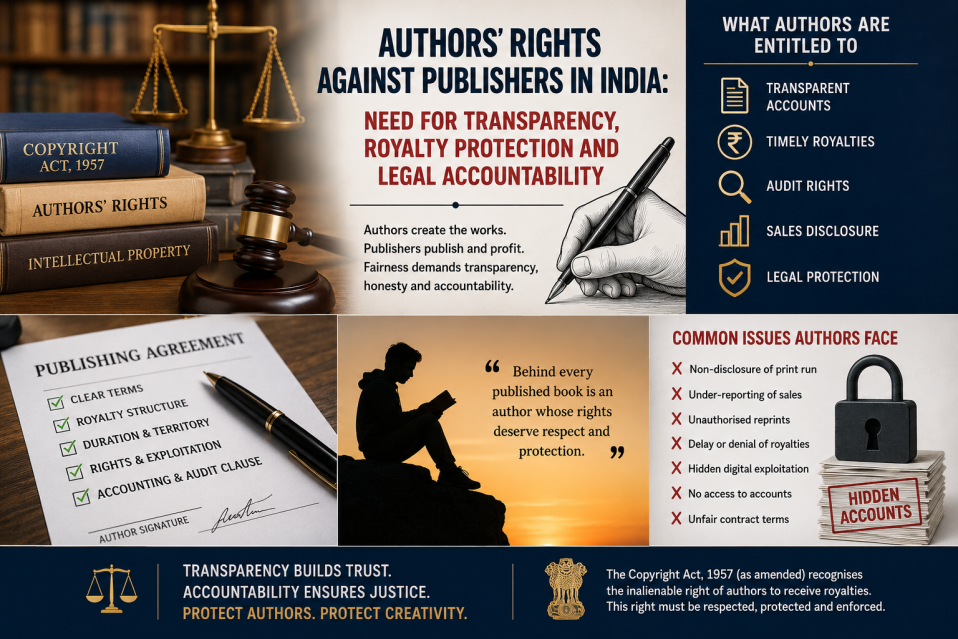
AUTHORS’ RIGHTS AGAINST PUBLISHERS IN INDIA: NEED FOR TRANSPARENCY, ROYALTY PROTECTION AND LEGAL ACCOUNTABILITY
AUTHORS’ RIGHTS AGAINST PUBLISHERS IN INDIA: NEED FOR TRANSPARENCY, ROYALTY PROTECTION AND LEGAL ACCOUNTABILITY BY SHRUTI DESAI Abstract The Indian publishing industry has witnessed growing concerns regarding non-payment of royalties, suppression of sales figures, denial of accounts, unauthorized reprints, and exploitative copyright assignments. Many authors, particularly academic and regional-language writers, suffer financial loss because publishers often maintain opaque accounting systems and one-sided publishing agreements. This article examines the legal rights of authors under the Copyright Act, 1957, discusses the right to royalties and rendition of accounts, and analyses important judicial precedents protecting authors against unfair publishing practices. The article also highlights the urgent need for statutory reforms ensuring transparency, accountability, and equitable sharing of publishing revenues. Keywords #Copyright, #royalty, #publishing #agreements, #rendition of #accounts, $authors’rights, #copyright #assignment, #literary works, #publishing industry, #moralrights, #transparency. INTRODUCTION The relationship between an author and a publisher is traditionally founded on trust, transparency, and mutual commercial benefit. However, in India, numerous authors — particularly academic writers, regional-language writers, educational authors, and first-time authors — have repeatedly complained of unfair publishing practices. These include non-payment or delayed payment of royalties, refusal to furnish proper sales statements, under-reporting of print runs, unauthorised reprints, misuse of digital rights, and one-sided copyright assignments. Many authors are compelled to sign standard-form publishing agreements without bargaining power. In several instances, publishers continue commercially exploit literary works while withholding accurate accounts of sales. Such practices not only amount to breach of contract but may also constitute infringement of statutory and moral rights under the Copyright Act, 1957. Indian courts have recognised that authors possess enforceable rights against publishers and licensees, including the right to rendition of accounts and protection against unauthorised exploitation of copyright. Legal Framework Under Indian Copyright Law The principal legislation governing literary rights in India is the Copyright Act, 1957. The Act recognises copyright as a valuable proprietary right and protects authors against unauthorised use of their works. Ownership of Copyright Section 17 of the Copyright Act recognises the author as the first owner of copyright, subject to limited exceptions. Assignment of Copyright Sections 18 and 19 regulate the assignment of copyright. An assignment must: • be in writing; • identify the specific rights assigned; • specify duration and territorial extent; • mention royalty and consideration. Where the duration is not specified, the assignment is deemed to be for five years. If the territorial extent is not specified, it is presumed to extend only within India. The 2012 amendments to the Copyright Act significantly strengthened author protection, especially concerning royalty rights. Royalty Rights of Authors The concept of royalty is central to publishing contracts. Royalty constitutes the author’s share in commercial exploitation of the literary work. Unfortunately, many publishers fail to disclose: • actual print quantities; • reprints; • warehouse stock; • digital sales; • export sales; • online platform sales; • discount structures; • destruction of unsold stock. This results in substantial financial loss to authors. The law increasingly recognizes that authors cannot be deprived of equitable royalty participation. In a significant development, the Calcutta High Court observed that the Copyright Act now recognizes the right of equal […]
Read more
VIOLATION OF THE COPYRIGHT ACT IS A CRIMINAL OFFENSE? IS IT A BAILABLE OFFENSE?
What is Copyright and when it becomes a criminal offense? To understand this question, we must know the legal provisions. COPYRIGHT ACT 1957 WHAT IS COPYRIGHT? Meaning of said term is given under Section 14 of the Act. [14. Meaning of Copyright.— For the purposes of this Act, “copyright” means the exclusive right subject to the provisions of this Act, to do or authorise the doing of any of the following acts in respect of a work or any substantial part thereof, namely:— (a) in the case of a literary, dramatic or musical work, not being a computer programme,— (i) to reproduce the work in any material form including the storing of it in any medium by electronic means; (ii) to issue copies of the work to the public not being copies already in circulation; (iii) to perform the work in public, or communicate it to the public; (iv) to make any cinematograph film or sound recording in respect of the work; (v) to make any translation of the work; (vi) to make any adaptation of the work; (vii) to do, in relation to a translation or an adaptation of the work, any of the acts specified in relation to the work in sub-clauses (i) to (vi); (b) in the case of a computer programme,— (i) to do any of the acts specified in clause (a); 1 [(ii) to sell or give on commercial rental or offer for sale or for commercial rental any copy of the computer programme: Provided that such commercial rental does not apply in respect of computer programmes where the programme itself is not the essential object of the rental.] (c) in the case of an artistic work,— 2 [(i) to reproduce the work in any material form including— (A) the storing of it in any medium by electronic or other means; or (B) depiction in three-dimensions of a two-dimensional work; or (C) depiction in two-dimensions of a three-dimensional work;] (ii) to communicate the work to the public; (iii) to issue copies of the work to the public not being copies already in circulation; (iv) to include the work in any cinematograph film; (v) to make any adaptation of the work; (vi) to do in relation to adaptation of the work any of the acts specified in relation to the work in sub-clauses (i) to (iv); (d) in the case of a cinematograph film,— [(i) to make a copy of the film, including— (A) a photograph of any image forming part thereof; or (B) storing of it in any medium by electronic or other means;] [(ii) to sell or give on commercial rental or offer for sale or for such rental, any copy of the film;] iii) to communicate the film to the public; (e) in the case of a sound recording,— (i) to make any other sound recording embodying it 1 [including storing of it in any medium by electronic or other means]; [(ii) to sell or give on commercial rental or offer for sale or for such rental, any copy of the sound recording;] (iii) to communicate the sound recording to the public. Offence […]
Read moreCAN THERE BE ORAL COPY RIGHT ASSIGNMENT? CAN COPY RIGHTS BE CLAIMED WITHOUT AGREEMENT?
Sections 18 and 19 of Copy Right Act 1957 is important for discussion. Let’s see provision of two relevant Sections. 18. Assignment of copyright.— (1) The owner of the copyright in an existing work or the prospective owner of the copyright in a future work may assign to any person the copyright either wholly or partially and either generally or subject to limitations and either for the whole of the copyright or any part thereof: Provided that in the case of the assignment of copyright in any future work, the assignment shall take effect only when the work comes into existence. (2) Where the assignee of a copyright becomes entitled to any right comprised in the copyright, the assignee as respects the rights so assigned, and the assignor as respects the rights not assigned, shall be treated for the purposes of this Act as the owner of copyright and the provisions of this Act shall have effect accordingly. (3) In this section, the expression “assignee” as respects the assignment of the copyright in any future work includes the legal representatives of the assignee, if the assignee dies before the work comes into existence. 19. Mode of assignment.—[ (1) ] No assignment of the copyright in any work shall be valid unless it is in writing signed by the assignor or by his duly authorised agent [(2) The assignment of copyright in any work shall identify such work, and shall specify the rights assigned and the duration and territorial extent of such assignment. (3) The assignment of copyright in any work shall also specify the amount of royalty payable, if any, to the author or his legal heirs during the currency of the assignment and the assignment shall be subject to revision, extension or termination on terms mutually agreed upon by the parties. (4) Where the assignee does not exercise the right assigned to him under any of the other sub-sections of this section within period of one year from the date of assignment, the assignment in respect of such rights shall be deemed to have lapsed after the expiry of the said period unless otherwise specified in the assignment. (5) If the period of assignment is not stated, it shall be deemed to be five years from the date of assignment. (6) If the territorial extent of assignment of the rights is not specified, it shall be presumed to extend within India. (7) Nothing in sub-section (2) or sub-section (3) or sub-section (4) or sub-section (5) or sub-section (6) shall be applicable to assignments made before the coming into force of the Copyright (Amendment) Act, 1994.]] There is landmark judgment on this issue passed by Karnataka High Court. Judicial Views: In K.A. Venugopala Setty vs Dr. Suryakantha U. Kamath, Karnataka High Court it framed question on oral agreement for Assignment and held that, “from the aforesaid provisions contained in S. 19 of the Act, it is clear that assignment of the copyright must be in writing and signed by the assignor or his duly authorised agent. In addition to this, the assignment must in clear terms state the rights proposed to be assigned and the size of the work. […]
Read more