
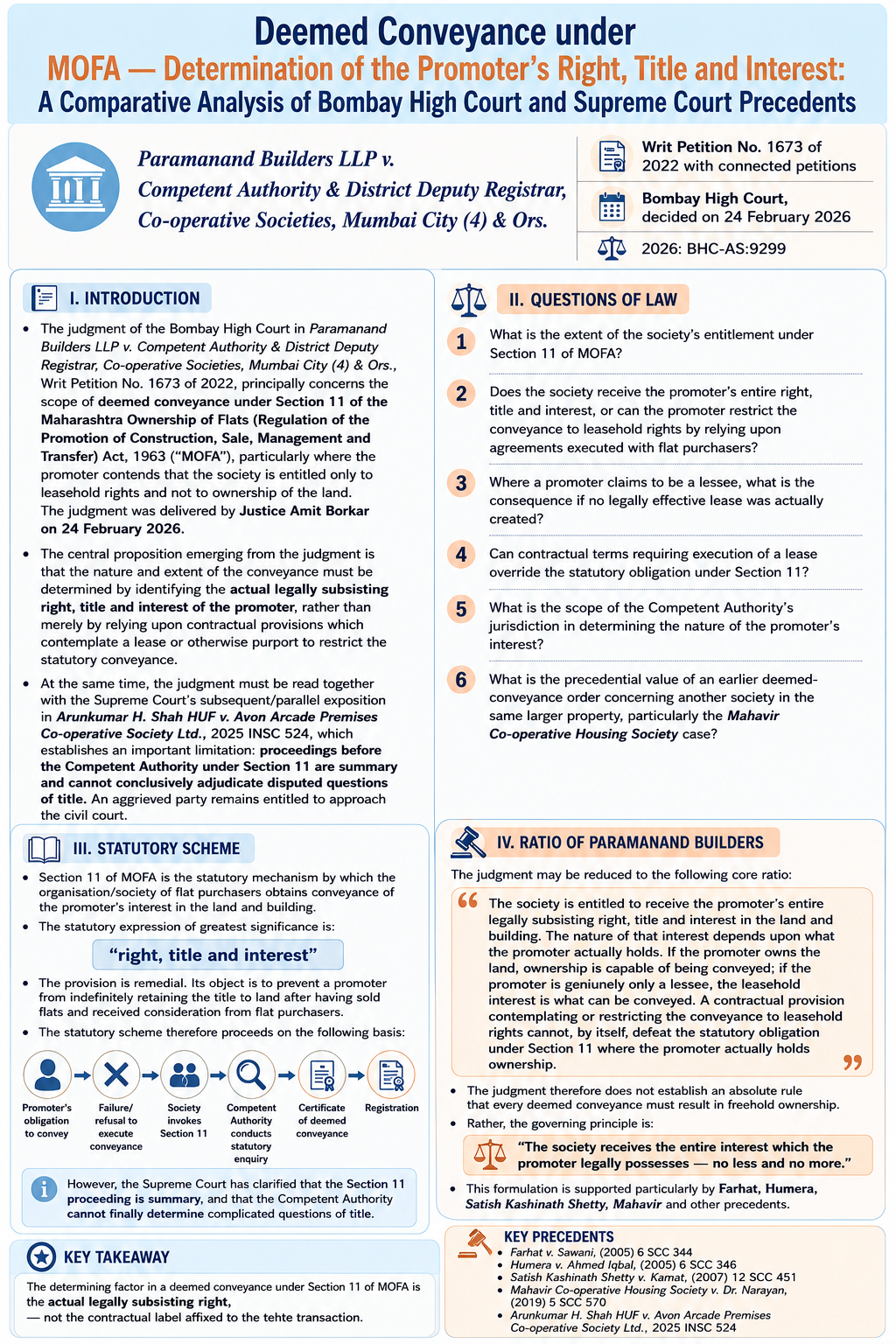
Paramanand Builders LLP v. Competent Authority & District Deputy Registrar, Co-operative Societies, Mumbai City (4) & Ors.
Writ Petition No. 1673 of 2022 with connected petitions
Bombay High Court, decided on 24 February 2026
2026: BHC-AS:9299 INTRODUCTION
The judgment of the Bombay High Court in Paramanand Builders LLP v. Competent Authority & District Deputy Registrar, Co-operative Societies, Mumbai City (4) & Ors., Writ Petition No. 1673 of 2022, principally concerns the scope of deemed conveyance under Section 11 of the Maharashtra Ownership of Flats (Regulation of the Promotion of Construction, Sale, Management and Transfer) Act, 1963 (“MOFA”), particularly where the promoter contends that the society is entitled only to leasehold rights and not to ownership of the land. The judgment was delivered by Justice Amit Borkar on 24 February 2026.
The central proposition emerging from the judgment is that the nature and extent of the conveyance must be determined by identifying the actual legally subsisting right, title and interest of the promoter, rather than merely by relying upon contractual provisions which contemplate a lease or otherwise purport to restrict the statutory conveyance.
At the same time, the judgment must be read together with the Supreme Court’s subsequent/parallel exposition in Arunkumar H. Shah HUF v. Avon Arcade Premises Co-operative Society Ltd., 2025 INSC 524, which establishes an important limitation: proceedings before the Competent Authority under Section 11 are summary and cannot conclusively adjudicate disputed questions of title. An aggrieved party remains entitled to approach the civil court.
A. QUESTIONS OF LAW
The principal legal questions may be formulated as follows:
- What is the extent of the society’s entitlement under Section 11 of MOFA?
- Does the society receive the promoter’s entire right, title and interest, or can the promoter restrict the conveyance to leasehold rights by relying upon agreements executed with flat purchasers?
- Where a promoter claims to be a lessee, what is the consequence if no legally effective lease was actually created?
- Can contractual terms requiring execution of a lease override the statutory obligation under Section 11?
- What is the scope of the Competent Authority’s jurisdiction in determining the nature of the promoter’s interest?
- What is the precedential value of an earlier deemed-conveyance order concerning another society in the same larger property, particularly the Mahavir Co-operative Housing Society case?
B. STATUTORY SCHEME
Section 11 of MOFA is the statutory mechanism by which the organisation/society of flat purchasers obtains conveyance of the promoter’s interest in the land and building.
The statutory expression of greatest significance is:
“right, title and interest”
The provision is remedial. Its object is to prevent a promoter from indefinitely retaining the title to land after having sold flats and received consideration from flat purchasers.
The statutory scheme therefore proceeds on the following basis:
Promoter’s obligation to convey
↓
Failure/refusal to execute conveyance
↓
Society invokes Section 11
↓
Competent Authority conducts statutory enquiry
↓
Certificate of deemed conveyance
↓
Registration
However, the Supreme Court has clarified that the Section 11 proceeding is summary, and that the Competent Authority cannot finally determine complicated questions of title.
C.RATIO OF PARAMANAND BUILDERS
The judgment may be reduced to the following core ratio:
The society is entitled to receive the promoter’s entire legally subsisting right, title and interest in the land and building. The nature of that interest depends upon what the promoter actually holds. If the promoter owns the land, ownership is capable of being conveyed; if the promoter is genuinely only a lessee, the leasehold interest is what can be conveyed. A contractual provision contemplating or restricting the conveyance to leasehold rights cannot, by itself, defeat the statutory obligation under Section 11 where the promoter actually holds ownership.
The judgment therefore does not establish an absolute rule that every deemed conveyance must result in freehold ownership.
Rather, the governing principle is:
“The society receives the entire interest which the promoter legally possesses — no less and no more.”
This formulation is supported particularly by Farhat, Haresh Bhatia and Ramniklal, and is subject to the Supreme Court’s limitation concerning the summary jurisdiction of the Competent Authority.
D. RAMNIKLAL TULSIDAS KOTAK v. VARSHA BUILDERS AIR 1992 Bom 62; (1993) Mh LJ 323 Bombay High Court, 26 August 1991 Ramniklal is important for identifying Paragraph 16 — categories of promoter
The Court identified four broad categories:
- the owner of freehold land;
- a lessee whose lease authorises construction and sale of flats on ownership basis;
- a person who has entered into an enforceable agreement to purchase the land from the lawful owner; and
- an agent of the owner or authorised lessee who is entitled to construct and dispose of flats.
The Court recognised that, in the third and fourth categories, the promoter may not have “title” in the conventional property-law sense, but MOFA uses the concept of the promoter’s title in a wider statutory sense.
Ratio
The promoter’s statutory status depends upon the nature of his legally enforceable entitlement to develop and sell flats, and not merely upon whether he is the registered owner. Paragraph 17 — sufficient entitlement
The Court held that the promoter need not necessarily be the absolute owner or long-term lessee but must have sufficient entitlement and authority to construct and dispose of flats so as to bind the owner of the freehold or leasehold interest.
Where the developer is merely acting under an agreement with the owner, the owner or authorised lessee must be made a confirming party so that the flat purchaser is not left without enforceable rights.
Ratio: The important proposition is: The promoter must possess sufficient legal authority to bind the superior titleholder in respect of the flat-purchase transaction.
E. FARHAT CO-OPERATIVE HOUSING SOCIETY LTD. v. MALKANI ENTERPRISES 2014 SCC OnLine Bom 1265; (2014) 6 Mh LJ 358 Bombay High Court, 23 September 2014
This is one of the principal authorities relied upon in Paramanand Builders.
Paragraph 24 — nature of interest conveyed Farhat concerned a developer who had an agreement to lease from the owners. The Court held that the society was entitled, under MOFA, to the interest which the developer was legally entitled to transfer. The factual matrix therefore resulted in assignment of leasehold rights rather than creation of a freehold estate.
Ratio : The society cannot obtain a greater estate than the promoter/developer legally possesses.
But equally: The society is entitled to the entirety of the promoter’s transferable interest.
This is the critical principle subsequently applied in Paramanand.
Paragraph 26 — owner as promoter The Court also recognised that an owner who obtains the relevant development permissions and causes construction to be undertaken through a developer may fall within the definition of “promoter” under Section 2(c) MOFA.
Ratio : Ownership and the statutory status of “promoter” are not mutually exclusive.
An owner who actively causes the construction/development and sale process to occur may itself attract the statutory obligations imposed upon a promoter.
G. HARESH VIJAYSINH BHATIA v. DISTRICT DEPUTY REGISTRAR 2025: BHC-AS:21311 W.P. No. 18739 of 2024 with W.P. No. 4649 of 2025 Bombay High Court, 8 May 2025
This is the most directly relevant authority on the question whether an owner/promoter can restrict the society to leasehold rights by relying upon contractual provisions.
Paragraph 62 — principal ratio
The Court held that Section 11 creates a statutory right in favour of the society to receive every right possessed by the promoter in relation to the land.
The distinction is explicit:
- Promoter is owner → ownership must be conveyed.
- Promoter is merely lessee → leasehold rights must be conveyed.
- Owner/promoter cannot contractually restrict the society to a lease if the promoter actually owns the land.
This is a ratio decidendi.
It was necessary to the Court’s determination and directly resolves the issue.
Paragraphs 63–67 — contractual restriction cannot defeat Section 11
The Court rejected the argument that the words “in accordance with the agreement executed under Section 4” permit the promoter to contractually limit the society’s statutory entitlement.
The Court reasoned that such an interpretation would permit the statutory right under Section 11 to be defeated by the very agreement that MOFA regulates.
Paragraph 67 is particularly significant: an interpretation permitting contractual restrictions to deprive the society of the promoter’s title would defeat the statutory right to conveyance and produce an incongruous result.
Ratio
The agreement remains relevant to determining the terms and extent of the transaction but cannot be interpreted so as to nullify the statutory obligation to convey the promoter’s actual right, title and interest.
H. ARUNKUMAR H. SHAH HUF v. AVON ARCADE PREMISES CO-OPERATIVE SOCIETY LTD. 2025 INSC 524 Supreme Court of India, 21 April 2025
This is the most important Supreme Court authority for understanding the jurisdictional limits of Section 11 proceedings.
Paragraph 37 — binding Supreme Court ratio
The Supreme Court formulated four conclusions:
(i) Summary nature of Section 11 proceedings
The Competent Authority possesses quasi-judicial powers, but proceedings under Section 11(3) are summary in nature.
The authority must record reasons for its final decision.
(ii) No final adjudication of title
The Competent Authority cannot conclusively and finally decide questions of title.
Consequently, an aggrieved party may institute a civil suit notwithstanding the deemed-conveyance order.
(iii) Limited writ interference
Because Section 11 is beneficial legislation protecting flat purchasers, a writ court should generally refrain from interfering with a deemed-conveyance order unless it is manifestly illegal.
(iv) Limited power of registering officer
The registering officer cannot sit in appeal over the Competent Authority’s order and can refuse registration only on the grounds legally available under Section 11(5).
Status These propositions are binding Supreme Court precedent.
Accordingly, any interpretation of Paramanand Builders must remain subject to Arunkumar H. Shah HUF.
- THE IMPORTANCE OF THE SUPREME COURT LIMITATION
This produces an important distinction between two questions:
Question 1
What should ultimately be conveyed?
The answer depends upon the promoter’s actual right, title and interest.
Question 2
Can the Competent Authority conclusively determine a disputed title?
The answer is no, if the issue involves a substantive title dispute requiring final adjudication.
That distinction reconciles Haresh Bhatia and Paramanand with Arunkumar.
The Competent Authority may examine the documents sufficiently to determine the appropriate deemed conveyance for purposes of Section 11, but it cannot transform the summary proceeding into a full-fledged civil title trial.
- THE MAHAVIR CO-OPERATIVE HOUSING SOCIETY PROCEEDING
W.P. No. 6167 of 2022
The petitioners in Paramanand Builders relied upon the Mahavir Co-operative Housing Society proceeding because it arose from the same larger property and involved allegedly similar documents.
According to the petitioners, in Mahavir the Competent Authority had directed only assignment of leasehold rights, rather than conveyance of ownership, and the High Court had upheld that result.
The argument was therefore:
Similar property + similar documents = same legal result.
The High Court rejected that approach.
Legal significance
The result in Mahavir was fact specific.
The mere fact that another society in the larger property received leasehold rights does not establish that every other plot or society in the same layout must receive only leasehold rights.
The decisive question remains:
What was the actual legal interest held by the promoter in the particular property in question?
Thus, Mahavir should not be cited as establishing a general rule that Section 11 permits only assignment of leasehold rights in Ratan Nagar or in similar layouts.
- COMPARATIVE CHART OF THE AUTHORITIES
| Sr No | Case Court / Year | Key paragraph | Principal proposition | Ratio / Fact |
| 1 | Ramniklal Tulsidas Kotak v. Varsha Builders Bombay HC, 1991 | 16–17 | Promoter may be owner, lessee, purchaser under enforceable agreement or authorised agent; promoter must have sufficient entitlement to develop/sell | Ratio |
| 2. | Farhat CHS v. Malkani Enterprises Bombay HC, 2014 | 24, 26 | Society receives promoter/developer’s actual right, title and interest; owner causing development may itself be promoter | Ratio |
| 3. | Haresh Vijaysinh Bhatia v. DDR Bombay HC, 2025 | 62–67 | Owner must convey ownership; lessee conveys leasehold; contract cannot reduce statutory entitlement | Core ratio |
| 4. | Arunkumar H. Shah HUF v. Avon Arcade CHS Supreme Court, 2025 | 37 | Section 11 proceedings are summary; Competent Authority cannot finally adjudicate title; civil suit remains available; writ interference limited | Binding SC ratio |
| 5. | Mahavir CHS, W.P. 6167/2022 Bombay HC | – | Assignment of lease upheld on its particular factual/title record | Fact-specific; not universal ratio |
| 6. | Paramanand Builders LLP Bombay HC, 2026 | Judgment as a whole; particularly treatment of Mahavir and Farhat | Entire actual promoter interest must be conveyed; another society’s result cannot control a different factual/title matrix | Ratio subject to SC Arunkumar |
XII. COMPARATIVE ANALYSIS: OWNERSHIP VERSUS LEASEHOLD
The authorities can be reconciled through the following proposition:
|
|||||||||||||||||||||||||
The last two propositions are particularly important when applying Paramanand.
DISTILLATION OF THE RATIO
The combined ratio of the authorities can be formulated as follows:
Proposition 1 — Identity of promoter
Under Section 2(c) MOFA, the promoter need not invariably be the registered owner. What matters is whether the person has the statutory and contractual entitlement to develop and dispose of flats.
Ramniklal, paras 16–17; Farhat, para 26.
Proposition 2 — Extent of conveyance
Under Section 11, the society is entitled to the promoter’s entire legally subsisting right, title and interest.
Farhat, para 24; Haresh Bhatia, para 62.
Proposition 3 — No greater title than promoter possesses
Section 11 does not enable a society to acquire a greater proprietary estate than the promoter possesses. A genuine lessee can convey only leasehold rights.
Farhat, para 24; Haresh Bhatia, para 62.
Proposition 4 — No contractual dilution
Conversely, an owner/promoter cannot rely upon a contractual clause to convey less than the ownership interest actually held by him. Haresh Bhatia, paras 62–67.
Proposition 5 — Actual legal interest, not nomenclature
The question is not merely whether the documents use the expression “lease”. The court/authority must determine whether a legally effective leasehold interest actually exists. This is the factual/legal inquiry that becomes decisive in Paramanand.
Proposition 6 — Summary jurisdiction The Competent Authority may undertake the statutory enquiry necessary for deemed conveyance, but cannot conclusively determine disputed title. Arunkumar H. Shah HUF, para 37(ii).
Proposition 7 — Civil remedy survives An order of deemed conveyance does not extinguish the right of an aggrieved party to institute a civil action concerning title or other proprietary rights. Arunkumar H. Shah HUF, para 37(ii).
Proposition 8 — Limited writ interference A writ court should not interfere merely because another view of the documents is possible. Intervention is warranted where the deemed-conveyance order is manifestly illegal. Arunkumar H. Shah HUF, para 37(iii).
APPLICATION TO PARAMANAND BUILDERS
The petitioner’s case depended substantially upon the proposition that the relevant documentation contemplated leasehold rights and therefore the society could not obtain ownership.
The Court’s approach was to distinguish between:
(a) a legally existing leasehold interest, and
(b) documents which merely contemplated or provided for execution of a lease.
The distinction is fundamental.
If a valid lease existed, the promoter could not convey more than its leasehold interest.
But if no legally effective lease had been created and the promoter/owner continued to possess ownership, the existence of contractual language referring to a future lease could not convert ownership into leasehold rights for the purposes of Section 11.
This reasoning is consistent with:
- Ramniklal — determine the promoter’s actual legal entitlement;
- Farhat — society receives the promoter’s actual interest;
- Haresh Bhatia — contractual terms cannot defeat the statutory obligation; and
- Arunkumar — while the Competent Authority can act under Section 11, a genuinely disputed title issue remains open to civil adjudication.
- PRECEDENTIAL VALUE
- Supreme Court authority Arunkumar H. Shah HUF v. Avon Arcade CHS Ltd., 2025 INSC 524 is binding Supreme Court authority.
Its paragraph 37 should therefore take precedence wherever there is a conflict concerning the jurisdictional limits of the Competent Authority or the extent of writ interference.
- Bombay High Court authorities
Ramniklal, Farhat and Haresh Bhatia are decisions of the Bombay High Court and constitute important persuasive/binding authorities within the High Court’s hierarchical framework, subject to decisions of larger Benches and the Supreme Court.
The propositions which are genuinely ratio decidendi should be distinguished from factual findings.
- Mahavir :
The Mahavir result should be treated primarily as fact-specific.
It does not establish a universal rule that all properties within the same larger layout must be conveyed by way of lease assignment.
The fact that another society obtained a particular form of conveyance is therefore not, by itself, sufficient to determine the legal entitlement of a different society.
XVI. IMPORTANT QUALIFICATION FOR LITIGATION
There is a potentially significant distinction between:
Case A — No genuine title dispute
The documents clearly establish that the promoter is the owner and no valid lease exists.
In that situation, Haresh Bhatia and Paramanand strongly support conveyance of ownership.
Case B — Genuine disputed title/lease
There is a serious dispute concerning:
- whether a lease was executed;
- validity of the lease;
- ownership;
- assignment;
- competing title documents;
- effect of consent terms;
- validity of a transfer; or
- superior proprietary rights.
In such a case, Arunkumar H. Shah HUF becomes critical.
The Competent Authority cannot finally determine that title dispute in a summary Section 11 proceeding. The aggrieved party can approach the civil court.
This distinction should be expressly pleaded if the matter involves a contested title rather than merely a disagreement over interpretation of an undisputed document.
The combined legal position emerging from the authorities is:
Section 11 of MOFA creates a statutory right in the society of flat purchasers to obtain conveyance of the promoter’s entire legally subsisting right, title and interest in the land and building. The society receives no greater interest than the promoter possesses, but the promoter cannot voluntarily or contractually convey less than the interest which the statute requires him to transfer. Thus, a genuine lessee may convey leasehold rights, but an owner/promoter cannot rely upon a contractual provision contemplating a lease to avoid conveyance of ownership where the promoter continues to hold ownership.
At the same time:
The Competent Authority’s jurisdiction under Section 11 is summary. It may examine the documentary material sufficiently to determine entitlement to deemed conveyance, but it cannot finally adjudicate a substantive and disputed question of title. Such a dispute remains open to civil adjudication.
Accordingly, the strongest legal formulation for reliance upon Paramanand Builders is not that “deemed conveyance always results in freehold ownership.” The correct proposition is:
“The society is entitled to the whole of the promoter’s legally subsisting interest; the nature of that interest must first be ascertained. Contractual language cannot artificially reduce that interest, but Section 11 itself cannot be used by the Competent Authority to conclusively adjudicate a genuinely disputed title.”
This formulation harmonises Ramniklal, Farhat, Haresh Bhatia, Mahavir, Paramanand Builders and, most importantly, the binding Supreme Court authority in Arunkumar H. Shah HUF.
Authorities
- Bombay High Court — *Paramanand Builders LLP*, 2026:BHC-AS:9299
- Bombay High Court — *Haresh Vijaysinh Bhatia*, 2025:BHC-AS:21311
- Bombay High Court — *Ramniklal Tulsidas Kotak v. Varsha Builders*
- Bombay High Court — *Farhat Co-operative Housing Society v. Malkani Enterprises*
- Supreme Court — *Arunkumar H. Shah HUF v. Avon Arcade Premises Co-operative Society Ltd.*, 2025 INSC 524
ADDITIONAL VIEW —
NUSLI NEVILLE WADIA v. IJMIMA IMITATION JEWELLERY MARKET CO-OPERATIVE SOCIETY (2026) ASSIGNMENT OF LAND INTEREST
The Bombay High Court’s decision in Nusli Neville Wadia, Administrator of Estate of Late E.F. Dinshaw v. IJMIMA – Imitation Jewellery Market Co-operative Society, W.P. No. 14690 of 2022 with connected petitions, decided on 24 February 2026, is particularly significant because it applies the same Section 11 principles in a dispute involving a substantial landowner/promoter structure. Justice Amit Borkar upheld the deemed conveyance granted by the Competent Authority in favour of the society.
The Court gave primacy to the statutory MOFA agreements with the flat purchasers over private/inter-se commercial arrangements between the landowner and developers. Section 11’s expression “his right, title and interest” was treated as extending to the entirety of the promoter’s legal and beneficial interest in the land and building. Where the promoter holds freehold ownership, the society’s entitlement correspondingly extends to that ownership; private arrangements cannot be used to retain a lesser or residual interest contrary to the statutory entitlement.
View on Nusli Neville Wadia : In my view, Nusli Neville Wadia materially strengthens the reasoning in Paramanand Builders and Haresh Bhatia. It moves the analysis away from the form or nomenclature of private arrangements and towards the substantive statutory rights of flat purchasers.
The judgment is especially useful where a landowner argues that development agreements, MOUs or internal arrangements with a developer restrict the interest capable of being conveyed. The strongest propositions are:
- Statutory agreements with purchasers prevail over private inter-se arrangements where the latter would diminish rights conferred by MOFA.
- Section 11 looks to the promoter’s actual interest; where ownership is retained by the promoter, the statutory conveyance cannot ordinarily be reduced merely because a private arrangement contemplates a different mode of transfer.
- The judgment does not eliminate the limitation recognised in Arunkumar H. Shah HUF. The Court preserved the availability of civil remedies for title disputes requiring detailed adjudication.
Thus, Nusli Neville Wadia can be relied upon as a strong 2026 Bombay High Court application of the principle that a promoter cannot use private contractual arrangements to retain an interest which Section 11 requires to be conveyed.
ADDITIONAL VIEW — KHATRI BUILDERS v. MOHMED FARID KHAN (1991)
Khatri Builders v. Mohmed Farid Khan & Ors., Appeal from Order No. 489 of 1979, decided by A.V. Savant, J. on 19 September 1991, concerned a promoter’s attempt to construct an additional structure/additional floor on the terrace of the building “Aashiana”. The flat purchasers sought an injunction restraining the promoter from carrying out the additional construction. The Bombay High Court dismissed the promoter’s appeal.
The judgment is important because it rejects the proposition that a promoter can rely upon a blanket consent contained in standard/proforma agreements to circumvent the statutory protection afforded to purchasers. In discussing the earlier authorities, the Court referred to Neena Sudarshan Wadia v. Venus Enterprises, where it was held that a promoter could not use blanket consent obtained under a proforma agreement to carry out additional structures in a manner that nullified the protective provisions of MOFA.
View on Khatri Builders: The relevance of Khatri Builders to the present Section 11/deemed-conveyance analysis is principally structural rather than directly jurisdictional. It is not a Section 11 conveyance case and therefore should not be cited as direct authority for the proposition that a society is entitled to ownership under Section 11.
Its importance lies in the Court’s broader approach to MOFA: contractual consent must be read consistently with the statutory protection and cannot be used as an instrument for defeating the protection which the statute was enacted to provide.
That reasoning supports the later approach in Haresh Bhatia, Paramanand Builders and Nusli Neville Wadia: a promoter should not be permitted to rely upon contractual wording, blanket consent, or private arrangements in a manner that defeats a substantive statutory right of flat purchasers.
There is, however, an important distinction. Khatri Builders concerned additional construction under Section 7, whereas Paramanand Builders and Nusli Neville Wadia concern deemed conveyance under Section 11. The safer pleading is therefore to use Khatri Builders as an interpretive and purposive MOFA authority, and not as the primary precedent for the extent of title conveyed under Section 11.
- CONSOLIDATED VIEW — NUSLI WADIA, KHATRI BUILDERS AND THE SECTION 11 LINE
Read together, the authorities support a consistent statutory philosophy:
| Sr No | Authority | Principal relevance | Practical proposition |
| 1. | Khatri Builders v. Mohmed Farid Khan (1991) | Section 7 / additional construction | Blanket contractual consent cannot be used to defeat statutory protection of flat purchasers. |
| 2. | Neena Sudarshan Wadia v. Venus Enterprises | Section 7/ additional construction | Proforma or blanket consent cannot nullify MOFA safeguards. |
| 3. | Haresh Vijaysinh Bhatia v. District Deputy Registrar (2025) | Section 11 | Contractual terms cannot reduce the society’s statutory entitlement to the promoter’s actual interest. |
| 4 | Paramanand Builders LLP (2026) | Section 11 | Society receives the promoter’s entire legally subsisting interest; another society’s fact-specific result does not control. |
| 5. | Nusli Neville Wadia v. IJMIMA CHS (2026) | Section 11 | Private inter-se arrangements cannot dilute statutory rights of purchasers; the promoter’s actual legal interest is central.
|
| 6. | Arunkumar H. Shah HUF v. Avon Arcade CHS (2025) | Section 11 jurisdiction | Competent Authority’s proceedings are summary and cannot finally adjudicate a genuinely disputed title. |
The resulting proposition may therefore be stated as follows:
“MOFA does not permit the promoter to use contractual form, blanket consent, private inter-se arrangements or nomenclature to defeat substantive statutory rights of flat purchasers. Under Section 11, the society receives the promoter’s legally subsisting interest, subject always to the important limitation that the Competent Authority cannot finally adjudicate a genuinely disputed question of title.”
This makes Nusli Neville Wadia a particularly useful contemporary authority for the Section 11 portion of the analysis, while Khatri Builders is best used to demonstrate the longer-standing Bombay High Court approach that MOFA’s protective provisions must not be rendered ineffective by contractual devices.
CONCLUSION
The combined legal position emerging from the authorities is: Section 11 of MOFA creates a statutory right in the society of flat purchasers to obtain conveyance of the promoter’s entire legally subsisting right, title and interest in the land and building. The society receives no greater interest than the promoter possesses, but the promoter cannot voluntarily or contractually convey less than the interest which the statute requires him to transfer. Thus, a genuine lessee may convey leasehold rights, but an owner/promoter cannot rely upon a contractual provision contemplating a lease to avoid conveyance of ownership where the promoter continues to hold ownership.
At the same time: The Competent Authority’s jurisdiction under Section 11 is summary. It may examine the documentary
material sufficiently to determine entitlement to deemed conveyance, but it cannot finally adjudicate a substantive and disputed question of title. Such a dispute remains open to civil adjudication. Accordingly, the strongest legal formulation for reliance upon Paramanand Builders is not that “deemed conveyance always results in freehold ownership.” The correct proposition is: “The society is entitled to the whole of the promoter’s legally subsisting interest; the nature of that interest must first be ascertained. Contractual language cannot artificially reduce that interest, but Section 11 itself cannot be used by the Competent
Authority to conclusively adjudicate a genuinely disputed title.”
This formulation harmonises Ramniklal, Farhat, Haresh Bhatia, Mahavir, Paramanand Builders and, most importantly, the binding Supreme Court authority in Arunkumar H. Shah HUF.
Authorities
- Bombay High Court — *Paramanand Builders LLP*, 2026:BHC-AS:9299
- Bombay High Court — *Haresh Vijaysinh Bhatia*, 2025:BHC-AS:21311
- Bombay High Court — *Ramniklal Tulsidas Kotak v. Varsha Builders*
- Bombay High Court — *Farhat Co-operative Housing Society v. Malkani Enterprises*
- Supreme Court — *Arunkumar H. Shah HUF v. Avon Arcade Premises Co-operative Society
Shruti Desai
26 August 2026
Post a comment