
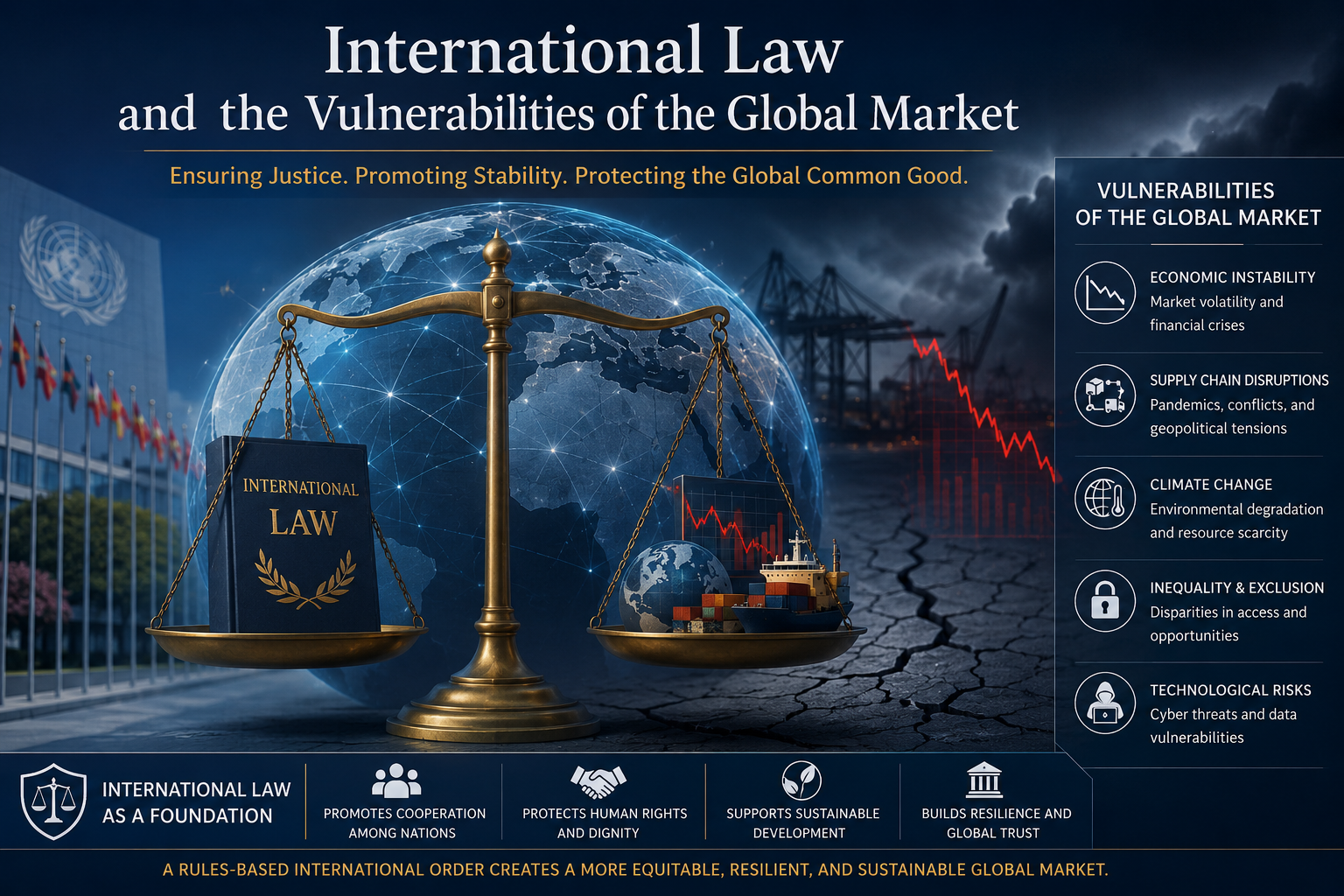
The foundational promise of postwar international economic law was straightforward: establish a rules-based order, and predictable markets would generate shared global prosperity. For decades, multilateral institutions—anchored by the World Trade Organization (WTO), the International Monetary Fund (IMF), and an expansive network of Bilateral Investment Treaties (BITs)—functioned as stabilizing mechanisms for global capital and cross-border trade. Yet the contemporary world economy is increasingly defined not by seamless integration, but by structural fragmentation, geopolitical rivalry, volatile supply chains, and re-surging economic nationalism.
As global markets become more vulnerable to political shocks and strategic competition, international legal frameworks are struggling to adapt. Rather than operating as neutral arbiters of trade and investment, these institutions are increasingly transformed into arenas of geopolitical contestation.
Geopolitical Power and the Global Economy
The global economy is often portrayed as a system governed primarily by trade law, market liberalization, and international cooperation. In practice, however, power politics continues to shape economic outcomes far more profoundly than legal idealism frequently acknowledges. Economic sanctions, military interventions, control over strategic resources, and dominance over global financial infrastructure have become central instruments of international influence.
One of the clearest examples is the structural dominance of the United States within the dollar-based global financial system. Since a significant portion of international trade, energy transactions, and sovereign reserves are denominated in U.S. dollars, Washington possesses extraordinary leverage over the global economy. States perceived as challenging American strategic interests can face sanctions, restrictions on banking access, limitations on dollar settlements, and exclusion from critical financial networks. This financial centrality extends American influence far beyond conventional territorial boundaries.
India itself experienced the coercive dimension of economic policy following the 1998 Pokhran nuclear tests, when the United States imposed sanctions under its non-proliferation framework. Although India ultimately absorbed these pressures and later developed stronger strategic relations with the United States, the episode illustrated how economic instruments can be mobilized to discipline sovereign states.
Similarly, Iran has endured decades of comprehensive sanctions affecting its banking sector, oil exports, trade networks, and broader economic stability. The Iranian case demonstrates how sanctions can evolve from temporary diplomatic measures into long-term geopolitical instruments aimed at strategic containment.
Energy politics further intensifies these tensions. Oil-rich regions frequently become focal points of international intervention, proxy conflicts, and political destabilization. Critics argue that major powers often seek to influence resource-rich states either directly through military intervention or indirectly through regime pressure, economic dependency, and geopolitical alignment.
At the same time, recent developments indicate that American financial dominance is no longer entirely uncontested. China, Russia, India, and several BRICS members have increasingly explored alternatives to dollar-centric trade mechanisms through local currency settlements, regional payment systems, and efforts toward financial multipolarity. Although the dollar remains dominant, these developments reflect growing dissatisfaction with the concentration of monetary power within a single state.
The Iranian experience also reveals the limitations of conventional coercive power. Despite decades of sanctions and diplomatic isolation, Iran has retained significant regional influence and strategic resilience. This underscores the broader reality that modern geopolitical conflicts cannot be resolved solely through economic pressure or military superiority.
Consequently, the modern global economy cannot be understood exclusively through the lens of trade agreements or free-market theory. Military capability, sanctions regimes, energy security, technological control, and financial infrastructure collectively shape contemporary global power structures.
The Weaponization of Economic Law
Perhaps the most significant transformation in the contemporary economic order is the shift from multilateral cooperation toward unilateral economic coercion. Trade law and international financial architecture are increasingly weaponized through sanctions, export controls, investment restrictions, and industrial policy measures justified under national security exceptions.
Provisions once treated as extraordinary safeguards are now routinely invoked to justify strategic economic interventions. This legal transformation generates severe structural uncertainty. When dominant economies bypass multilateral dispute resolution mechanisms in pursuit of domestic strategic objectives, the predictability required for stable global investment begins to erode.
For developing nations, this evolution fundamentally alters the purpose of international law. Rather than functioning as a safeguard against “might-makes-right” economic behavior, international legal systems increasingly risk legitimizing asymmetrical power structures that favor advanced economies capable of exerting financial and technological pressure on weaker states.
Tech Hegemony and the Regulation of the Borderless Economy
Simultaneously, traditional legal frameworks are struggling to govern the rise of the digital economy. International trade law was designed primarily for tangible goods crossing physical borders. Today, however, global economic value is increasingly concentrated in data flows, artificial intelligence, digital infrastructure, and proprietary technological ecosystems.
This transformation presents two major legal challenges.
- Jurisdictional Fragmentation
As transnational technology corporations consolidate unprecedented market power, sovereign states are adopting fragmented regulatory approaches involving anti-monopoly laws, data localization requirements, digital taxation, and AI governance frameworks. The absence of harmonized standards creates jurisdictional conflict and regulatory fragmentation, undermining the coherence of global digital commerce.
- Knowledge Monopolies
Intellectual property regimes, particularly those reinforced through agreements such as the Agreement on Trade-Related Aspects of Intellectual Property Rights (TRIPS), often entrench technological asymmetries between advanced and developing economies. By strengthening patent protections and restricting technology transfers, these frameworks enable multinational corporations to preserve technological dominance while limiting industrial upgrading within the Global South.
As a result, international economic law risks institutionalizing a persistent knowledge hierarchy in which innovation remains concentrated within technologically advanced states while developing economies remain structurally dependent on foreign intellectual capital.
The Green Transition and the Rise of New Protectionism
One of the most volatile intersections between law and macroeconomics now emerges within the global climate transition. In pursuit of decarbonization targets, advanced economies have introduced expansive industrial policies involving green subsidies, carbon border adjustment mechanisms, and strategic clean-energy investment programs.
Although environmentally necessary, these measures increasingly conflict with core WTO principles of non-discrimination and competitive neutrality. Domestic subsidies favoring national clean-tech industries distort international competition, while carbon tariffs risk functioning as neo-protectionist barriers that disproportionately burden developing economies lacking the financial capacity to rapidly transition toward green infrastructure.
International law therefore confronts a profound contradiction. It must either preserve rigid trade disciplines that may inhibit urgent climate action, or accommodate unilateral environmental policies that fragment the global trading system and intensify economic inequality.
Re-imagining Stability in a Fragmented Order
International economic law is not fracturing because it lacks enforcement mechanisms; rather, it is destabilizing because its foundational architecture prioritizes systemic capital stability over equitable global resilience. The paralysis of the WTO Appellate Body symbolizes this broader institutional crisis—revealing a global order in which dominant states increasingly resist legal constraints when those constraints conflict with geopolitical strategy.
For the international legal system to remain viable within an increasingly vulnerable global economy, it must evolve beyond the assumptions of hyper-globalization. Genuine structural stability cannot be achieved merely by reinforcing the dominance of advanced economies. Instead, legal frameworks must accommodate industrial flexibility, equitable technology access, resilient supply chains, and enforceable labor and environmental protections.
Without such reforms, international economic law risks ceasing to function as a stabilizing framework for global cooperation. It may instead become a mechanism that formalizes and perpetuates global economic stratification within an increasingly fragmented international order.
Conclusion
The contemporary global economy reveals a fundamental contradiction at the heart of international economic law. While the postwar legal order was constructed on ideals of neutrality, interdependence, and rules-based cooperation, the realities of modern geopolitics demonstrate that economic systems remain deeply intertwined with strategic power. Sanctions, financial dominance, technological monopolies, resource competition, and industrial protectionism increasingly shape global economic relations alongside—and often above—formal legal commitments.
The vulnerabilities exposed by geopolitical conflict, supply-chain disruptions, digital fragmentation, and climate transition pressures indicate that the existing architecture of international law is undergoing a profound transformation. Institutions designed to manage liberal globalization now face mounting pressure from states prioritizing strategic autonomy, economic security, and geopolitical influence over multilateral consensus.
At the same time, the growing resistance to concentrated financial and technological power signals the emergence of a more fragmented and multipolar international order. Developing nations are increasingly demanding greater flexibility within trade regimes, fairer access to technology, and a more equitable distribution of economic power. These demands challenge the structural asymmetries embedded within existing legal and financial systems.
Ultimately, the future legitimacy of international economic law will depend not merely on its ability to facilitate trade, but on its capacity to reconcile economic integration with sovereignty, development, and global equity. If international legal frameworks continue to privilege geopolitical and corporate dominance over inclusive resilience, they risk accelerating instability rather than preventing it. However, if reformed toward greater fairness, adaptability, and shared responsibility, international economic law may still serve as a meaningful foundation for cooperation within an increasingly uncertain global economy.
SHRUTI DESAI
14th May 2026

Post a comment