
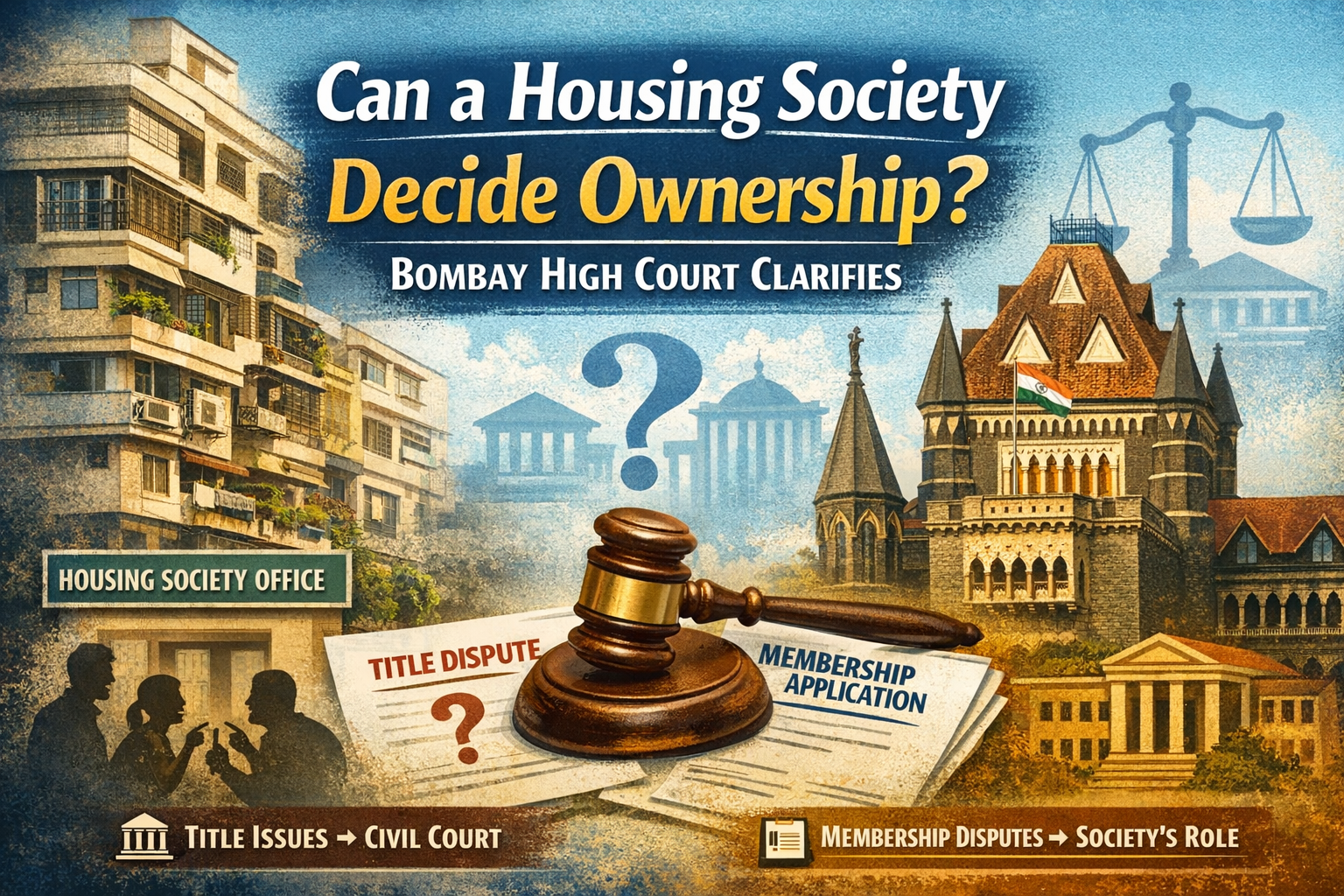
STOP PLAYING JUDGE: HOUSING SOCIETIES CANNOT DECIDE TITLE
An interesting case came up before the Bombay High Court, where aforesaid issue was argued and decided.
Facts of the case are as under:
The dispute concerns ownership of Flat No. 31 in a Malad housing society in Mumbai. The flat was purchased around 1969–70 by Ramlal Dhanuka using his own funds but was registered jointly in his name and Pannadevi (wife of his son D. R. Dhanuka).
Ramlal had three sons—D. R. Dhanuka, K. R. Dhanuka, and Radheshyam Dhanuka (Respondent No. 4)—who later occupied different flats bought by him. After Ramlal and his wife died in 1989, the sons became legal heirs.
In 2007, Pannadevi filed a suit claiming exclusive ownership of the disputed flat and denying any rights of Radheshyam. She died in 2008, and her legal heirs continued the case.
Meanwhile, an order was passed restraining the housing society from transferring or dealing with the flat’s membership rights until the suit is decided.
Core issue: Whether the flat belongs exclusively to Pannadevi or forms part of the family property.
Now let us see the arguments of the Petitioner:
the Society argued that Respondent No. 4 wrongly applied for transfer of membership instead of transmission after the member’s death and failed to follow mandatory procedures under Bye-Law 35, including public notice and verification of legal heirs, while also submitting an incomplete application. It also argued that there are disputes among heirs; society further contended that the Divisional Joint Registrar lacked jurisdiction to hear a revision against the Deputy Registrar’s order, but the Court rejected this, holding that cooperative societies only perform limited administrative roles (not deciding ownership, as noted in Usha Jhaveri vs State of Maharashtra) and that revisional authority remains valid despite delegation of powers, thereby upholding the legality of such review.
Respondent member argued that:
After the earlier suit concerning the flat was unconditionally withdrawn in 2012, clearing disputes over title, Respondent No. 4 applied for membership as a legal heir, but the society failed to decide his application, leading him to seek deemed membership and later file a revision; he argued that the society had effectively recognized him by accepting maintenance charges and that minor defects in the application form should not defeat his substantive claim of succession, while also relying on lack of opposition from key family members, whereas the petitioners contended that multiple heirs existed and the application was invalid due to incorrect form and procedure; the Court, however, emphasized that substance prevails over form, held that the application was essentially for transmission based on inheritance despite technical errors, found that the alleged disputes among heirs were not strong enough to justify inaction, and rejected the jurisdictional objection, thereby supporting the validity of the revisional proceedings and Respondent No. 4’s claim being considered.
It was held by the Bombay High Court that:
the dispute before the society was not about ownership/title, but merely about recognition of membership after the death of a member, making it an issue of internal administration rather than adjudication of property rights. It emphasized that Section 30 of the Maharashtra Cooperative Societies Act applies where claims arise through inheritance, requiring the society to make only a prima facie administrative determination of who appears to be the legal heir. The society’s role is limited to assessing whether the claimant has a plausible connection to the deceased, whether objections exist, and whether basic requirements are met, and once satisfied, it must process the claim without delving into complex title disputes.
Comments:
Committee takes wide powers in their hands. Usually, they use those powers to harass or scoring personal vendetta or interest. Nowadays redevelopment is a brand concept, the committee block votes which are not favourable to them. In this case family is big. But where there is only widow left, they force them to sell at a discounted rate.
It was suggested by the writer of this blog to the Ministry of Cooperation that a Centralised Body like NSDL is needed to manage transfer and transmission of shares of Co-operative Society. The said blogs are also here on the website.
SHRUTI DESAI
21st April 2026

Post a comment