

The Expanding Definition of “Promoter”: Impact on Landowners’ Rights. Need for parliamentary intervention?
NEED FOR AUTHORITATIVE CLARIFICATION BY THE BOMBAY HIGH COURT ON THE SCOPE OF SECTION 11 OF MOFA: GERALD MICHAEL MISQUITTA AND ROHINI GUPTA Gerald Michael Misquitta Vs State of Maharashtra ( “Gerald” ) Rohini Gupta & Anr. v. District Deputy Registrar, Co-operative Societies & Ors., WP No. 5991/2026, Bombay High Court, decided 8 September 2026, in which Mohini Gupta is the second petitioner. Indian Kanoon ( “Gupta” ) The two cases are quite closely connected because both concern Section 11 of MOFA, deemed conveyance, landowners/lessees, and the powers of the District Deputy Registrar (DDR). But there is an important difference: Gerald Misquitta is primarily a procedural/natural-justice case, whereas Gupta is substantially a Section 2(c)/Section 11 substantive-promoter case. Basic facts — side-by-side Sr No Particulars Gerald Michael Misquitta v. State of Maharashtra Rohini Gupta & Anr. v. DDR3 1 Court Bombay High Court Bombay High Court 2 Judgment date 25 Feb 2026 8 Sept 2026 3 Petition WP 1739/2022 WP 5991/2026 4 Ownership Misquitta family property, Vile Parle West Gupta family property, Juhu 5 Original owners Multiple Misquitta co-owners Late Kundanlal Laxmichand Gupta; petitioners were his heirs 6 Developer/lessee structure Owners → Rahejas → A.K. Associates/sub-lessee Owner → Raheja/Wadhwa lessees → developers 7 Society Name Priya Co-operative Housing Society Queens Park Premises Co-operative Society 8 Lease 98-year lease 98-year lease 9 Earlier transfer to society Society claimed/received only leasehold-related rights Society already received assignment of leasehold rights in 1978 10 DDR order 28 May 2014 23 June 2025 11 Main challenge Owners were not properly impleaded/heard; DDR did not conduct required enquiry Whether landowners themselves became “promoters” under MOFA Result DDR order + conveyance quashed and remanded Petition dismissed; DDR order upheld The Misquitta judgment records that the property was owned by several co-owners and that the society’s deemed-conveyance application proceeded without impleading all of them. Indian Kanoon The Gupta judgment records a 98-year lease from Kundanlal Gupta and subsequent construction of Queens Park by the lessees/developers. Indian Kanoon Paragraph-wise comparison This is the more useful way to read the judgments. Para 1–3 — What is being challenged? Gerald — paras 1–3 The petitioner challenged the DDR’s 28 May 2014 certificate permitting unilateral deemed conveyance and the subsequent registered deed of assignment/transfer dated 5 July 2014. The important factual feature was that the petitioner claimed to be a co-owner, but was not properly made a party to the deemed-conveyance proceedings. Indian Kanoon Gupta — paras 1–4 The petitioners were the legal heirs of the original landowner. They challenged the DDR’s order dated 23 June 2025 granting unilateral deemed conveyance of approximately 3,901.70 sq.m. to Queens Park Society. The Gupta petitioners said that their father had died in 1981 and that the DDR had proceeded on a notice issued in his name. Indian Kanoon Difference In Gerald, the central problem was: “Were all persons whose rights were affected actually heard?” In Gupta, the central question became: “Were these landowners themselves promoters under Section 2(c) MOFA?” Paragraphs 10–15 — Meaning of “promoter” This is the most important substantive difference. Gerald The Court did not finally determine the title/promoter controversy because […]
Read more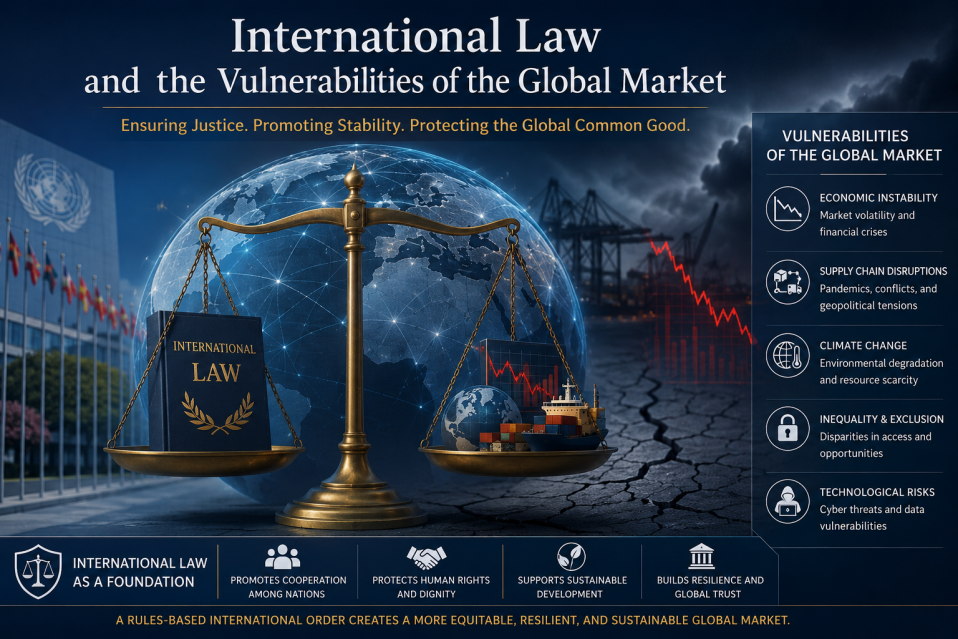
International Law and the Vulnerabilities of the Global Market
The foundational promise of postwar international economic law was straightforward: establish a rules-based order, and predictable markets would generate shared global prosperity. For decades, multilateral institutions—anchored by the World Trade Organization (WTO), the International Monetary Fund (IMF), and an expansive network of Bilateral Investment Treaties (BITs)—functioned as stabilizing mechanisms for global capital and cross-border trade. Yet the contemporary world economy is increasingly defined not by seamless integration, but by structural fragmentation, geopolitical rivalry, volatile supply chains, and re-surging economic nationalism. As global markets become more vulnerable to political shocks and strategic competition, international legal frameworks are struggling to adapt. Rather than operating as neutral arbiters of trade and investment, these institutions are increasingly transformed into arenas of geopolitical contestation. Geopolitical Power and the Global Economy The global economy is often portrayed as a system governed primarily by trade law, market liberalization, and international cooperation. In practice, however, power politics continues to shape economic outcomes far more profoundly than legal idealism frequently acknowledges. Economic sanctions, military interventions, control over strategic resources, and dominance over global financial infrastructure have become central instruments of international influence. One of the clearest examples is the structural dominance of the United States within the dollar-based global financial system. Since a significant portion of international trade, energy transactions, and sovereign reserves are denominated in U.S. dollars, Washington possesses extraordinary leverage over the global economy. States perceived as challenging American strategic interests can face sanctions, restrictions on banking access, limitations on dollar settlements, and exclusion from critical financial networks. This financial centrality extends American influence far beyond conventional territorial boundaries. India itself experienced the coercive dimension of economic policy following the 1998 Pokhran nuclear tests, when the United States imposed sanctions under its non-proliferation framework. Although India ultimately absorbed these pressures and later developed stronger strategic relations with the United States, the episode illustrated how economic instruments can be mobilized to discipline sovereign states. Similarly, Iran has endured decades of comprehensive sanctions affecting its banking sector, oil exports, trade networks, and broader economic stability. The Iranian case demonstrates how sanctions can evolve from temporary diplomatic measures into long-term geopolitical instruments aimed at strategic containment. Energy politics further intensifies these tensions. Oil-rich regions frequently become focal points of international intervention, proxy conflicts, and political destabilization. Critics argue that major powers often seek to influence resource-rich states either directly through military intervention or indirectly through regime pressure, economic dependency, and geopolitical alignment. At the same time, recent developments indicate that American financial dominance is no longer entirely uncontested. China, Russia, India, and several BRICS members have increasingly explored alternatives to dollar-centric trade mechanisms through local currency settlements, regional payment systems, and efforts toward financial multipolarity. Although the dollar remains dominant, these developments reflect growing dissatisfaction with the concentration of monetary power within a single state. The Iranian experience also reveals the limitations of conventional coercive power. Despite decades of sanctions and diplomatic isolation, Iran has retained significant regional influence and strategic resilience. This underscores the broader reality that modern geopolitical conflicts cannot be resolved solely through economic pressure or military superiority. Consequently, the modern global economy cannot be understood exclusively […]
Read more
“Can Sons Restrain a Mother from Transferring Property? A Legal Analysis under Hindu Law”
CAN SONS FILE SUIT AGAINST MOTHER (HINDU) FOR STAY AGAINST TRANSFER OF SHARES / PROPERTY HELD BY MOTHER IN A FAMILY PROPERTY/ PRIVATE COMPANY ABSOLUTELY TO DAUGHTER? Hindu law prohibits dowry. But dowry is given in one form or another. Hindu Law after 2004 amendment gave equal right to married daughter in father’s property. View of Author Equal property rights for married daughters are an important step toward fairness and gender equality. However, in some families this can also create tensions in relationships. After marriage, daughters may be influenced by their husband or in-laws, and when disputes over property arise, disagreements can escalate into legal battles or serious family conflicts. While the intention behind laws like the Hindu Succession (Amendment) Act, 2005 is to ensure justice and equal rights, the practical implementation sometimes leads to strained family ties when expectations about property are unclear or contested. In such situations, disagreements over inheritance may even end up in court or cause long-lasting rifts within families. Therefore, along with legal equality, maintaining open communication, clear property planning, and mutual understanding within families is important to prevent conflicts and preserve relationships. Law makers must prevent this situation resulting into strained relationships. Broken relations makes society psychologically weaker. Continue… with article… Let us see Section 14 of the Hindu Succession Act 1956. Property of a female Hindu to be her absolute property.―(1)Any property possessed by a female Hindu, whether acquired before or after the commencement of this Act, shall be held by her as full owner thereof and not as a limited owner. Explanation.―In this sub-section, “property” includes both movable and immovable property acquired by a female Hindu by inheritance or devise, or at a partition, or in lieu of maintenance or arrears of maintenance, or by gift from any person, whether a relative or not, before, at or after her marriage, or by her own skill or exertion, or by purchase or by prescription, or in any other manner whatsoever, and also any such property held by her as stridhana immediately before the commencement of this Act. (2) Nothing contained in sub-section (1) shall apply to any property acquired by way of gift or under a will or any other instrument or under a decree or order of a civil court or under an award where the terms of the gift, will or other instrument or the decree, order or award prescribe a restricted estate in such property. If the shares are the mother’s self-acquired property (bought by her or gifted to her), she has absolute authority to transfer them to anyone she wishes, and the sons have no legal standing to stop her during her lifetime. Section 5 of the said Act provides for exception: Act not to apply to certain properties. ―This Act shall not apply to― (i) any property succession to which is regulated by the Indian Succession Act, 1925 ( 39 of 1925), by reason of the provisions contained in section 21 of the Special Marriage Act, 1954 (43 of 1954); (ii) any estate which descends to a single heir by the terms of any covenant or agreement entered […]
Read more
India’s Emerging AI Hub
Vizag: India’s Emerging Metro City of Opportunity Narendra Modi, the Prime Minister of India, recently inaugurated the world’s largest AI Impact Summit, attended by global leaders in artificial intelligence and advanced technologies. The summit highlighted India’s growing leadership in AI, semiconductors, and high-performance computing. Among India’s rising technology hubs, Visakhapatnam (Vizag) is rapidly transforming into a global center for artificial intelligence and data infrastructure. 🌐 Vizag’s Transformation into a Global Data City Located in Andhra Pradesh, Vizag is emerging as one of the world’s largest AI data center hubs, driven by an estimated $15 billion investment from Google and other major industry leaders. This ambitious “Data City” initiative aims to build more than 2.5 GW+ of digital infrastructure capacity, positioning Vizag as a cornerstone of India’s digital economy. 🔹 Key Partners and Investments Google Developing its largest AI data center outside the United States in Vizag. AdaniConnex A joint venture between Adani Enterprises and EdgeConneX, focused on creating a 1GW+ AI-driven data center ecosystem. Reliance–BrookfieldPlatform A collaboration between Reliance Industries and Brookfield Asset Management, contributing to large-scale infrastructure development. 📍 Location and Scope Project Area: Madhurawada–Kapuluppada corridor Land Area: ~500 acres Purpose: Dedicated technology and data center cluster This region is being developed as a future-ready digital and innovation zone. ⚡ Capacity, Timeline, and Vision Target Capacity: 2.5 GW+ Implementation Period: 2026–2030 Goal: Establish Vizag as a leading global AI and cloud computing hub The initiative will significantly strengthen India’s digital sovereignty and computing capabilities. 🌱 Advanced Features Integration of renewable and green energy systems Subsea cable landing stations for global connectivity High-performance AI and machine learning infrastructure Smart grid and cooling technologies These features ensure sustainability and global competitiveness. 👩💼 Economic and Employment Impact Creation of thousands of direct and indirect jobs Growth in IT services, construction, logistics, and support industries Boost to local entrepreneurship and skill development Increased foreign direct investment Vizag is set to become a major employment and innovation hub for the region. 🌍 Global Competitiveness With these developments, Vizag is positioning itself to compete with established global data center clusters such as Northern Virginia, one of the world’s largest digital infrastructure hubs. 🚀 Conclusion The Vizag Data City initiative represents a landmark step in India’s journey toward technological leadership. Backed by global corporations, strong government support, and sustainable infrastructure, Visakhapatnam is poised to become: Shruti Desai 17th February 2026
Read more
Digital Euro Initiative: Modernizing Payments and Ensuring Monetary Sovereignty in Europe
Digital Euro Initiative: Modernizing Payments and Ensuring Monetary Sovereignty in Europe European Central Bank (ECB) is driving the digital euro initiative to modernize payments, ensure monetary sovereignty, and complement, not replace, cash. Following completed technical preparations, the project entered a two-year preparation phase in November 2023. A potential rollout is targeted for 2029, with pilot projects expected in 2027 pending legislative approval. Overview • On 28 June, the European Commission proposed legislation to create a legal framework for a digital euro. • The digital euro would be a central bank–issued digital currency designed to complement cash. • It aims to strengthen European retail payments and support the euro’s international role. Objectives • Maintain public access to central bank money in a digital economy. • Respond to declining cash use. • Promote financial inclusion, competition, and innovation. • Enable payments where cash cannot be used, such as online. Relationship with Cash • The digital euro will not replace physical cash. • It is meant to coexist with banknotes and coins. • A parallel proposal protects cash’s legal tender status and accessibility. • Users remain free to choose their payment method. Regulatory Framework • The draft regulation covers: o Legal tender status o Privacy and data protection o Anti-money laundering rules o Distribution and access o Financial stability o International use • The framework is “enabling,” setting core rules without fixing final design details. Digital Euro vs. Bank Deposits • Digital euro: o Issued by the ECB o Liability of the central bank o Similar in nature to cash • Bank account money: o Issued by commercial banks o Private-sector liability • The digital euro may allow offline, proximity payments. Access and User Services • Provided through banks and authorized payment providers. • Alternatives available for people without bank accounts. • Users can switch providers. • Basic services for individuals are free, including: o Account management o Balance checks o Funding and withdrawals o Transfers and payments Privacy Protections • User data handled by service providers, not the ECB. • The ECB will not see users’ identities. • Offline payments offer privacy similar to cash. Holding Limits • Limits may be set to: o Protect monetary and financial stability o Prevent money laundering o Fight terrorism financing Programmability • No automatic restrictions on how money is spent. • Users control how they use their funds. • Conditional payments are possible. Legislative Process and Next Steps • The proposal follows extensive consultations. • It requires approval by the European Parliament and Council. • After adoption, the ECB will decide: o Whether to issue the digital euro o When to launch it o Which design features to adopt Complementary Measures • A separate proposal ensures continued access to cash. • Together, both initiatives aim to guarantee reliable access to public money in all forms. Website: https://www.ecb.europa.eu/euro/digital_euro/html/index.en.html #prof Key aspects of the digital euro : • Strategic Priority: Aimed at strengthening Europe’s financial independence amidst rising private digital currencies and foreign payment solutions. • Key Features: Designed to be a free-of-charge, secure, and instant method for both online and offline payments across the euro area. […]
Read more
Monetary Power in the 21st Century: Theories, and The Rise and Resilience of the Dollar
Monetary Power in the 21st Century: Theories and The Rise and Resilience of the Dollar Printing more dollars hits the US economy hard because it increases the money supply without a corresponding increase in the actual goods and services produced, leading to devaluation and higher prices When the Federal Reserve prints money (or creates it digitally through quantitative easing), it devalues the existing currency, which reduces purchasing power and causes inflation. Here is how printing money hurts the economy: High Inflation: When more money chases the same amount of goods, prices for everyday items rise, as demonstrated in 2021-2022 when high money supply growth led to sharp inflation. Decreased Purchasing Power: As inflation rises, each dollar buys fewer goods and services. This is particularly harmful to consumers, as their wages and savings no longer stretch as far, reducing their standard of living. Erosion of Savings: Inflation act as a “hidden tax” on cash holders. Those with savings, particularly on fixed incomes, see the real value of their money plummet. Loss of Investor Confidence: Excessive, uncontrolled money printing can lead to a loss of faith in the US dollar. If investors believe the currency will continue to lose value, they may shift to more stable assets, reducing the demand for dollars globally. Currency Devaluation Risk: Persistent printing can cause the dollar to weaken against other currencies, making imports more expensive and contributing to trade imbalances. Increased National Debt: When the government prints money to finance spending, it increases the national debt. As the debt grows, it becomes harder for the government to service its obligations without further debasing the currency. Market Bubbles: The influx of money often flows into stocks and real estate rather than into the productive economy, creating asset price bubbles that can lead to financial instability. While printing money can provide a temporary economic boost during a recession, it can cause significant long-term damage if it becomes an addictive tool for handling debt, with historical cases like Germany in the 1920s and Zimbabwe in the 2000s highlighting how it can destroy an economy. THEORY PROPELLED BY VARIOUS ECONOMIST. The concept of printing currency is a highly debated topic among leading economists. On one side, traditional theory stress the importance of maintaining monetary stability, while more modern perspectives support using debt-financed spending to stimulate the economy. At the heart of this debate is the challenge of finding the right balance between leveraging money creation to boost economic activity and managing the potential risks of inflation Here are the primary theories and the authors associated with them: 1. Modern Monetary Theory (MMT) MMT, which gained prominence in the 2010s, argues that governments that issue their own fiat currency (like the US, UK, Japan, and Canada) are not constrained by revenue when it comes to spending. Therefore, they can, and should, print money to fund public services and maintain full employment. Key Authors/Proponents: Warren Mosler (who authored The 7 Deadly Innocent Frauds of Economic Policy and Soft Currency Economics), Stephanie Kelton (The Deficit Myth), L. Randall Wray, and Bill Mitchell. Core Theory: Sovereign governments cannot go broke and do not need […]
Read more
“DE-DOLLARIZATION: DIVERSIFYING FOR A RESILIENT FUTURE”
“DE-DOLLARIZATION: DIVERSIFYING FOR A RESILIENT FUTURE” De-dollarization refers to the process by which countries, institutions, and companies reduce their reliance on the U.S. dollar in international trade, finance, and reserves. In practical terms, it means: Using other currencies (like the euro, yuan, or local currencies) instead of the dollar for trade and payments Holding fewer U.S. dollars in central bank reserves Issuing debt and pricing commodities in non-dollar currencies Settling financial transactions outside the dollar-based system Key idea: Structural vs. Cyclical Demand Structural demand (long-term) This is about the dollar’s role as the world’s main reserve and transaction currency. It includes: Dominance in foreign exchange markets Use in global commodities (oil, gas, metals) Currency used for international loans and bonds Share of global central bank reserves De-dollarization mainly targets this structural role. If it happens meaningfully, the dollar’s global influence weakens over time. Cyclical demand (short-term) This is driven by economic cycles and market trends, such as: Strong U.S. economic growth High U.S. interest rates Strong stock market performance Global investors seeking “safe assets” Recently, strong U.S. performance (“U.S. exceptionalism”) has increased demand for dollars. Investors hold more USD because U.S. assets looked more attractive. A weaker dollar in the future doesn’t automatically mean de-dollarization. It may just reflect changing market conditions. Why countries pursue de-dollarization? As of early 2026, the USA actively imposes financial and trade sanctions via the Office of Foreign Assets Control (OFAC) and Bureau of Industry and Security (BIS). Key targeted countries include Russia, Iran, Cuba, North Korea, Syria, and Venezuela, aiming to restrict trade, influence behavior, and protect national security. Recent actions involve targeting entities linked to Iran’s energy trade, including firms in India, China, and the UAE. Countries may want to reduce dollar dependence to: Avoid U.S. sanctions and financial pressure Reduce exposure to U.S. monetary policy Increase financial sovereignty Strengthen their own currencies Examples include China, Russia, and some BRICS countries promoting trade in local currencies. BRICS SUMMIT 2024 INDIA’S APPROACH ON THE ISSUE The central bank of India, Reserve Bank of India, erstwhile Governor Shaktikanta Das, stated in December 2024 that dedollarization for India was only a part of “derisking” Indian trade and reducing dependence on any one currency since that may become “problematic”. While a BRICS currency had been raised by a member state, nothing specific was decided. He also compared the Euro and stated how nations in Euro countries are located in proximity, while that is not the case with BRICS.This was in response to a question about President-elect Trump warning about tariffs. Former ambassador D. Bala Venkatesh Varma, in an interview with the think tank India Foundation, states that India’s stance in BRICS is “pro-India” and “claiming that BRICS is dominated by China is an exaggeration”. ( wikipedia) US Gold Reserves: Stability, Not Decline US gold reserves have remained unchanged for decades, currently at 8,133.46 tonnes (about $11.041 billion at official valuation). The US remains the world’s largest official holder of gold, accounting for over a quarter of global central bank gold reserves. While the US gold stock is stable, other countries—especially China, Russia, and several emerging markets—have accelerated […]
Read more