
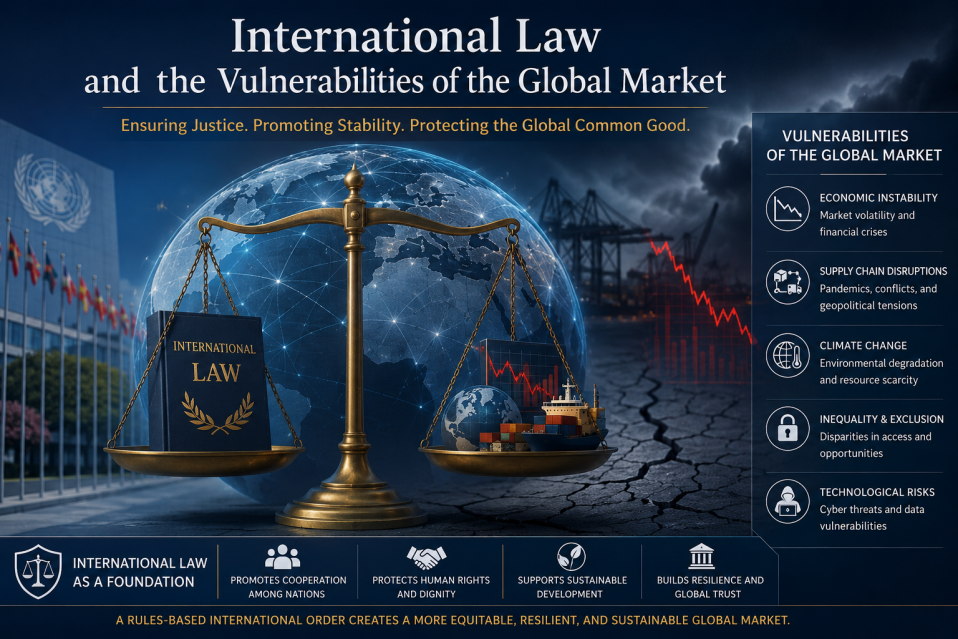
International Law and the Vulnerabilities of the Global Market
The foundational promise of postwar international economic law was straightforward: establish a rules-based order, and predictable markets would generate shared global prosperity. For decades, multilateral institutions—anchored by the World Trade Organization (WTO), the International Monetary Fund (IMF), and an expansive network of Bilateral Investment Treaties (BITs)—functioned as stabilizing mechanisms for global capital and cross-border trade. Yet the contemporary world economy is increasingly defined not by seamless integration, but by structural fragmentation, geopolitical rivalry, volatile supply chains, and re-surging economic nationalism. As global markets become more vulnerable to political shocks and strategic competition, international legal frameworks are struggling to adapt. Rather than operating as neutral arbiters of trade and investment, these institutions are increasingly transformed into arenas of geopolitical contestation. Geopolitical Power and the Global Economy The global economy is often portrayed as a system governed primarily by trade law, market liberalization, and international cooperation. In practice, however, power politics continues to shape economic outcomes far more profoundly than legal idealism frequently acknowledges. Economic sanctions, military interventions, control over strategic resources, and dominance over global financial infrastructure have become central instruments of international influence. One of the clearest examples is the structural dominance of the United States within the dollar-based global financial system. Since a significant portion of international trade, energy transactions, and sovereign reserves are denominated in U.S. dollars, Washington possesses extraordinary leverage over the global economy. States perceived as challenging American strategic interests can face sanctions, restrictions on banking access, limitations on dollar settlements, and exclusion from critical financial networks. This financial centrality extends American influence far beyond conventional territorial boundaries. India itself experienced the coercive dimension of economic policy following the 1998 Pokhran nuclear tests, when the United States imposed sanctions under its non-proliferation framework. Although India ultimately absorbed these pressures and later developed stronger strategic relations with the United States, the episode illustrated how economic instruments can be mobilized to discipline sovereign states. Similarly, Iran has endured decades of comprehensive sanctions affecting its banking sector, oil exports, trade networks, and broader economic stability. The Iranian case demonstrates how sanctions can evolve from temporary diplomatic measures into long-term geopolitical instruments aimed at strategic containment. Energy politics further intensifies these tensions. Oil-rich regions frequently become focal points of international intervention, proxy conflicts, and political destabilization. Critics argue that major powers often seek to influence resource-rich states either directly through military intervention or indirectly through regime pressure, economic dependency, and geopolitical alignment. At the same time, recent developments indicate that American financial dominance is no longer entirely uncontested. China, Russia, India, and several BRICS members have increasingly explored alternatives to dollar-centric trade mechanisms through local currency settlements, regional payment systems, and efforts toward financial multipolarity. Although the dollar remains dominant, these developments reflect growing dissatisfaction with the concentration of monetary power within a single state. The Iranian experience also reveals the limitations of conventional coercive power. Despite decades of sanctions and diplomatic isolation, Iran has retained significant regional influence and strategic resilience. This underscores the broader reality that modern geopolitical conflicts cannot be resolved solely through economic pressure or military superiority. Consequently, the modern global economy cannot be understood exclusively […]
Read more
India’s Emerging AI Hub
Vizag: India’s Emerging Metro City of Opportunity Narendra Modi, the Prime Minister of India, recently inaugurated the world’s largest AI Impact Summit, attended by global leaders in artificial intelligence and advanced technologies. The summit highlighted India’s growing leadership in AI, semiconductors, and high-performance computing. Among India’s rising technology hubs, Visakhapatnam (Vizag) is rapidly transforming into a global center for artificial intelligence and data infrastructure. 🌐 Vizag’s Transformation into a Global Data City Located in Andhra Pradesh, Vizag is emerging as one of the world’s largest AI data center hubs, driven by an estimated $15 billion investment from Google and other major industry leaders. This ambitious “Data City” initiative aims to build more than 2.5 GW+ of digital infrastructure capacity, positioning Vizag as a cornerstone of India’s digital economy. 🔹 Key Partners and Investments Google Developing its largest AI data center outside the United States in Vizag. AdaniConnex A joint venture between Adani Enterprises and EdgeConneX, focused on creating a 1GW+ AI-driven data center ecosystem. Reliance–BrookfieldPlatform A collaboration between Reliance Industries and Brookfield Asset Management, contributing to large-scale infrastructure development. 📍 Location and Scope Project Area: Madhurawada–Kapuluppada corridor Land Area: ~500 acres Purpose: Dedicated technology and data center cluster This region is being developed as a future-ready digital and innovation zone. ⚡ Capacity, Timeline, and Vision Target Capacity: 2.5 GW+ Implementation Period: 2026–2030 Goal: Establish Vizag as a leading global AI and cloud computing hub The initiative will significantly strengthen India’s digital sovereignty and computing capabilities. 🌱 Advanced Features Integration of renewable and green energy systems Subsea cable landing stations for global connectivity High-performance AI and machine learning infrastructure Smart grid and cooling technologies These features ensure sustainability and global competitiveness. 👩💼 Economic and Employment Impact Creation of thousands of direct and indirect jobs Growth in IT services, construction, logistics, and support industries Boost to local entrepreneurship and skill development Increased foreign direct investment Vizag is set to become a major employment and innovation hub for the region. 🌍 Global Competitiveness With these developments, Vizag is positioning itself to compete with established global data center clusters such as Northern Virginia, one of the world’s largest digital infrastructure hubs. 🚀 Conclusion The Vizag Data City initiative represents a landmark step in India’s journey toward technological leadership. Backed by global corporations, strong government support, and sustainable infrastructure, Visakhapatnam is poised to become: Shruti Desai 17th February 2026
Read more
From Demonetisation to Digital Currency: How India Led the Global Shift Toward Sovereign Digital Money
From Demonetisation to Digital Currency: How India Led the Global Shift Toward Sovereign Digital Money India is a visionary nation. India had a serious problem of terrorism and funding terrorism through fake currency notes. India, to abate terrorism, opted for demonetisation on 8th November 2016. India introduced digital payment platforms simultaneously. We now have Bharat Pay, G Pay and even every bank has started their UPI. India has shown the world the path towards a digital world. Now, the west side of the globe is following India’s footsteps. USA PASSES LAW OF REGULATORY FRAMEWORK OF DIGITAL CURRENCY: The Guiding and Establishing National Innovation for U.S. Stablecoins (GENIUS) Act, signed into law in July 2025, establishes the first comprehensive federal regulatory framework for payment stablecoins in the United States. It mandates 100% reserve backing, strict, liquidity requirements, and brings issuers under Bank Secrecy Act (BSA) compliance. Key Aspects of the GENIUS Act (2025-2026): Purpose: To foster innovation in digital assets while protecting consumers and ensuring financial stability. Reserve Requirements: Requires stablecoins to be backed 1:1 by high-quality, liquid assets, such as U.S. dollars or short-term Treasury bills. Issuer Regulation: Only permitted issuers can create payment stablecoins; they must adhere to capital and risk management rules. Consumer Protection: Guarantees redemption rights for stablecoin holders and mandates public disclosures of reserves. Compliance: Subjects issuers to anti-money laundering (AML), countering the financing of terrorism (CFT), and sanction requirements. International Scope: Foreign issuers targeting U.S. users are held to the same standards as domestic issuers. The Treasury Department is actively implementing the law, with public comment periods regarding the regulation of these digital assets extending into late 2025 Overview of U.S. Monetary Evolution The U.S. monetary system has undergone major changes, including: Early issuance of private bank and Treasury currencies. Creation of the Federal Reserve in 1914 as the sole currency issuer. Abandonment of gold and silver convertibility after 1933. These shifts were controversial decisions and actions but are now widely accepted. Emergence of Digital Currencies and CBDC Debate Private digital currencies (e.g., Bitcoin) and foreign CBDCs have prompted U.S. policy debates. A Central Bank Digital Currency (CBDC) is the digital form of a nation’s sovereign currency, issued and regulated by the central bank (e.g., RBI’s “Digital Rupee” or e₹). It acts as legal tender, is interchangeable 1:1 with physical cash, and is designed to make transactions faster, cheaper, and more secure. Key Aspects of CBDCs: Types: Divided into Retail (CBDC-R) for public use and Wholesale (CBDC-W) for interbank settlements. Storage: Held in digital wallets provided by banks, offering 24/7 transactions. Global Status: Over 130 countries, representing 98% of global GDP, are exploring or have launched CBDCs, driven by the need for enhanced digital payment efficiency. Digital Currency Vs. Crypto: Unlike cryptocurrencies, CBDCs are centralised, backed by the state, and not volatile. Goals: Reduce cash-handling costs, improve financial inclusion, and increase cross-border payment efficiency. Key questions include: Whether the Federal Reserve should issue a CBDC. Whether a CBDC would fundamentally change the financial system or simply modernise it. USA Congress has held several hearings and proposed multiple CBDC-related bills in recent sessions. Purpose of the […]
Read more