
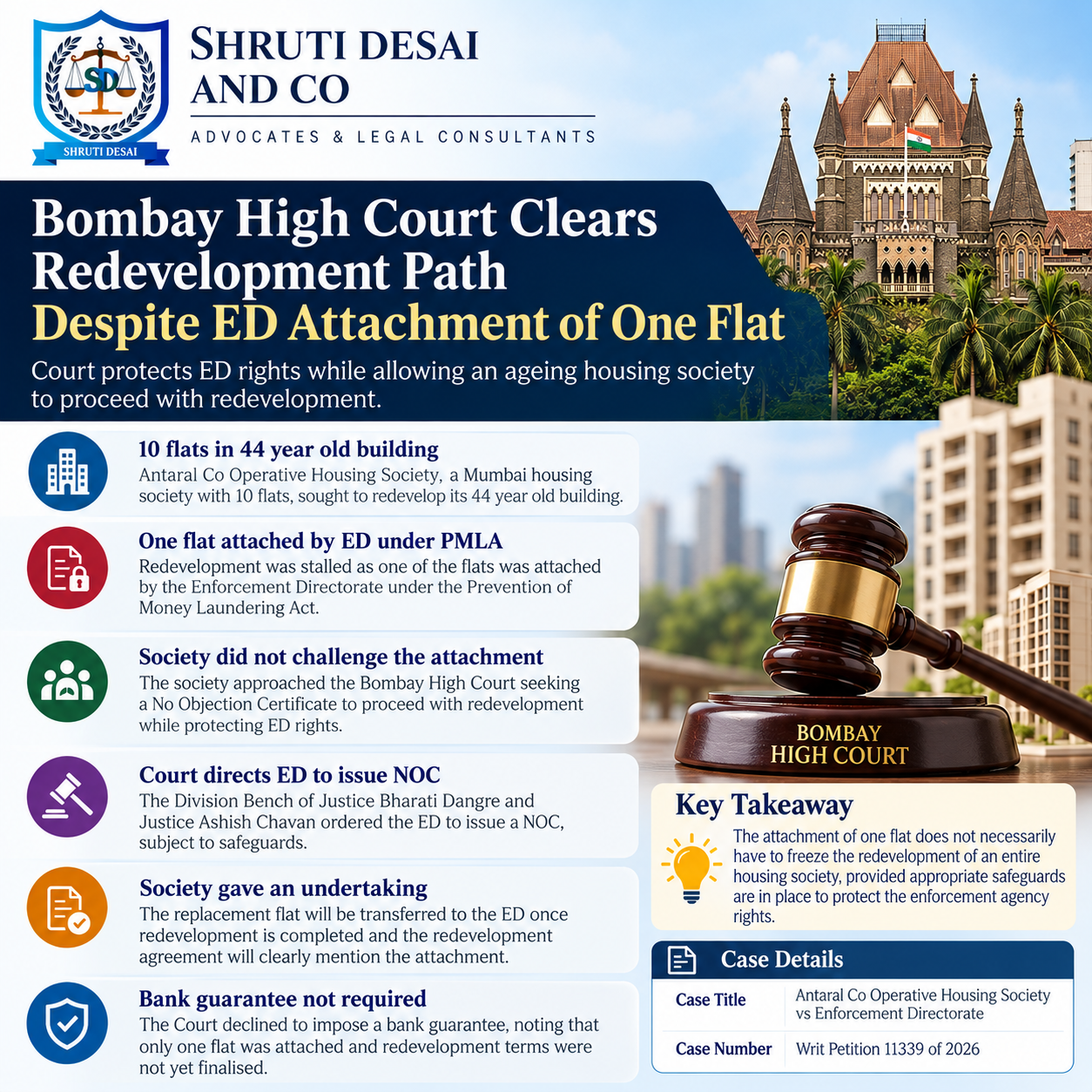
I feel this is one of the best Judgment passed by the Bombay High Court.
It has protected right of Enforcement Department and also protected right of redevelopment of the members of the Society.
Case Title : Antaral Co-Operative Housing Society vs Enforcement DirectorateCase Number : Writ Petition 11339 of 2026
The Bombay High Court has delivered an important ruling for cooperative housing societies facing redevelopment difficulties because one or more flats are subject to attachment proceedings under the Prevention of Money Laundering Act, commonly known as the Prevention of Money Laundering Act.
In a recent order, the Court directed the Enforcement Directorate, commonly known as the ED, to issue a No Objection Certificate to a housing society so that it could proceed with redevelopment of its 44-year-old building, even though one of the ten flats in the building was under attachment by the ED.
The decision shows that the attachment of an individual flat does not necessarily have to bring the redevelopment of an entire housing society to a standstill, provided appropriate safeguards are put in place to protect the rights of the enforcement agency.
Background of the Case
The matter concerned a cooperative housing society consisting of ten flats. The building was more than 44 years old and the society wanted to undertake redevelopment.
The difficulty arose because one of the flats in the building had been attached by the Enforcement Directorate under the PMLA. The attachment was connected with proceedings before a Special Court in Ranchi, Jharkhand.
Since redevelopment would involve demolition of the existing building, the society approached the ED for a No Objection Certificate. The issue was that the attached flat formed part of the building that was proposed to be demolished and reconstructed.
The society therefore approached the Bombay High Court seeking permission to proceed with redevelopment while ensuring that the rights of the ED over the attached property remained protected.
Society Did Not Challenge the Attachment
An important aspect of the matter was that the society was not seeking to challenge or cancel the attachment of the flat.
Instead, the society proposed a mechanism under which the ED would continue to have rights over the property even after redevelopment.
The society gave an undertaking that the replacement flat corresponding to the attached flat would be transferred to the ED once the redevelopment was completed.
The society also agreed that the redevelopment documents would clearly record that the particular flat was subject to attachment pursuant to the order of the Special Court in Ranchi.
Safeguards Offered by the Society
The society offered several safeguards to address the concerns of the ED.
The replacement flat in the redeveloped building would continue to remain subject to the attachment.
The replacement flat would be clearly identified in the redevelopment documents, including its flat number, floor and carpet area.
After completion of redevelopment and receipt of the Occupation Certificate, the replacement flat would be handed over to the authorised officer of the ED.
The redevelopment agreement and the Permanent Alternate Accommodation Agreement would specifically mention the attachment and the rights of the ED.
The monetary benefits relating to the attached flat would also be dealt with in a manner that protected the interests of the ED.
These safeguards allowed the society to proceed with redevelopment without extinguishing or compromising the attachment.
Bombay High Court Directs ED to Issue NOC
The Division Bench comprising Justice Bharati Dangre and Justice Ashish Chavan considered the undertaking given by the society and the safeguards proposed for protecting the interests of the ED.
The Court directed the ED to issue the No Objection Certificate to the society within the stipulated period, subject to compliance with the safeguards provided by the society.
The Court therefore allowed the redevelopment process to move forward while ensuring that the attached property would continue to receive the same protection in the redeveloped building.
The Court also required the attachment to be specifically reflected in the redevelopment documentation.
Bank Guarantee Not Required
Another significant aspect of the matter was the issue of a bank guarantee.
The ED had sought additional financial security in the form of a bank guarantee before the attached flat could be demolished.
The Court did not find it necessary to impose such an additional financial burden on the society.
The Court took into consideration that only one flat was under attachment and that the developer had not yet been appointed and the final redevelopment terms had not yet been settled.
The Court therefore preferred specific contractual and legal safeguards rather than imposing an immediate financial burden on the entire society.
Importance for Housing Societies
The decision may be particularly relevant for old cooperative housing societies in Mumbai and other parts of Maharashtra where redevelopment is necessary but one or more flats are affected by legal proceedings.
The ruling indicates that the existence of an attachment does not automatically mean that redevelopment of the entire building has to remain suspended indefinitely.
A society may be able to propose a structured arrangement under which the attached property is replaced by a corresponding flat in the new building while the rights of the enforcement agency remain protected.
This can be particularly important for older buildings where further delay in redevelopment may create issues relating to building safety, maintenance costs, transit accommodation and the welfare of senior citizens.
Importance of the Redevelopment Agreement
The judgment also highlights the importance of carefully drafting the redevelopment agreement when a flat is subject to attachment.
The documents should clearly identify the original attached flat and the replacement flat.
They should also specify the carpet area, other entitlements, treatment of transit rent and other monetary benefits, continuing rights of the ED and the circumstances in which the replacement flat will be handed over.
Clear documentation can help prevent disputes between the society, developer and enforcement authorities at later stages of the redevelopment.
A Practical Balance Between Attachment and Redevelopment
The Bombay High Court has effectively adopted a balanced approach.
On one side, the Court has protected the rights of the ED and ensured that the attachment is not defeated merely because the existing building is demolished.
On the other side, the Court has recognised that the attachment of one flat should not necessarily prevent the other members of the society from proceeding with redevelopment of their ageing building.
The attached property is effectively carried forward into the redevelopment through a replacement flat.
This approach allows the society to move forward while preserving the legal rights associated with the attached property.
What Housing Societies Can Learn From the Decision
Housing societies facing a similar situation should not automatically assume that an attached flat makes redevelopment impossible.
Instead, the society can consider developing a detailed proposal that protects the rights of the enforcement agency while allowing the remaining members to proceed with redevelopment.
The proposal should clearly identify the replacement flat and preserve the attachment.
It should protect the monetary benefits connected with the attached flat.
The redevelopment agreement and Permanent Alternate Accommodation Agreement should clearly record the rights of the ED.
The society should also ensure that the replacement flat provides the required area and entitlements and that the property can ultimately be handed over in accordance with the directions of the competent court.
Each case will depend on its own facts, the nature of the attachment and the stage of the PMLA proceedings.
Conclusion
The Bombay High Court decision provides a practical solution to a difficult redevelopment issue.
The Court did not cancel or dilute the attachment imposed by the Enforcement Directorate.
Instead, it protected the ED rights while allowing the housing society to proceed with redevelopment of its ageing building.
The decision demonstrates that the attachment of one flat does not necessarily have to freeze the redevelopment of an entire housing society.
With appropriate safeguards, proper documentation and protection of the enforcement agencies rights, redevelopment may be allowed to proceed while the attached property remains protected.
For housing societies, developers and legal professionals dealing with redevelopment involving properties attached under the PMLA, the decision provides an important example of how the competing interests of redevelopment and enforcement proceedings can be balanced.
This article is for general informational purposes only and should not be considered legal advice. The application of the decision will depend on the facts and circumstances of each individual case.
Shruti Desai
22nd October 2026

Post a comment