

Recently Muskan Rastogi and her boyfriend Sahil Shukla were sentenced to death by a court in Meerut, Uttar Pradesh, for the 2025 murder of her husband, Saurabh Rajput, in a case widely known as the “blue drum murder case “. So I thought of writing this casual blog.
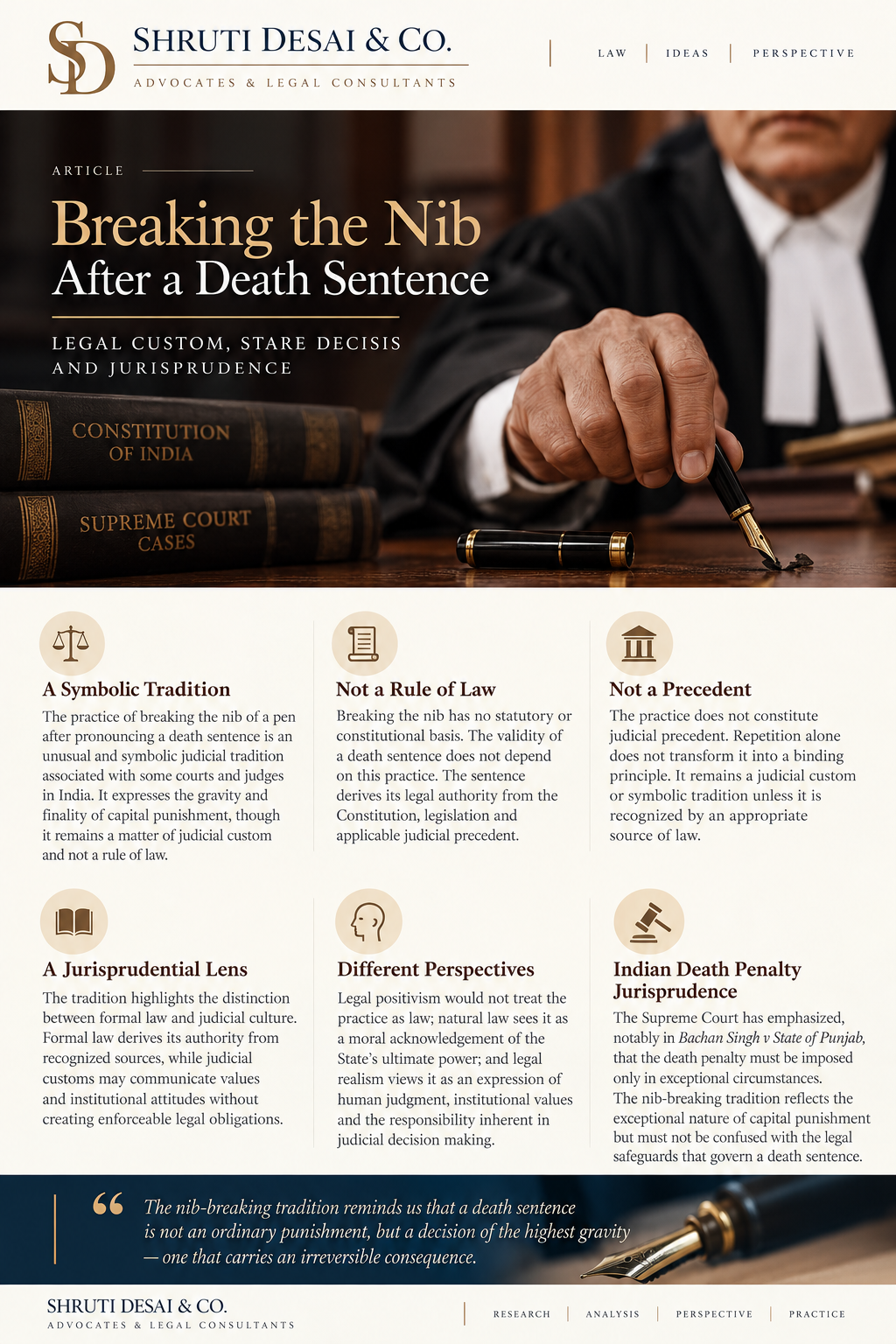
The practice of breaking the nib of a pen after pronouncing a death sentence is an unusual and symbolic judicial tradition associated with some courts and judges in India. The practice has attracted attention because of its connection with the seriousness and finality of capital punishment. Although it carries considerable symbolic significance, it is important to distinguish this judicial custom from a rule of law.
The practice is generally understood as a symbolic expression of the gravity of imposing the death penalty. A judge who breaks the nib after signing a death sentence may be conveying the idea that the act of sentencing a person to death is fundamentally different from an ordinary judicial decision. It represents the irreversible nature of the punishment and the heavy responsibility placed upon the judge.
However, breaking the nib has no statutory or constitutional basis. There is no general legal requirement that a judge must break the nib after imposing a death sentence. The validity of a death sentence does not depend upon whether the judge follows this practice. The sentence derives its legal authority from the Constitution, legislation and applicable judicial precedent, and not from the ritual accompanying the pronouncement.
The practice also raises an interesting question concerning stare decisis. Stare decisis is the doctrine under which courts follow established judicial precedents. In the Indian legal system, decisions of higher courts, particularly the Supreme Court, may establish binding principles of law for subordinate courts. The doctrine promotes consistency, certainty and predictability in the administration of justice.
The breaking of the nib, however, does not constitute judicial precedent. A judicial precedent normally contains a legal principle that forms part of the reasoning necessary for deciding a case. Such a principle may have binding or persuasive authority depending upon the court that delivers the decision and the circumstances in which it is applied.
The practice of breaking the nib does not establish such a legal principle. Even if judges repeatedly follow the practice, repetition alone does not transform it into a binding precedent. It remains a judicial custom or symbolic tradition unless it is recognized by an appropriate source of law.
This distinction is important from the perspective of jurisprudence. Jurisprudence examines the nature, sources and functions of law. The nib breaking tradition demonstrates the difference between formal law and judicial culture. Formal law derives its authority from recognized legal sources. Judicial customs and rituals, on the other hand, may communicate values and institutional attitudes without creating enforceable legal obligations.
From the perspective of legal positivism, the practice would not become law simply because judges follow it. Legal validity depends upon recognized sources and rules of the legal system. The fact that a practice is traditionally followed does not, by itself, give it the status of a binding legal rule.
From a natural law perspective, the practice can be understood in terms of the moral responsibility associated with capital punishment. The death penalty involves the ultimate exercise of State power over an individual’s life. The solemnity of the ritual may therefore be viewed as an acknowledgement of the moral consequences of the judicial decision.
Legal realism offers another perspective. Realist approaches to law recognize that judicial decision making involves human judgment and institutional practices. A judicial ritual such as breaking the nib illustrates that courts are not merely mechanical institutions applying abstract rules. Judicial practices can also express institutional values, emotions and perceptions concerning justice and responsibility.
The practice is particularly significant when considered alongside Indian death penalty jurisprudence. The Supreme Court has repeatedly emphasized that capital punishment must be imposed only in exceptional circumstances. The doctrine developed in Bachan Singh v State of Punjab is commonly described as the rarest of rare doctrine. Under this approach, the death penalty is not to be imposed merely because an offence is serious. The court must consider the circumstances of the crime as well as the circumstances of the offender and determine whether the alternative of life imprisonment is unquestionably foreclosed.
The symbolic act of breaking the nib can therefore be understood as reflecting the exceptional nature of capital punishment. It may remind the judge and the public that a death sentence is not an ordinary punishment and that the decision carries an irreversible consequence.
At the same time, the ritual must not be confused with the legal safeguards surrounding a death sentence. A person sentenced to death has access to appellate remedies and other procedures recognized by law. The sentence may be challenged before a higher court, and the constitutional and statutory framework governing capital punishment continues to apply irrespective of whether the judge follows the nib breaking tradition.
The distinction between custom and precedent is therefore central to understanding the legal significance of the practice. A custom may have historical, cultural or institutional importance, while a precedent establishes a legal proposition that may guide or bind future courts. Stare decisis operates through the latter, not through symbolic judicial rituals.
The breaking of the nib is consequently better understood as a jurisprudential symbol rather than a legal rule. It represents the solemnity of judicial power, the finality associated with capital punishment and the personal responsibility of the judge who imposes it. It does not, however, determine the legality of the sentence or create a binding rule for future cases.
Ultimately, the practice provides an interesting example of the relationship between law, judicial institutions and legal culture. It demonstrates that the administration of justice involves not only formal rules and precedents but also traditions and symbols that communicate the values underlying the judicial process. Yet the distinction must always be maintained between what is symbolically meaningful and what is legally binding.
The broken nib may therefore symbolize the end of a pen, but it does not mark the end of legal scrutiny. In a constitutional system governed by precedent, due process and judicial review, the validity of a death sentence rests not on the ritual accompanying its pronouncement but on the law and jurisprudence governing capital punishment.
ACADEMIC CASE LAW AND JURISPRUDENCE FRAMEWORK
The discussion above can be situated within the broader framework of Indian constitutional and criminal jurisprudence concerning capital punishment.
The constitutional foundation of the modern Indian death penalty framework is Bachan Singh v State of Punjab, reported in (1980) 2 SCC 684. The Constitution Bench upheld the constitutional validity of the death penalty while developing the principle that it should be imposed only in the rarest of rare cases. The Court emphasized the importance of considering both aggravating and mitigating circumstances and the circumstances of the offender.
The decision is particularly relevant to the symbolism of breaking the nib because it demonstrates that the imposition of death is not intended to be an ordinary sentencing exercise. The law requires exceptional justification before the ultimate punishment can be imposed.
In Machhi Singh v State of Punjab, reported in (1983) 3 SCC 470, the Supreme Court further explained the rarest of rare principle and discussed circumstances in which the death penalty could be considered appropriate.
The Court emphasized the need to balance aggravating and mitigating circumstances. Later Supreme Court decisions have relied upon this approach while stressing that mitigating circumstances must receive serious consideration. The principle reinforces the exceptional character of capital punishment.
In Mithu v State of Punjab, reported in (1983) 2 SCC 277, the Supreme Court examined the constitutional validity of the mandatory death penalty under Section 303 of the Indian Penal Code. The Court struck down the provision as unconstitutional.
Mithu is significant from a jurisprudence perspective because it demonstrates that even where legislation provides for severe punishment, constitutional principles impose limits upon the State’s power to take life. Capital punishment must operate within the framework of fundamental rights and constitutional safeguards.
In Santosh Kumar Satishbhushan Bariyar v State of Maharashtra, reported in (2009) 6 SCC 498, the Supreme Court examined the principles governing the imposition of the death penalty and emphasized proportionality, rehabilitation and the circumstances of the offender.
The judgment is particularly important because it cautioned against a purely crime centred approach to sentencing. The possibility of reform and rehabilitation must be given serious consideration. This approach strengthens the jurisprudential understanding that a death sentence requires much more than the existence of a particularly serious offence.
In Sangeet v State of Haryana, reported in (2013) 2 SCC 452, the Supreme Court expressed concern about inconsistencies in the application of the rarest of rare doctrine and emphasized the importance of a structured sentencing approach.
This case is useful in understanding the relationship between precedent and judicial discretion. While stare decisis promotes consistency, sentencing in capital cases requires individualized consideration. The challenge is to ensure that judicial discretion operates within principled constitutional boundaries.
In Swamy Shraddananda v State of Karnataka, reported in (2008) 13 SCC 767, the Supreme Court considered the problem of cases in which life imprisonment may not adequately address the circumstances, but the death penalty may also be inappropriate.
The Court developed the possibility of imposing a special category of life imprisonment for an extended period. The decision illustrates the continuing evolution of Indian sentencing jurisprudence and the judicial effort to develop alternatives between ordinary life imprisonment and capital punishment.
CONSTITUTIONAL CONTEXT
The jurisprudence of capital punishment must also be understood in the context of Article 21 of the Constitution of India. The right to life and personal liberty cannot be deprived except according to procedure established by law.
The Supreme Court’s death penalty jurisprudence has progressively required greater procedural fairness, individualized sentencing and consideration of mitigating circumstances. The appellate and review mechanisms associated with death sentences further demonstrate that the pronouncement of a death sentence by a trial court does not bring the legal process to an immediate end.
STARE DECISIS AND CAPITAL PUNISHMENT
The doctrine of stare decisis has particular importance in capital cases because consistency and predictability are essential when the punishment is irreversible.
The binding force of judicial precedent comes from the legal authority of the decision and the principle established by the court. It does not arise from the personal practices or rituals of individual judges.
Consequently, a judge’s practice of breaking the nib cannot become binding merely because other judges subsequently adopt it. There is no ratio decidendi in the ritual itself. There is no legal proposition being established concerning the rights or liabilities of the parties. It is therefore fundamentally different from a precedent.
The distinction also demonstrates an important jurisprudential principle. Not everything regularly done by courts is necessarily law. Judicial institutions possess practices, conventions and traditions that may have symbolic significance without possessing normative legal force.
CONCLUSION
The breaking of the nib after pronouncing a death sentence occupies an unusual position between judicial tradition and jurisprudential symbolism. It has no independent legal force and does not determine the validity of a death sentence. Its significance lies in the message it conveys concerning the gravity, solemnity and irreversible consequences of capital punishment.
Indian constitutional jurisprudence places the death penalty within a strict legal framework based upon Article 21, the rarest of rare doctrine, individualized sentencing, proportionality, mitigation and the possibility of reform and rehabilitation.
The distinction between the broken nib and binding precedent is therefore fundamental. The former is a symbol of judicial responsibility, while the latter is a source of legal authority. The former may communicate the moral seriousness of taking a human life, while the latter determines the legal principles that courts must follow.
The jurisprudential importance of the practice ultimately lies in this distinction. Law is not composed solely of rituals and institutional customs, but neither does the judicial process exist in a purely mechanical world of rules. Judicial traditions may express the values of an institution, while constitutional law and precedent determine the legal limits within which that institution operates.
The broken nib may symbolize finality, but the law continues to demand scrutiny, review and constitutional accountability.
The case law above is consistent with the Supreme Court’s published materials on capital punishment, including its discussion of Bachan Singh, Santosh Bariyar and the requirement that the rarest of rare standard be applied with attention to rehabilitation and the circumstances of the offender. api.sci.gov.in
Bibliography
- Bachan Singh v. State of Punjab, (1980) 2 SCC 684 (India).
- ; see also Machhi Singh v. State of Punjab, (1983) 3 SCC 470 (India).
- Mithu v. State of Punjab, (1983) 2 SCC 277 (India).
- Santosh Kumar Satishbhushan Bariyar v. State of Maharashtra, (2009) 6 SCC 498 (India).
- Sangeet v. State of Haryana, (2013) 2 SCC 452 (India).
- Swamy Shraddananda v. State of Karnataka, (2008) 13 SCC 767 (India).
- Mithu, (1983) 2 SCC 277.
- Santosh Kumar Satishbhushan Bariyar, (2009) 6 SCC 498.
- Sangeet, (2013) 2 SCC 452.
- Swamy Shraddananda, (2008) 13 SCC 767.
- INDIA CONST. art. 21.
- Bachan Singh, (1980) 2 SCC 684.
- Machhi Singh, (1983) 3 SCC 470.
- Santosh Kumar Satishbhushan Bariyar, (2009) 6 SCC 498.
- Sangeet, (2013) 2 SCC 452.
- Swamy Shraddananda, (2008) 13 SCC 767.
- See Bachan Singh, (1980) 2 SCC 684 (holding the death penalty constitutionally permissible while requiring its exceptional application and consideration of relevant sentencing circumstances).
- See Machhi Singh, (1983) 3 SCC 470 (explaining the application of the “rarest of rare” principle).
- See Mithu, (1983) 2 SCC 277 (invalidating the mandatory death penalty imposed by Section 303 of the Indian Penal Code).
- See Santosh Kumar Satishbhushan Bariyar, (2009) 6 SCC 498 (emphasizing proportionality, mitigation and the possibility of rehabilitation in capital sentencing).
- See Sangeet, (2013) 2 SCC 452 (discussing inconsistencies in the application of the rarest-of-rare doctrine and the need for a principled sentencing framework).
- See Swamy Shraddananda, (2008) 13 SCC 767 (recognizing a category of life imprisonment extending beyond the ordinary fourteen-year framework in an appropriate case).
- INDIA CONST. art. 21.
- Bachan Singh, (1980) 2 SCC 684.
- Machhi Singh, (1983) 3 SCC 470.
- Santosh Kumar Satishbhushan Bariyar, (2009) 6 SCC 498.
- Sangeet, (2013) 2 SCC 452.
- Swamy Shraddananda, (2008) 13 SCC 767.
Shruti Desai
16th October 2026

Post a comment