
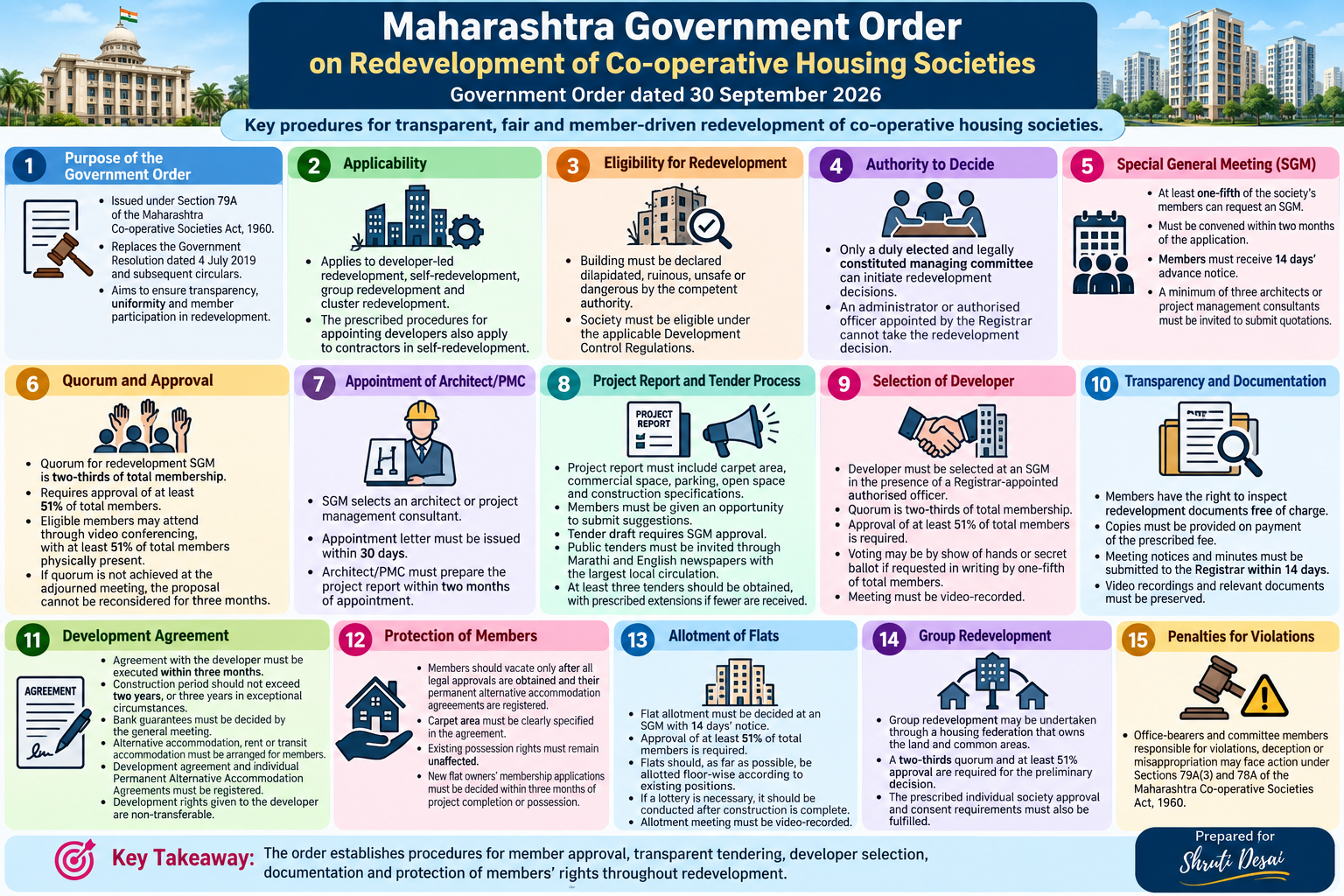
Short Notes: Maharashtra Government Order on Redevelopment of Co-operative Housing Societies (30 September 2026)
Government Order dated 30 September 2026
30-09-2026 Redevelopment Govt Circular English-Marathi
Short Notes: Maharashtra Government Order on Redevelopment of Co-operative Housing Societies (30 September 2026)
Government Order dated 30 September 2026
- Purpose of the Government Order
- Issued under Section 79A of the Maharashtra Co-operative Societies Act, 1960.
- Replaces the Government Resolution dated 4 July 2019 and subsequent circulars.
- Aims to ensure transparency, uniformity and member participation in redevelopment.
- Applicability
- Applies to developer-led redevelopment, self-redevelopment, group redevelopment and cluster redevelopment.
- The prescribed procedures for appointing developers also apply to contractors in self-redevelopment.
- Eligibility for Redevelopment
- The building must be declared dilapidated, ruinous, unsafe or dangerous by the competent authority.
- The society must be eligible under the applicable Development Control Regulations.
- Authority to Decide
- Only a duly elected and legally constituted managing committee can initiate redevelopment decisions.
- An administrator or authorised officer appointed by the Registrar cannot take the redevelopment decision.
- Special General Meeting (SGM)
- At least one-fifth of the society’s members can request an SGM.
- The SGM must be convened within two months of the application.
- Members must receive 14 days’ advance notice.
- A minimum of three architects or project management consultants must be invited to submit quotations.
- Quorum and Approval
- The quorum for the redevelopment SGM is two-thirds of the total membership.
- Redevelopment requires approval from at least 51% of the total members.
- Eligible members may attend through video conferencing, subject to the requirement that at least 51% of total members are physically present.
- If quorum is not achieved at the adjourned meeting, the proposal cannot be reconsidered for three months.
- Appointment of Architect/PMC
- The SGM selects an architect or project management consultant.
- The appointment letter must be issued within 30 days.
- The architect/PMC must prepare the project report within two months of appointment.
- Project Report and Tender Process
- The project report must include carpet area, commercial space, parking, open space and construction specifications.
- Members must be given an opportunity to submit suggestions.
- The tender draft requires SGM approval.
- Public tenders must be invited through Marathi and English newspapers with the largest local circulation.
- At least three tenders should be obtained, with prescribed extensions if fewer are received.
- Selection of Developer
- The developer must be selected at an SGM in the presence of a Registrar-appointed authorised officer.
- The quorum is two-thirds of total membership.
- Approval of at least 51% of total members is required.
- Voting may be by show of hands or secret ballot if requested in writing by one-fifth of total members.
- The meeting must be video-recorded.
- Transparency and Documentation
- Members have the right to inspect redevelopment documents free of charge.
- Copies must be provided on payment of the prescribed fee.
- Meeting notices and minutes must be submitted to the Registrar within 14 days.
- Video recordings and relevant documents must be preserved.
- Development Agreement
- The agreement with the developer must be executed within three months.
- The construction period should not exceed two years, or three years in exceptional circumstances.
- Bank guarantees must be decided by the general meeting.
- Alternative accommodation, rent or transit accommodation must be arranged for members.
- The development agreement and individual Permanent Alternative Accommodation Agreements must be registered.
- Development rights given to the developer are non-transferable.
- Protection of Members
- Members should vacate only after all legal approvals are obtained and their permanent alternative accommodation agreements are registered.
- Carpet area must be clearly specified in the agreement.
- Existing possession rights must remain unaffected.
- New flat owners’ membership applications must be decided within three months of project completion or possession.
- Allotment of Flats
- Flat allotment must be decided at an SGM with 14 days’ notice.
- Approval of at least 51% of total members is required.
- Flats should, as far as possible, be allotted floor-wise according to existing positions.
- If a lottery is necessary, it should be conducted after construction is complete.
- The allotment meeting must be video-recorded.
- Group Redevelopment
- Group redevelopment may be undertaken through a housing federation that owns the land and common areas.
- A two-thirds quorum and at least 51% approval are required for the preliminary decision.
- The prescribed individual society approval and consent requirements must also be fulfilled.
- Penalties for Violations
– Office-bearers and committee members responsible for violations, deception or misappropriation may face action under Sections 79A(3) and 78A of the Maharashtra Co-operative Societies Act, 1960.
Key takeaway: The order establishes procedures for member approval, transparent tendering, developer selection, documentation and protection of members’ rights throughout redevelopment.
- Purpose of the Government Order
- Issued under Section 79A of the Maharashtra Co-operative Societies Act, 1960.
- Replaces the Government Resolution dated 4 July 2019 and subsequent circulars.
- Aims to ensure transparency, uniformity and member participation in redevelopment.
- Applicability
- Applies to developer-led redevelopment, self-redevelopment, group redevelopment and cluster redevelopment.
- The prescribed procedures for appointing developers also apply to contractors in self-redevelopment.
- Eligibility for Redevelopment
- The building must be declared dilapidated, ruinous, unsafe or dangerous by the competent authority.
- The society must be eligible under the applicable Development Control Regulations.
- Authority to Decide
- Only a duly elected and legally constituted managing committee can initiate redevelopment decisions.
- An administrator or authorised officer appointed by the Registrar cannot take the redevelopment decision.
- Special General Meeting (SGM)
- At least one-fifth of the society’s members can request an SGM.
- The SGM must be convened within two months of the application.
- Members must receive 14 days’ advance notice.
- A minimum of three architects or project management consultants must be invited to submit quotations.
- Quorum and Approval
- The quorum for the redevelopment SGM is two-thirds of the total membership.
- Redevelopment requires approval from at least 51% of the total members.
- Eligible members may attend through video conferencing, subject to the requirement that at least 51% of total members are physically present.
- If quorum is not achieved at the adjourned meeting, the proposal cannot be reconsidered for three months.
- Appointment of Architect/PMC
- The SGM selects an architect or project management consultant.
- The appointment letter must be issued within 30 days.
- The architect/PMC must prepare the project report within two months of appointment.
- Project Report and Tender Process
- The project report must include carpet area, commercial space, parking, open space and construction specifications.
- Members must be given an opportunity to submit suggestions.
- The tender draft requires SGM approval.
- Public tenders must be invited through Marathi and English newspapers with the largest local circulation.
- At least three tenders should be obtained, with prescribed extensions if fewer are received.
- Selection of Developer
- The developer must be selected at an SGM in the presence of a Registrar-appointed authorised officer.
- The quorum is two-thirds of total membership.
- Approval of at least 51% of total members is required.
- Voting may be by show of hands or secret ballot if requested in writing by one-fifth of total members.
- The meeting must be video-recorded.
- Transparency and Documentation
- Members have the right to inspect redevelopment documents free of charge.
- Copies must be provided on payment of the prescribed fee.
- Meeting notices and minutes must be submitted to the Registrar within 14 days.
- Video recordings and relevant documents must be preserved.
- Development Agreement
- The agreement with the developer must be executed within three months.
- The construction period should not exceed two years, or three years in exceptional circumstances.
- Bank guarantees must be decided by the general meeting.
- Alternative accommodation, rent or transit accommodation must be arranged for members.
- The development agreement and individual Permanent Alternative Accommodation Agreements must be registered.
- Development rights given to the developer are non-transferable.
- Protection of Members
- Members should vacate only after all legal approvals are obtained and their permanent alternative accommodation agreements are registered.
- Carpet area must be clearly specified in the agreement.
- Existing possession rights must remain unaffected.
- New flat owners’ membership applications must be decided within three months of project completion or possession.
- Allotment of Flats
- Flat allotment must be decided at an SGM with 14 days’ notice.
- Approval of at least 51% of total members is required.
- Flats should, as far as possible, be allotted floor-wise according to existing positions.
- If a lottery is necessary, it should be conducted after construction is complete.
- The allotment meeting must be video-recorded.
- Group Redevelopment
- Group redevelopment may be undertaken through a housing federation that owns the land and common areas.
- A two-thirds quorum and at least 51% approval are required for the preliminary decision.
- The prescribed individual society approval and consent requirements must also be fulfilled.
- Penalties for Violations
– Office-bearers and committee members responsible for violations, deception or misappropriation may face action under Sections 79A(3) and 78A of the Maharashtra Co-operative Societies Act, 1960.
Key takeaway: The order establishes procedures for member approval, transparent tendering, developer selection, documentation and protection of members’ rights throughout redevelopment.
Post a comment