
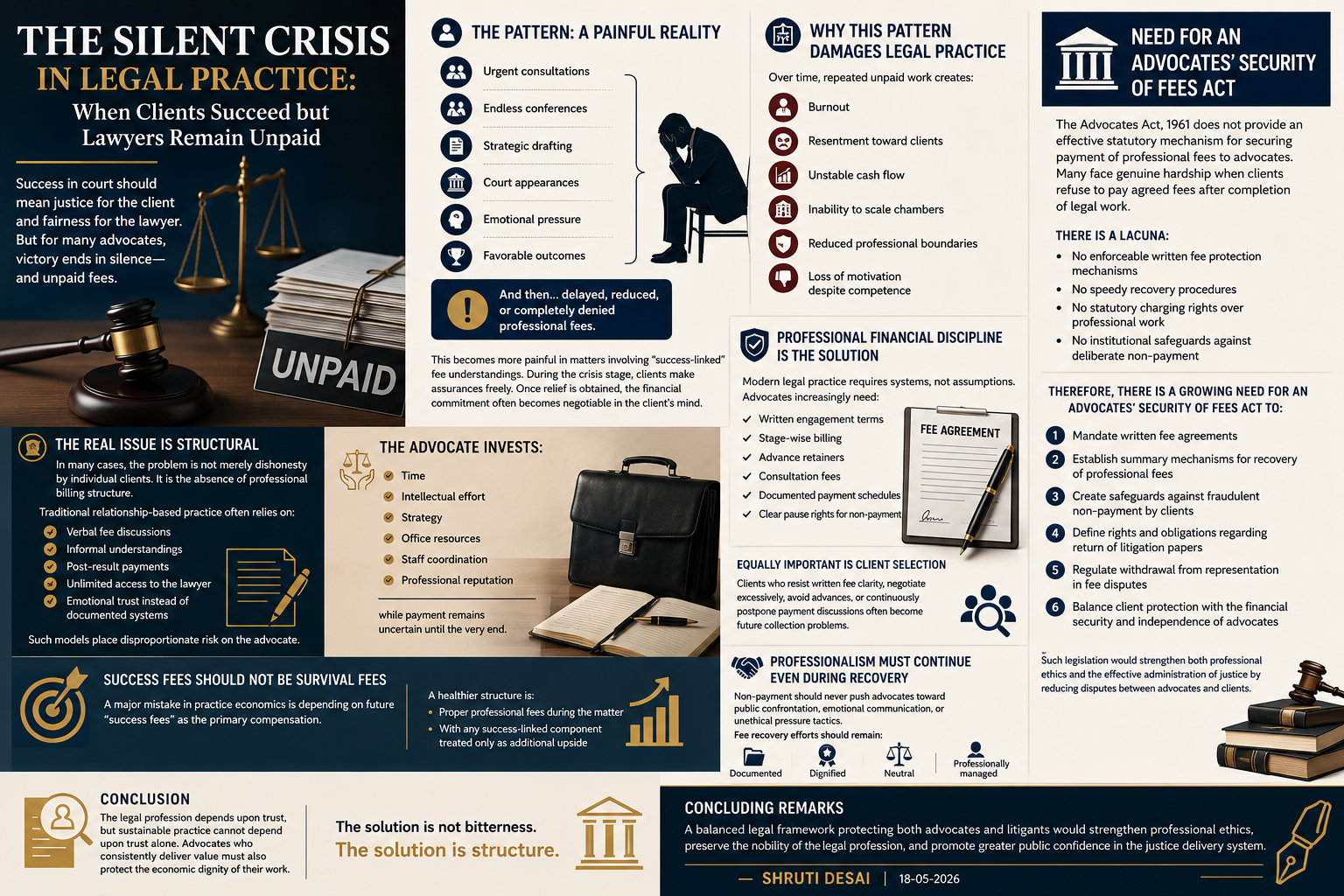
The Silent Crisis in Legal Practice: When Clients Succeed but Lawyers Remain Unpaid
For many advocates, the deepest professional frustration is not losing a case. It is succeeding for a client and still remaining unpaid.
Across years of practice, many lawyers experience the same pattern repeatedly:
- urgent consultations,
- endless conferences,
- strategic drafting,
- court appearances,
- emotional pressure,
- favorable outcomes,
- and then delayed, reduced, or completely denied professional fees.
This problem becomes more painful in matters involving “success-linked” fee understandings. During the crisis stage, clients make assurances freely. Once relief is obtained — settlement, injunction, bail, recovery, business advantage, or litigation success — the financial commitment often becomes negotiable in the client’s mind.
The result is not only financial loss. It creates professional exhaustion and distrust within practice.
- The Real Issue Is Structural
In many cases, the problem is not merely dishonesty by individual clients. It is the absence of professional billing structure.
Traditional relationship-based practice often relies on:
- verbal fee discussions,
- informal understandings,
- post-result payments,
- unlimited access to the lawyer,
- and emotional trust instead of documented systems.
Such models place disproportionate risk on the advocate.
The lawyer invests:
- time,
- intellectual effort,
- strategy,
- office resources,
- staff coordination,
- and professional reputation,
while payment remains uncertain until the very end.
Why This Pattern Damages Legal Practice
Over time, repeated unpaid work creates:
- burnout,
- resentment toward clients,
- unstable cash flow,
- inability to scale chambers,
- reduced professional boundaries,
- and loss of motivation despite competence.
Many capable lawyers become financially strained not because they lack legal skill, but because they lack enforceable economic structure within practice management.
The Need for Professional Financial Discipline
Modern legal practice requires systems, not assumptions.
Advocates increasingly need:
* written engagement terms,
* stage-wise billing,
* advance retainers,
* consultation fees,
* documented payment schedules,
* and clear pause rights for non-payment.
Equally important is client selection. Clients who:
* resist written fee clarity,
* negotiate excessively,
* avoid advances,
* or continuously postpone payment discussions often become future collection problems.
Success Fees Should Not Be Survival Fees
A major mistake in practice economics is depending on future “success fees” as the primary compensation.
A healthier structure is:
* proper professional fees during the matter,
* with any success-linked component treated only as additional upside.
This protects the advocate from total economic loss even if the client later defaults.
Professionalism Must Continue Even During Recovery
Non-payment should never push advocates toward public confrontation, emotional communication, or unethical pressure tactics.
Fee recovery efforts should remain:
* Documented,
* Dignified,
* Neutral,
* And professionally managed.
Long-term reputation is more valuable than short-term anger.
A major lacuna in the existing legal framework is the absence of a statutory mechanism securing payment of professional fees to advocates. While the Advocates Act, 1961 emphasizes professional ethics and duties toward clients, it does not adequately protect advocates from non-payment of legitimate fees after rendering legal services.
Need for an Advocates’ Security of Fees Act
The present legal framework under the Advocates Act, 1961 does not provide an effective statutory mechanism for securing payment of professional fees to advocates. Although advocates are ethically prohibited from abandoning clients unfairly or withholding litigation papers in a manner prejudicial to justice, many advocates face genuine hardship when clients refuse to pay agreed professional fees after completion of legal work.
Unlike several other professions and commercial sectors, advocates often lack:
- enforceable written fee protection mechanisms,
- speedy recovery procedures,
- statutory charging rights over professional work,
- and institutional safeguards against deliberate non-payment by litigants.
This imbalance creates tension between professional ethics and economic realities of legal practice. Advocates are expected to maintain the dignity of the profession and continue representation in the interest of justice, yet the law provides insufficient protection for their livelihood and professional remuneration.
Therefore, there is a growing need for an “Advocates’ Security of Fees Act” or similar legislative reform to:
- mandate written fee agreements,
- establish summary mechanisms for recovery of professional fees,
- create safeguards against fraudulent non-payment by clients,
- define rights and obligations regarding return of litigation papers,
- regulate withdrawal from representation in fee disputes, and
- balance client protection with the financial security and independence of advocates.
Such legislation would strengthen both professional ethics and the effective administration of justice by reducing disputes between advocates and clients.
Conclusion
The legal profession depends upon trust, but sustainable practice cannot depend upon trust alone.Advocates who consistently deliver value must also protect the economic dignity of their work.
Concluding Remarks
The legal profession occupies a unique position in the administration of justice, where advocates are not merely service providers, but officers of the court entrusted with protecting the rule of law and the rights of litigants. The Advocates Act, 1961 and the Bar Council of India Rules impose high standards of professional ethics and responsibility upon advocates. However, the existing framework reveals significant lacunae regarding regulation of professional fees, withdrawal from representation, and protection of advocates against deliberate non-payment by clients.
While advocates are ethically restrained from acting in a manner prejudicial to the interests of clients, the law simultaneously fails to provide adequate statutory safeguards securing legitimate professional remuneration. This imbalance has led to increasing conflicts between advocates and litigants, adversely affecting professional dignity, trust, and the efficient administration of justice.
Therefore, there is an urgent need for comprehensive legal reform, including the introduction of an “Advocates’ Security of Fees Act” or similar statutory mechanism to ensure transparency in fee arrangements, speedy recovery of professional dues, protection of client rights, and clearer ethical standards governing advocate-client relationships. A balanced legal framework protecting both advocates and litigants would strengthen professional ethics, preserve the nobility of the legal profession, and promote greater public confidence in the justice delivery system.
SHRUTI DESAI
18-05-2026

Post a comment