
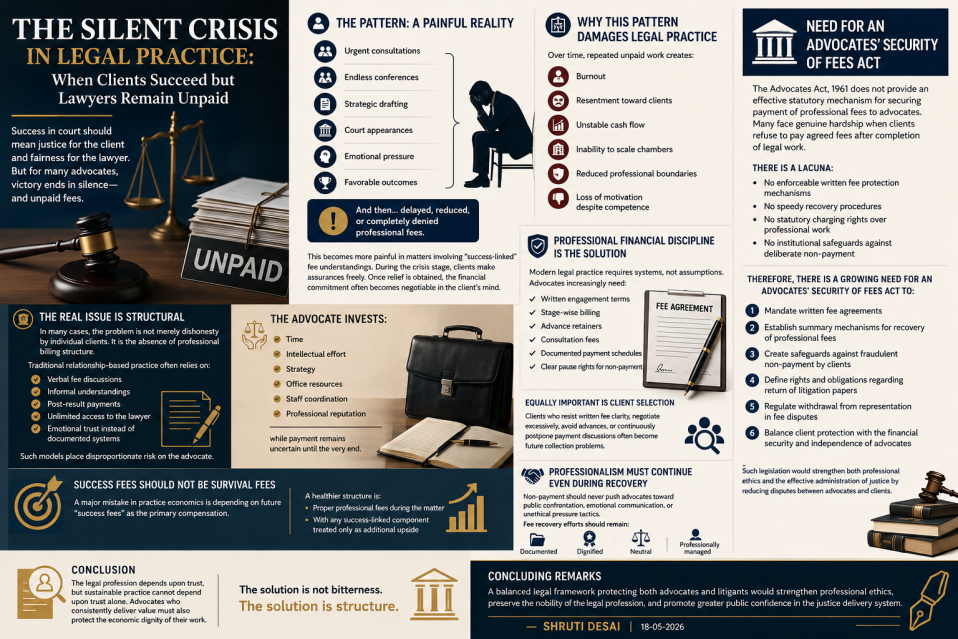
The Silent Crisis in Legal Practice: When Clients Succeed but Lawyers Remain Unpaid
The Silent Crisis in Legal Practice: When Clients Succeed but Lawyers Remain Unpaid For many advocates, the deepest professional frustration is not losing a case. It is succeeding for a client and still remaining unpaid. Across years of practice, many lawyers experience the same pattern repeatedly: urgent consultations, endless conferences, strategic drafting, court appearances, emotional pressure, favorable outcomes, and then delayed, reduced, or completely denied professional fees. This problem becomes more painful in matters involving “success-linked” fee understandings. During the crisis stage, clients make assurances freely. Once relief is obtained — settlement, injunction, bail, recovery, business advantage, or litigation success — the financial commitment often becomes negotiable in the client’s mind. The result is not only financial loss. It creates professional exhaustion and distrust within practice. The Real Issue Is Structural In many cases, the problem is not merely dishonesty by individual clients. It is the absence of professional billing structure. Traditional relationship-based practice often relies on: verbal fee discussions, informal understandings, post-result payments, unlimited access to the lawyer, and emotional trust instead of documented systems. Such models place disproportionate risk on the advocate. The lawyer invests: time, intellectual effort, strategy, office resources, staff coordination, and professional reputation, while payment remains uncertain until the very end. Why This Pattern Damages Legal Practice Over time, repeated unpaid work creates: burnout, resentment toward clients, unstable cash flow, inability to scale chambers, reduced professional boundaries, and loss of motivation despite competence. Many capable lawyers become financially strained not because they lack legal skill, but because they lack enforceable economic structure within practice management. The Need for Professional Financial Discipline Modern legal practice requires systems, not assumptions. Advocates increasingly need: * written engagement terms, * stage-wise billing, * advance retainers, * consultation fees, * documented payment schedules, * and clear pause rights for non-payment. Equally important is client selection. Clients who: * resist written fee clarity, * negotiate excessively, * avoid advances, * or continuously postpone payment discussions often become future collection problems. Success Fees Should Not Be Survival Fees A major mistake in practice economics is depending on future “success fees” as the primary compensation. A healthier structure is: * proper professional fees during the matter, * with any success-linked component treated only as additional upside. This protects the advocate from total economic loss even if the client later defaults. Professionalism Must Continue Even During Recovery Non-payment should never push advocates toward public confrontation, emotional communication, or unethical pressure tactics. Fee recovery efforts should remain: * Documented, * Dignified, * Neutral, * And professionally managed. Long-term reputation is more valuable than short-term anger. A major lacuna in the existing legal framework is the absence of a statutory mechanism securing payment of professional fees to advocates. While the Advocates Act, 1961 emphasizes professional ethics and duties toward clients, it does not adequately protect advocates from non-payment of legitimate fees after rendering legal services. Need for an Advocates’ Security of Fees Act The present legal framework under the Advocates Act, 1961 does not provide an effective statutory mechanism for securing payment of professional fees to advocates. Although advocates are ethically prohibited from abandoning clients unfairly […]
Read more
Monetary Power in the 21st Century: Theories, and The Rise and Resilience of the Dollar
Monetary Power in the 21st Century: Theories and The Rise and Resilience of the Dollar Printing more dollars hits the US economy hard because it increases the money supply without a corresponding increase in the actual goods and services produced, leading to devaluation and higher prices When the Federal Reserve prints money (or creates it digitally through quantitative easing), it devalues the existing currency, which reduces purchasing power and causes inflation. Here is how printing money hurts the economy: High Inflation: When more money chases the same amount of goods, prices for everyday items rise, as demonstrated in 2021-2022 when high money supply growth led to sharp inflation. Decreased Purchasing Power: As inflation rises, each dollar buys fewer goods and services. This is particularly harmful to consumers, as their wages and savings no longer stretch as far, reducing their standard of living. Erosion of Savings: Inflation act as a “hidden tax” on cash holders. Those with savings, particularly on fixed incomes, see the real value of their money plummet. Loss of Investor Confidence: Excessive, uncontrolled money printing can lead to a loss of faith in the US dollar. If investors believe the currency will continue to lose value, they may shift to more stable assets, reducing the demand for dollars globally. Currency Devaluation Risk: Persistent printing can cause the dollar to weaken against other currencies, making imports more expensive and contributing to trade imbalances. Increased National Debt: When the government prints money to finance spending, it increases the national debt. As the debt grows, it becomes harder for the government to service its obligations without further debasing the currency. Market Bubbles: The influx of money often flows into stocks and real estate rather than into the productive economy, creating asset price bubbles that can lead to financial instability. While printing money can provide a temporary economic boost during a recession, it can cause significant long-term damage if it becomes an addictive tool for handling debt, with historical cases like Germany in the 1920s and Zimbabwe in the 2000s highlighting how it can destroy an economy. THEORY PROPELLED BY VARIOUS ECONOMIST. The concept of printing currency is a highly debated topic among leading economists. On one side, traditional theory stress the importance of maintaining monetary stability, while more modern perspectives support using debt-financed spending to stimulate the economy. At the heart of this debate is the challenge of finding the right balance between leveraging money creation to boost economic activity and managing the potential risks of inflation Here are the primary theories and the authors associated with them: 1. Modern Monetary Theory (MMT) MMT, which gained prominence in the 2010s, argues that governments that issue their own fiat currency (like the US, UK, Japan, and Canada) are not constrained by revenue when it comes to spending. Therefore, they can, and should, print money to fund public services and maintain full employment. Key Authors/Proponents: Warren Mosler (who authored The 7 Deadly Innocent Frauds of Economic Policy and Soft Currency Economics), Stephanie Kelton (The Deficit Myth), L. Randall Wray, and Bill Mitchell. Core Theory: Sovereign governments cannot go broke and do not need […]
Read more
“UNVEILING THE SFIO: INDIA’S MULTI-DISCIPLINARY AGENCY Ft5tt5OR CORPORATE FRAUD INVESTIGATION”
“UNVEILING THE SFIO: INDIA’S MULTI-DISCIPLINARY AGENCY FOR CORPORATE FRAUD INVESTIGATION” NOTIFICATION: The Central Government, by notification, established an office called the Serious Fraud Investigation Office to investigate frauds relating to a company: The said office is setup by the Central Government in terms of the Government of India Resolution No. 45011/16/2003-Adm-I, dated the 2nd of July 2003 and shall be deemed to be the Serious Fraud Investigation Office for the purpose of this section. SET UP The Serious Fraud Investigation Office is headed by a director and consist of such number of experts from the following fields to be appointed by the Central Government from amongst persons of ability, integrity and experience in,— (i) banking; (ii) corporate affairs; (iii) taxation; (iv) forensic audit; (v) capital market; (vi) information technology; (vii) law; or (viii) such other fields as may be prescribed. Director in the Serious Fraud Investigation Office, shall be an officer not below the rank of a Joint Secretary to the Government of India having knowledge and experience in dealing with matters relating to corporate affairs. The Central Government may appoint also experts and other officers and employees in the Serious Fraud Investigation Office as it considers necessary for the efficient discharge of its functions under this Act. The terms and conditions of service of Director, experts, and other officers and employees of the Serious Fraud Investigation Office shall be such as may be prescribed. (see rules) RULES OF APPOINTMENT 14.1.3- Companies (Inspection, Investigation and Inquiry) Rules,2014 3. Appointment of persons having expertise in various fields.— The Central Government may appoint persons having expertise in the fields of investigations, cyber forensics, financial accounting, management accounting, cost accounting and any other fields as may be necessary for the efficient discharge of Serious Fraud Investigation Office (SFIO) functions under the Act. 14.1.4-Companies (Inspection, Investigation and Inquiry) Rules,2014 Terms and Condition of service.— The terms and conditions of service of Director, experts and other officers and employees of the Serious Fraud Investigation Office under sub-section (5) of Section 211 shall be as under— (a) the terms and conditions of appointment of Director shall be governed by the deputation rules under the Central Staffing Scheme of Government of India; (b) the terms and conditions of service of experts from the Central Government or the State Government or Union territory Government, Public Sector Undertaking, Autonomous Bodies and such other organizations shall be as per the recruitment rules which may be duly notified by the Central Government under article 309 of the Constitution of India; (c) the terms and conditions of service of other officers and employees from the Central Government or the State Government or Union Territory Government, Public Sector Undertaking, Autonomous Bodies and such other organizations shall be as per the recruitment rules which may be duly notified by the Central Government under article 309 of the Constitution of India; (d) the Central Government may appoint experts or consultants or other professionals or professional firms on contractual basis as per the Scheme of engagement of experts or consultants which may be duly approved by the Central Government. India’s Companies Act, 2013, specifically Sections 211 and […]
Read more