
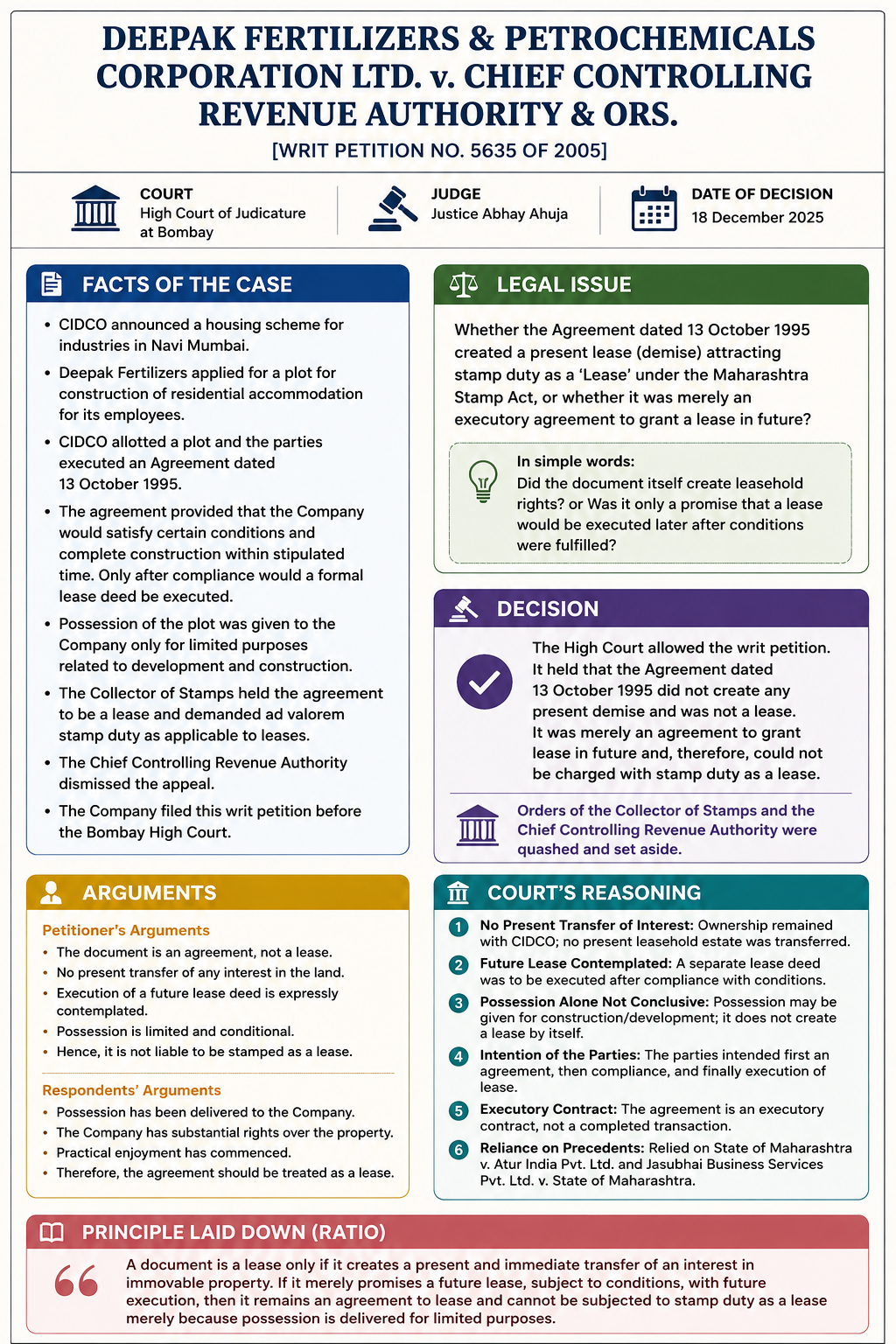
Deepak Fertilizers and Petrochemicals Corporation Ltd. v. Chief Controlling Revenue Authority & Ors., Writ Petition No. 5635 of 2005, decided on 18 December 2025 by Justice Abhay Ahuja. (Verdictum)
- Background and Facts
The dispute arose from an agreement executed on 13 October 1995 between Deepak Fertilizers and CIDCO under a scheme through which CIDCO allotted developed residential plots to industries for construction of staff housing.
The material facts were:
- CIDCO announced a housing scheme for industries in Navi Mumbai.
- Deepak Fertilizers applied for a plot for construction of residential accommodation for its employees.
- CIDCO allotted a plot and the parties executed an Agreement dated 13 October 1995.
- The agreement contemplated that:
- the company would satisfy several conditions;
- construction had to be completed within stipulated time;
- only after compliance would a formal lease deed be executed.
- Possession given to the company was only for limited purposes connected with development and construction under the agreement.
- The Collector of Stamps held that the agreement itself amounted to a lease and demanded ad valorem stamp duty as applicable to leases.
- The Chief Controlling Revenue Authority dismissed the company’s appeal.
- Deepak Fertilizers challenged those orders before the Bombay High Court. (Verdictum)
- Procedural History
| Authority | Decision |
| Collector of Stamps | Held the agreement was a lease and liable to stamp duty as a lease |
| Chief Controlling Revenue Authority | Confirmed Collector’s order |
| Bombay High Court | Allowed the writ petition and set aside both orders |
- Legal Issue
The central legal issue was:
Whether the Agreement dated 13 October 1995 created a present lease (demise) attracting stamp duty as a “Lease” under the Maharashtra Stamp Act, or whether it was merely an executory agreement to grant a lease in future.
In simple words:
Did the document itself create leasehold rights? or
Was it only a promise that a lease would be executed later after conditions were fulfilled?
- Petitioner’s Arguments
Deepak Fertilizers argued that:
- the document repeatedly described itself as an Agreement;
- it did not transfer any present interest in land;
- no leasehold estate came into existence immediately;
- execution of a future lease deed was expressly contemplated;
- possession was limited and conditional;
- therefore the agreement could not be stamped as a lease.
The company relied upon earlier Bombay High Court decisions distinguishing between:
- agreement to lease
- actual lease
- Respondents’ Arguments
The Revenue and CIDCO contended that:
- possession had already been handed over;
- the company had substantial rights over the property;
- practical enjoyment had commenced;
- therefore the agreement should be treated as a lease for stamp purposes.
- Core Legal Question Considered by the Court
The Court examined a classical property law distinction:
Does the document itself create a present demise?
If yes → it is a lease.
If no → it is merely an agreement to lease.
This distinction has existed in Indian property law for decades.
- Court’s Reasoning
Justice Abhay Ahuja analysed the document clause-by-clause.
The Court emphasized that the substance of the document—not merely possession or nomenclature—determines its legal character. (Verdictum)
- No Present Transfer of Interest
The Court observed that:
- ownership remained with CIDCO;
- no present leasehold estate was transferred;
- the agreement only created contractual obligations.
This is the most important factor.
- Future Lease Clearly Contemplated
The agreement expressly required execution of a separate lease deed after:
- construction,
- fulfilment of conditions,
- approvals,
- compliance with the scheme.
Therefore:
the present document could not itself be the lease.
- Possession Alone Does Not Create Lease
One of the Revenue’s principal arguments was that possession had been delivered.
The Court rejected this.
It held:
Possession may be delivered for many reasons.
For example:
- licence
- development
- construction
- supervision
- temporary occupation
Possession by itself does not create a lease.
There must also be:
- present transfer of legal interest in land.
- Intention of Parties
The Court repeatedly examined the intention reflected from the document.
It found:
The parties intended:
- first an agreement,
- then compliance,
- finally execution of lease.
Thus there was no intention to create an immediate demise.
- Executory Contract
The Court characterized the agreement as an executory contract.
Meaning:
It was a contract promising that something would happen in future.
It was not the completed transaction itself.
- Earlier Precedents
The Court relied significantly on earlier Bombay High Court decisions including:
- State of Maharashtra v. Atur India Pvt. Ltd.
- Jasubhai Business Services Pvt. Ltd. v. State of Maharashtra
These authorities held that where no present demise is created, an agreement cannot be taxed as a lease merely because possession has been granted for a limited purpose. (Verdictum)
- Principle Laid Down
The Court reaffirmed the following rule:
A document is a lease only if it creates a present and immediate transfer of an interest in immovable property.
If it merely promises:
- future lease,
- subject to conditions,
- with future execution,
then it remains an agreement to lease.
- Holding
The High Court held that:
- the Agreement dated 13 October 1995 did not create any present demise;
- it was not a lease;
- it was merely an agreement to grant lease in future;
- therefore it could not be charged with stamp duty as a lease.
Accordingly:
- the Collector’s order was quashed;
- the Chief Controlling Revenue Authority’s appellate order was quashed;
- the writ petition was allowed. (Verdictum)
- Ratio Decidendi (Legal Principle)
The ratio of the judgment is:
An agreement that merely contemplates execution of a lease in future, without creating a present transfer of interest in immovable property, is not a lease and cannot be subjected to stamp duty as a lease merely because possession is delivered for limited purposes.
- Importance of the Judgment
The judgment is significant because it:
- clarifies the distinction between a lease and an agreement to lease under the Maharashtra Stamp Act;
- emphasizes that substance prevails over form, but the decisive test is whether there is a present demise;
- confirms that delivery of possession alone is not conclusive of a lease;
- provides guidance for drafting development, allotment, and industrial land agreements to avoid unintended stamp duty consequences. (Verdictum)
Obiter
The Court’s reasoning can be summarized in one sentence:
Stamp duty depends on whether the document immediately creates a legal interest in the property; if it only promises a future lease after specified conditions are met, it is an agreement to lease—not a lease—and cannot be stamped as one.
SHRUTI DESAI
8th July 2026


Post a comment