
The Expanding Definition of “Promoter”: Impact on Landowners’ Rights. Need for parliamentary intervention?
NEED FOR AUTHORITATIVE CLARIFICATION BY THE BOMBAY HIGH COURT ON THE SCOPE OF SECTION 11 OF MOFA: GERALD MICHAEL MISQUITTA AND ROHINI GUPTA Gerald Michael Misquitta Vs State of Maharashtra ( “Gerald” ) Rohini Gupta & Anr. v. District Deputy Registrar, Co-operative Societies & Ors., WP No. 5991/2026, Bombay High Court, decided 8 September 2026, in which Mohini Gupta is the second petitioner. Indian Kanoon ( “Gupta” ) The two cases are quite closely connected because both concern Section 11 of MOFA, deemed conveyance, landowners/lessees, and the powers of the District Deputy Registrar (DDR). But there is an important difference: Gerald Misquitta is primarily a procedural/natural-justice case, whereas Gupta is substantially a Section 2(c)/Section 11 substantive-promoter case. Basic facts — side-by-side Sr No Particulars Gerald Michael Misquitta v. State of Maharashtra Rohini Gupta & Anr. v. DDR3 1 Court Bombay High Court Bombay High Court 2 Judgment date 25 Feb 2026 8 Sept 2026 3 Petition WP 1739/2022 WP 5991/2026 4 Ownership Misquitta family property, Vile Parle West Gupta family property, Juhu 5 Original owners Multiple Misquitta co-owners Late Kundanlal Laxmichand Gupta; petitioners were his heirs 6 Developer/lessee structure Owners → Rahejas → A.K. Associates/sub-lessee Owner → Raheja/Wadhwa lessees → developers 7 Society Name Priya Co-operative Housing Society Queens Park Premises Co-operative Society 8 Lease 98-year lease 98-year lease 9 Earlier transfer to society Society claimed/received only leasehold-related rights Society already received assignment of leasehold rights in 1978 10 DDR order 28 May 2014 23 June 2025 11 Main challenge Owners were not properly impleaded/heard; DDR did not conduct required enquiry Whether landowners themselves became “promoters” under MOFA Result DDR order + conveyance quashed and remanded Petition dismissed; DDR order upheld The Misquitta judgment records that the property was owned by several co-owners and that the society’s deemed-conveyance application proceeded without impleading all of them. Indian Kanoon The Gupta judgment records a 98-year lease from Kundanlal Gupta and subsequent construction of Queens Park by the lessees/developers. Indian Kanoon Paragraph-wise comparison This is the more useful way to read the judgments. Para 1–3 — What is being challenged? Gerald — paras 1–3 The petitioner challenged the DDR’s 28 May 2014 certificate permitting unilateral deemed conveyance and the subsequent registered deed of assignment/transfer dated 5 July 2014. The important factual feature was that the petitioner claimed to be a co-owner, but was not properly made a party to the deemed-conveyance proceedings. Indian Kanoon Gupta — paras 1–4 The petitioners were the legal heirs of the original landowner. They challenged the DDR’s order dated 23 June 2025 granting unilateral deemed conveyance of approximately 3,901.70 sq.m. to Queens Park Society. The Gupta petitioners said that their father had died in 1981 and that the DDR had proceeded on a notice issued in his name. Indian Kanoon Difference In Gerald, the central problem was: “Were all persons whose rights were affected actually heard?” In Gupta, the central question became: “Were these landowners themselves promoters under Section 2(c) MOFA?” Paragraphs 10–15 — Meaning of “promoter” This is the most important substantive difference. Gerald The Court did not finally determine the title/promoter controversy because […]
Read more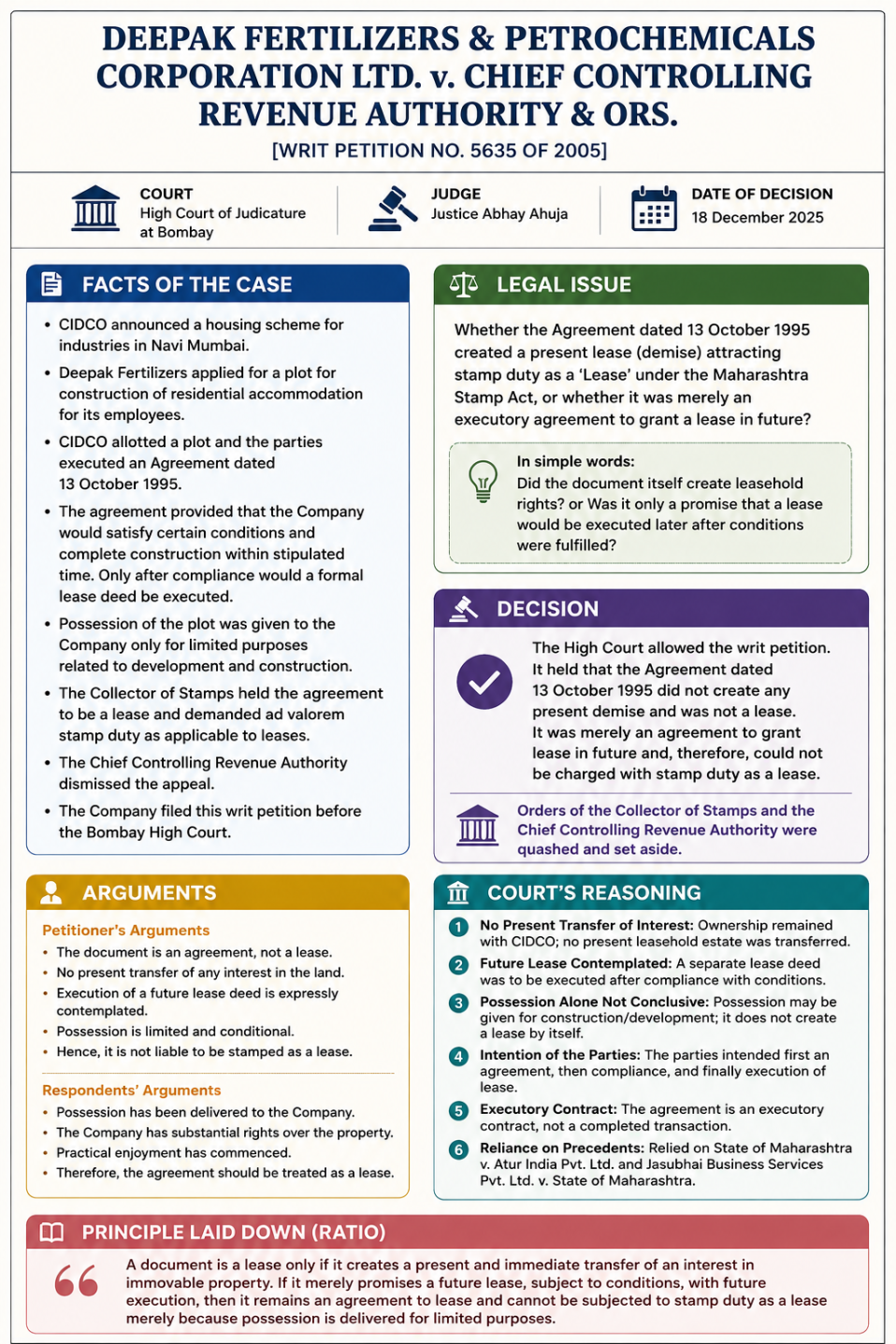
Lease or Agreement to Lease? A Case Analysis of Deepak Fertilizers v. Chief Controlling Revenue Authority
Deepak Fertilizers and Petrochemicals Corporation Ltd. v. Chief Controlling Revenue Authority & Ors., Writ Petition No. 5635 of 2005, decided on 18 December 2025 by Justice Abhay Ahuja. (Verdictum) Background and Facts The dispute arose from an agreement executed on 13 October 1995 between Deepak Fertilizers and CIDCO under a scheme through which CIDCO allotted developed residential plots to industries for construction of staff housing. The material facts were: CIDCO announced a housing scheme for industries in Navi Mumbai. Deepak Fertilizers applied for a plot for construction of residential accommodation for its employees. CIDCO allotted a plot and the parties executed an Agreement dated 13 October 1995. The agreement contemplated that: the company would satisfy several conditions; construction had to be completed within stipulated time; only after compliance would a formal lease deed be executed. Possession given to the company was only for limited purposes connected with development and construction under the agreement. The Collector of Stamps held that the agreement itself amounted to a lease and demanded ad valorem stamp duty as applicable to leases. The Chief Controlling Revenue Authority dismissed the company’s appeal. Deepak Fertilizers challenged those orders before the Bombay High Court. (Verdictum) Procedural History Authority Decision Collector of Stamps Held the agreement was a lease and liable to stamp duty as a lease Chief Controlling Revenue Authority Confirmed Collector’s order Bombay High Court Allowed the writ petition and set aside both orders Legal Issue The central legal issue was: Whether the Agreement dated 13 October 1995 created a present lease (demise) attracting stamp duty as a “Lease” under the Maharashtra Stamp Act, or whether it was merely an executory agreement to grant a lease in future. In simple words: Did the document itself create leasehold rights? or Was it only a promise that a lease would be executed later after conditions were fulfilled? Petitioner’s Arguments Deepak Fertilizers argued that: the document repeatedly described itself as an Agreement; it did not transfer any present interest in land; no leasehold estate came into existence immediately; execution of a future lease deed was expressly contemplated; possession was limited and conditional; therefore the agreement could not be stamped as a lease. The company relied upon earlier Bombay High Court decisions distinguishing between: agreement to lease actual lease Respondents’ Arguments The Revenue and CIDCO contended that: possession had already been handed over; the company had substantial rights over the property; practical enjoyment had commenced; therefore the agreement should be treated as a lease for stamp purposes. Core Legal Question Considered by the Court The Court examined a classical property law distinction: Does the document itself create a present demise? If yes → it is a lease. If no → it is merely an agreement to lease. This distinction has existed in Indian property law for decades. Court’s Reasoning Justice Abhay Ahuja analysed the document clause-by-clause. The Court emphasized that the substance of the document—not merely possession or nomenclature—determines its legal character. (Verdictum) No Present Transfer of Interest The Court observed that: ownership remained with CIDCO; no present leasehold estate was transferred; the agreement only created contractual obligations. This is the most important […]
Read more