
IN THE SUPREME COURT OF INDIA CIVIL APPELLATE JURISDICTION
CIVIL APPEAL NO(s). 2896 OF 2009
RAJA RAM…APPELLANT(S) VS JAI PRAKASH SINGH AND OTHERS RESPONDENT(S)
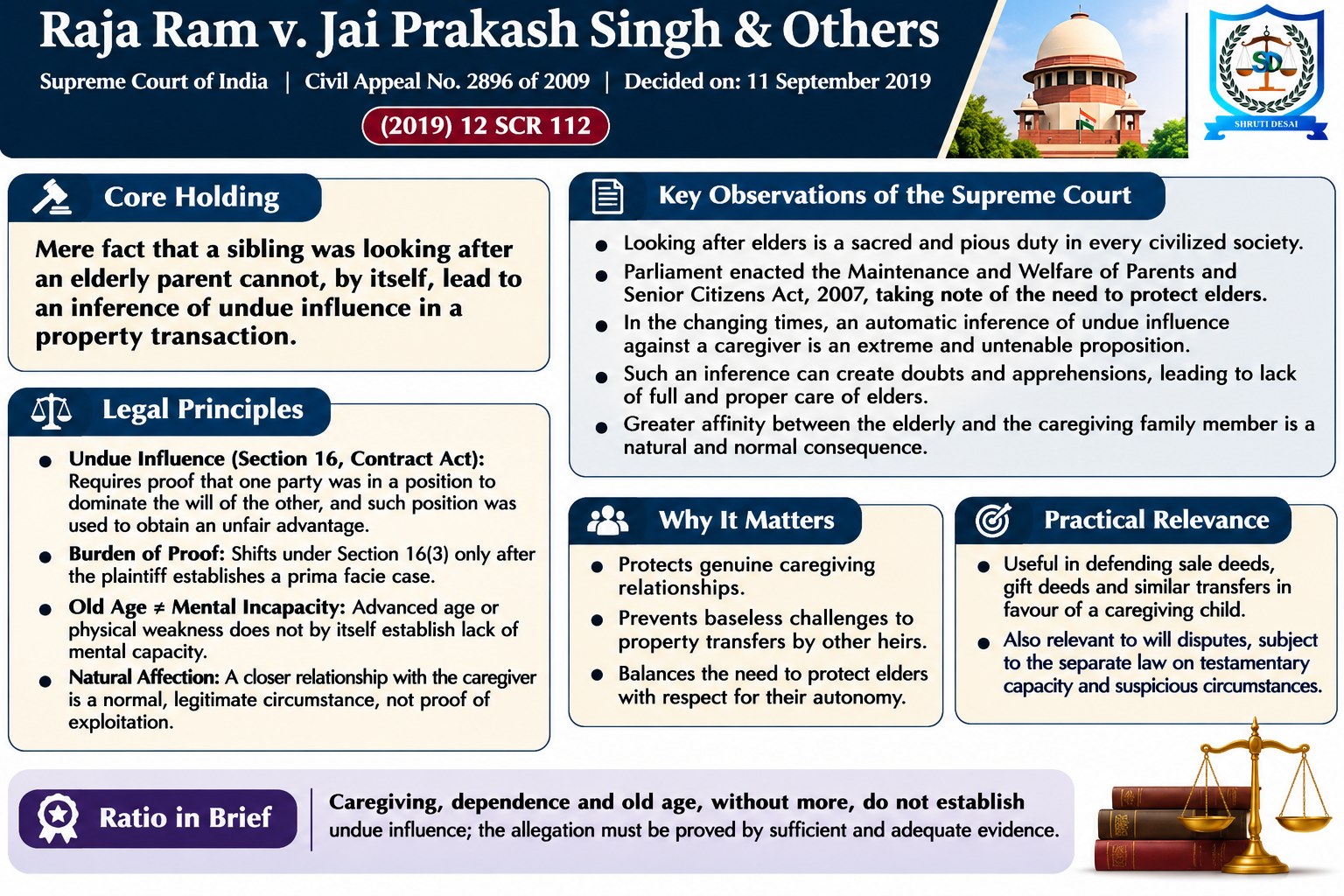
In every caste, creed, religion and civilized society, looking after the elders of the family is considered a sacred and pious duty. Nonetheless, today it has become a matter of serious concern. The Parliament taking note of the same enacted the Maintenance and Welfare of Parents and Senior Citizens Act, 2007. We are of the considered opinion, in the changing times and social mores, that to straightway infer undue influence merely because a sibling was looking after the family elder, is an extreme proposition which cannot be countenanced in absence of sufficient and adequate evidence. Any other interpretation by inferring a reverse burden of proof straightway, on those who were taking care of the elders, as having exercised undue influence can lead to very undesirable consequences. It may not necessarily lead to neglect, but can certainly create doubts and apprehensions leading to lack of full and proper care under the fear of allegations with regard to exercise of undue influence. Law and life run together. If certain members of the family are looking after the elderly and others by choice or by compulsion of vocation are unable to do so, there is bound to be more affinity between the elder members of the family with those who are looking after them day to day.
The Jurisprudence is Explained :
RAJA RAM v. JAI PRAKASH SINGH & OTHERS
Comprehensive legal analysis on undue influence, elderly parents and property transfers
Supreme Court of India Civil Appeal No. 2896 of 2009 Decided on: 11 September 2019 Reported as: (2019) 12 SCR 112
The judgment in Raja Ram v. Jai Prakash Singh & Others is an important authority in disputes where a property transaction executed by an elderly parent in favour of one child is challenged by other legal heirs on allegations of fraud, coercion, mental incapacity or undue influence.
The judgment recognises an important social and legal reality: the child who looks after an elderly parent may naturally develop a closer emotional relationship with that parent. Such a relationship cannot automatically be treated as exploitation.
The following is a developed legal analysis suitable for use in pleadings, written submissions, legal opinions and arguments before civil courts.
- Background and factual matrix
The dispute arose out of a property transaction executed by an elderly father in favour of the wife of one of his sons.
The appellant, Raja Ram, challenged the transaction on allegations of fraud, deceit and undue influence.
The material circumstances included the father’s advanced age, his physical condition and the fact that he was residing with the respondents, who were looking after him.
The appellant sought to question the validity of the transaction on the premise that the respondents, by virtue of their proximity and caregiving relationship, had exercised undue influence over the father.
The Supreme Court examined whether such allegations, without sufficient supporting evidence, could justify an inference that the transaction had been procured through undue influence.
The Court declined to accept the proposition that caregiving, by itself, could establish undue influence.
- Central question of law
Whether a property transaction executed by an elderly parent in favour of a family member who was looking after the parent can be presumed to have been procured through undue influence merely because of the caregiver’s proximity, relationship, affection and access to the elderly person?
The answer given by the Supreme Court was clear:
No. The mere fact that one sibling was looking after the elderly parent cannot, by itself, give rise to a presumption of undue influence.
The allegation must be supported by sufficient and adequate evidence establishing the ingredients of undue influence.
III. Legal principle laid down by the Supreme Court
The Supreme Court made an important observation concerning the changing social circumstances and the responsibility of family members towards elderly parents.
It recognised that looking after elderly family members is traditionally regarded as a sacred and pious duty.
The Court also referred to the Maintenance and Welfare of Parents and Senior Citizens Act, 2007, recognising the increasing importance of protecting elderly persons.
The underlying reasoning is that if the law begins to presume that a child who looks after an elderly parent necessarily exercises undue influence over that parent, it may create unnecessary suspicion around genuine caregiving relationships.
Such an interpretation could discourage children from providing proper care to elderly parents for fear that any subsequent property transaction in their favour might be challenged by other siblings.
The Court therefore cautioned against drawing an automatic inference of undue influence.
The law must distinguish between natural affection arising from caregiving and actual domination of another person’s will for obtaining an unfair advantage.
- Undue influence under Section 16 of the Indian Contract Act, 1872
Section 16 of the Indian Contract Act provides the statutory framework governing undue influence.
For establishing undue influence, the following essential ingredients must be examined:
- One party must be in a position to dominate the will of the other.
- The dominant position must have been used.
- Such use must have resulted in obtaining an unfair advantage.
The statutory circumstances under Section 16(2) include relationships involving real or apparent authority, fiduciary relationships and circumstances in which mental capacity is affected by age, illness or bodily or mental distress.
However, the existence of a relationship of confidence or dependence does not automatically establish that undue influence was actually exercised.
There is a distinction between being in a position to dominate another person’s will and actually using that position to obtain an unfair advantage.
This distinction is fundamental.
A son may provide continuous care to his elderly father. The father may repose confidence in that son, consult him on personal matters and voluntarily decide to transfer property to him.
Such circumstances may establish closeness and confidence, but they do not, without more, establish that the son manipulated or overpowered the father’s independent judgment.
- Burden of proof under Section 16(3)
One of the most significant aspects of the judgment concerns the shifting of the burden of proof.
Section 16(3) provides that where a person is in a position to dominate the will of another and the transaction appears on its face or on the evidence adduced to be unconscionable, the burden of proving that the contract was not induced by undue influence lies upon the person occupying the dominant position.
The legal position can be explained in the following manner:
First: The person challenging the transaction must plead the material facts constituting undue influence.
Second: The challenger must establish the foundational circumstances demonstrating that the beneficiary was in a position to dominate the will of the executant.
Third: The challenger must establish that the transaction was unconscionable, having regard to the circumstances.
Fourth: Once the statutory conditions are established, the burden shifts to the beneficiary to establish that the transaction was not induced by undue influence.
Therefore, the burden cannot automatically be shifted merely because the beneficiary is the child who was residing with and looking after the elderly parent.
The judgment reinforces the principle that the statutory burden-shifting mechanism cannot be invoked without establishing its foundational requirements.
- Old age and mental incapacity are legally distinct
This is another important aspect of the judgment.
Advanced age, physical weakness and dependence upon family members do not necessarily establish mental incapacity.
An elderly person may be physically weak, unable to move independently or dependent upon another family member for daily activities, yet retain the mental capacity to understand the nature and consequences of a property transaction.
The following distinctions are important:
| Circumstance | Legal significance |
| Advanced age | Does not automatically establish incapacity. |
| Physical weakness | Does not necessarily establish impaired judgment. |
| Dependence on children | Does not automatically establish domination of will. |
| Living with one child | Does not establish coercion. |
| Medical illness | Requires examination of its nature and effect on capacity. |
| Dementia or serious cognitive impairment | May be relevant if established at the time of execution. |
| Evidence of coercion or manipulation | May support a finding of undue influence. |
The relevant inquiry is not merely whether the executant was old, but whether the executant understood the nature and consequences of the transaction and whether the transaction was voluntary.
VII. Natural affection and the preference shown towards the caregiving child
The judgment recognises a principle of considerable practical importance in family property disputes.
An elderly parent may develop a stronger emotional attachment towards the child who provides continuous care.
This is a natural consequence of human relationships.
A child who regularly attends to the parent’s medical requirements, provides food and accommodation, accompanies the parent to hospitals and remains personally involved in daily affairs may naturally receive greater affection and confidence.
Consequently, an elderly parent may voluntarily decide to favour that child in a property transaction.
The law cannot treat such a decision as suspicious merely because other children have not received an equal benefit.
There is no universal legal requirement that a parent must distribute self-acquired property equally among all children during his or her lifetime.
The decision to benefit one child, even to the exclusion of others, is not by itself proof of undue influence.
This proposition must, however, be understood subject to the applicable rules of succession, ownership, capacity and validity of the transaction.
VIII. Application to registered gift deeds and sale deeds
The principles in Raja Ram are particularly relevant where an elderly parent executes a registered gift deed or sale deed in favour of one child.
Consider the following situation:
- A father owns self-acquired property.
- One son resides with him and looks after him for 15 years.
- The other children reside separately.
- The father voluntarily executes a registered gift deed in favour of the son who has been looking after him.
- Subsequently, the other children institute a civil suit seeking cancellation of the gift deed, alleging undue influence on account of the father’s old age and dependency.
In such circumstances, the mere fact that the beneficiary son was the caregiver cannot establish undue influence.
The court must examine the actual circumstances surrounding execution of the gift deed.
Relevant considerations would include:
- Whether the father was mentally capable of understanding the transaction.
- Whether he understood the nature and extent of the property being transferred.
- Whether the document was executed voluntarily.
- Whether there is evidence of threats, coercion or manipulation.
- Whether the beneficiary actively procured the transaction by exploiting a position of dominance.
- Whether the transaction was unconscionable.
- Whether the transaction was consistent with the father’s intention and surrounding circumstances.
A registered document is relevant evidence of execution and registration, but registration by itself does not conclusively establish the absence of undue influence.
The validity of the transaction must be assessed on the entire evidence.
- Application to testamentary dispositions and wills
Although Raja Ram concerned a sale deed, its reasoning concerning caregiving and natural affection is relevant to disputes concerning wills.
However, the legal framework governing wills is distinct.
The following principles must be considered:
- Testamentary capacity
Under Section 59 of the Indian Succession Act, 1925, a person of sound mind, who is not a minor, may make a will.
Advanced age alone does not disqualify a person from executing a valid will.
- Execution and attestation
Section 63 of the Indian Succession Act prescribes the requirements for execution and attestation of an unprivileged will.
- Proof of will
The applicable law of evidence requires proof of the will in accordance with the statutory requirements.
For proceedings governed by the Bharatiya Sakshya Adhiniyam, 2023, the corresponding provisions must be applied, subject to the applicable savings provisions.
- Suspicious circumstances
The propounder must establish the genuineness of the will and remove legitimate suspicious circumstances.
- Unequal distribution
The mere fact that one child receives the entire estate or a substantial portion of it does not automatically invalidate the will.
The testator is ordinarily entitled to decide how his or her self-acquired property should devolve, subject to applicable law.
- Caregiving
The fact that the beneficiary was looking after the testator may provide a natural explanation for the testator’s preference.
Nevertheless, where the beneficiary actively participates in procuring the will or other suspicious circumstances exist, the court must examine those circumstances carefully.
The judgment in Raja Ram should therefore be used to rebut the automatic inference of undue influence, not to dispense with the independent requirements for proving a will.
- Relevance of Section 111 of the Indian Evidence Act and Section 114 of the Bharatiya Sakshya Adhiniyam
The judgment must also be read in the context of the law relating to fiduciary relationships and active confidence.
Section 111 of the former Indian Evidence Act, 1872 dealt with proof of good faith in transactions where one party stood in a position of active confidence.
Its corresponding provision is Section 114 of the Bharatiya Sakshya Adhiniyam, 2023.
The important distinction is that the existence of a relationship of confidence must be examined in its factual and legal context.
A mere familial relationship does not automatically establish that every transaction between a parent and child is one in which the child has exercised undue influence.
The court must consider whether the circumstances establish a position of active confidence and whether the transaction has been properly explained.
- Additional Supreme Court authorities supporting the legal position
The following decisions may be considered when developing arguments alongside Raja Ram.
| Judgment | Legal principle |
| Anil Rishi v. Gurbaksh Singh, (2006) 5 SCC 558 | Burden of proof and the foundational requirements for shifting the burden. |
| H. Venkatachala Iyengar v. B.N. Thimmajamma, AIR 1959 SC 443 | Proof of wills and suspicious circumstances. |
| Madhukar D. Shende v. Tarabai Aba Shedage, (2002) 2 SCC 85 | Testamentary capacity and proof of a will. |
| Rani Purnima Debi v. Kumar Khagendra Narayan Deb, AIR 1962 SC 567 | Effect of registration and suspicious circumstances surrounding a will. |
These authorities address different aspects of the legal framework and should not be treated as though they all decide the same question.
XII. Proposed written submissions for a civil property dispute
The following is a developed argument that may be adapted for defending a property transfer in favour of a caregiving child.
SUBMISSIONS REGARDING ABSENCE OF UNDUE INFLUENCE AND VOLUNTARY EXECUTION OF THE PROPERTY TRANSACTION
- It is respectfully submitted that the allegations of fraud, coercion and undue influence levelled against the beneficiary are wholly misconceived and unsupported by legally admissible evidence.
- The mere fact that the beneficiary was residing with the executant and attending to his day-to-day needs, including food, accommodation, medical treatment and personal care, cannot, by itself, constitute undue influence within the meaning of Section 16 of the Indian Contract Act, 1872.
- The Hon’ble Supreme Court of India, in Raja Ram v. Jai Prakash Singh & Others, Civil Appeal No. 2896 of 2009, decided on 11 September 2019, has categorically observed that to straightaway infer undue influence merely because a sibling was looking after the family elder would be an extreme proposition which cannot be countenanced in the absence of sufficient and adequate evidence.
- The Hon’ble Supreme Court has further recognised that a greater degree of affection and emotional affinity may naturally develop between an elderly parent and the family member who attends to the parent’s daily requirements. Such natural affection and confidence cannot be equated with legal undue influence.
- It is submitted that the law does not presume that every transaction executed by an elderly parent in favour of the child providing care is tainted by coercion, manipulation or exploitation. Such an inference, without supporting evidence, would be contrary to the principles governing voluntary transactions and the statutory requirements of Section 16 of the Indian Contract Act.
- The statutory burden-shifting mechanism under Section 16(3) of the Indian Contract Act can be invoked only upon establishing the foundational requirements, namely, the existence of a position to dominate the will of the executant and circumstances demonstrating that the transaction was unconscionable.
- Mere old age, physical infirmity, residence with the beneficiary or dependence upon the beneficiary for daily requirements cannot independently establish that the executant lacked the mental capacity to understand the nature and consequences of the transaction.
- It is further submitted that the plaintiffs cannot seek cancellation of an otherwise valid property transaction merely on the ground that the executant chose to favour one child over the others. Where the property constitutes the executant’s self-acquired property, the executant is ordinarily entitled to decide the manner in which such property should be transferred, subject to the applicable legal requirements.
- The plaintiffs are required to establish their allegations by cogent evidence demonstrating actual domination of the executant’s will and the exercise of such domination to obtain an unfair advantage. Suspicion, conjecture and assumptions arising merely from the relationship between the executant and beneficiary cannot substitute proof.
- In the absence of sufficient evidence establishing fraud, coercion, incapacity or undue influence, the transaction cannot be invalidated merely because the beneficiary was the family member who looked after the elderly executant.
- Accordingly, applying the principles laid down by the Hon’ble Supreme Court in Raja Ram v. Jai Prakash Singh & Others, the allegations of undue influence deserve to be rejected and the validity of the transaction ought to be determined on the basis of the actual pleadings and evidence on record.
XIII. Important qualifications and limitations of the judgment
For effective use before a court, the following distinctions must be kept in mind:
- Raja Ram does not hold that an elderly person’s transaction can never be challenged.
- It does not eliminate the possibility of establishing undue influence through circumstantial evidence.
- It does not declare that every transaction in favour of a caregiving child is valid.
- It does not dispense with proof of due execution and attestation of a will.
- It does not protect a person who has actually exploited the elderly parent’s physical, mental or financial vulnerability.
- It does not override the rights of coparceners or co-owners in property that the executant does not exclusively own.
The judgment must be applied according to the nature of the property, the nature of the instrument and the evidence concerning the executant’s capacity and voluntariness.
XIV. Conclusion: The ratio and its practical importance
The real significance of Raja Ram v. Jai Prakash Singh & Others lies in the Supreme Court’s recognition that caregiving cannot be converted into a presumption of exploitation.
A child who devotes time, effort and resources to caring for an elderly parent cannot be treated as having exercised undue influence merely because the parent subsequently chooses to transfer property in that child’s favour.
The law requires proof of the legally recognised ingredients of undue influence. It does not permit a court to substitute suspicion for evidence.
Equally, the law must respect the autonomy of an elderly person to make independent decisions concerning his or her property.
The governing principle is that natural affection, confidence and gratitude arising from caregiving must be distinguished from actual domination of the executant’s will and the procurement of an unfair advantage.
This is the central proposition for which the judgment is particularly valuable in family property litigation.
- A further issue worth examining
There is an important distinction between two situations that can substantially affect the outcome of a property case:
- Situation A: An elderly father voluntarily transfers his self-acquired property to the son who has looked after him for many years.
- Situation B: An elderly father transfers his property to one son, but the evidence shows that the son isolated him, controlled his finances, prevented access to other family members and actively procured the transfer.
The first situation may be explained by natural affection and gratitude. The second may raise genuine questions of domination, exploitation and undue influence.
The court must distinguish between the two on the basis of evidence.
Raja Ram is particularly relevant to preventing Situation A from being incorrectly treated as Situation B.
FROM THE PEN OF AUTHOR
law provides for equal share. it also provides for WILL (vasiyat). the errant kids who never took care of parents in majority of cases challenge even last wish of dead parent.
one who never shared cost of hospitalisation, regular medicine, clothes, food and never participated in taking care at home or in the hospital is entitled to equal share just because he/she is born in the family? Should he/she be entitled? Hindu Succession Act needs a relook?
Shruti Desai
18th November 2026.

Post a comment