
Can a Child Be Accused of Undue Influence for Caring for an Elderly Parent? Supreme Court Explains
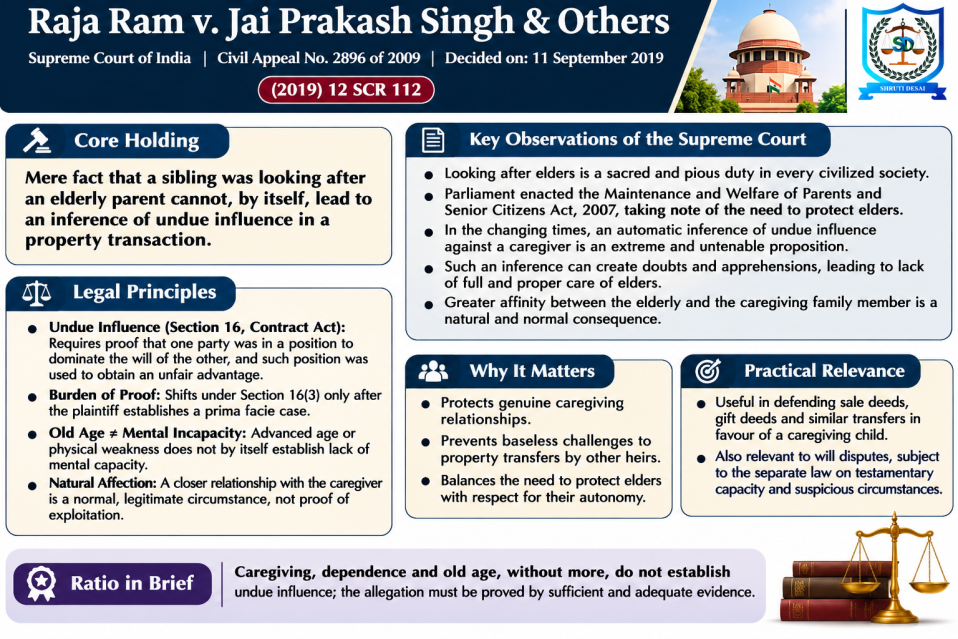
IN THE SUPREME COURT OF INDIA CIVIL APPELLATE JURISDICTION CIVIL APPEAL NO(s). 2896 OF 2009 RAJA RAM…APPELLANT(S) VS JAI PRAKASH SINGH AND OTHERS RESPONDENT(S) In every caste, creed, religion and civilized society, looking after the elders of the family is considered a sacred and pious duty. Nonetheless, today it has become a matter of serious concern. The Parliament taking note of the same enacted the Maintenance and Welfare of Parents and Senior Citizens Act, 2007. We are of the considered opinion, in the changing times and social mores, that to straightway infer undue influence merely because a sibling was looking after the family elder, is an extreme proposition which cannot be countenanced in absence of sufficient and adequate evidence. Any other interpretation by inferring a reverse burden of proof straightway, on those who were taking care of the elders, as having exercised undue influence can lead to very undesirable consequences. It may not necessarily lead to neglect, but can certainly create doubts and apprehensions leading to lack of full and proper care under the fear of allegations with regard to exercise of undue influence. Law and life run together. If certain members of the family are looking after the elderly and others by choice or by compulsion of vocation are unable to do so, there is bound to be more affinity between the elder members of the family with those who are looking after them day to day. The Jurisprudence is Explained : RAJA RAM v. JAI PRAKASH SINGH & OTHERS Comprehensive legal analysis on undue influence, elderly parents and property transfers Supreme Court of India Civil Appeal No. 2896 of 2009 Decided on: 11 September 2019 Reported as: (2019) 12 SCR 112 The judgment in Raja Ram v. Jai Prakash Singh & Others is an important authority in disputes where a property transaction executed by an elderly parent in favour of one child is challenged by other legal heirs on allegations of fraud, coercion, mental incapacity or undue influence. The judgment recognises an important social and legal reality: the child who looks after an elderly parent may naturally develop a closer emotional relationship with that parent. Such a relationship cannot automatically be treated as exploitation. The following is a developed legal analysis suitable for use in pleadings, written submissions, legal opinions and arguments before civil courts. Background and factual matrix The dispute arose out of a property transaction executed by an elderly father in favour of the wife of one of his sons. The appellant, Raja Ram, challenged the transaction on allegations of fraud, deceit and undue influence. The material circumstances included the father’s advanced age, his physical condition and the fact that he was residing with the respondents, who were looking after him. The appellant sought to question the validity of the transaction on the premise that the respondents, by virtue of their proximity and caregiving relationship, had exercised undue influence over the father. The Supreme Court examined whether such allegations, without sufficient supporting evidence, could justify an inference that the transaction had been procured through undue influence. The Court declined to accept the proposition that caregiving, […]
Read more