
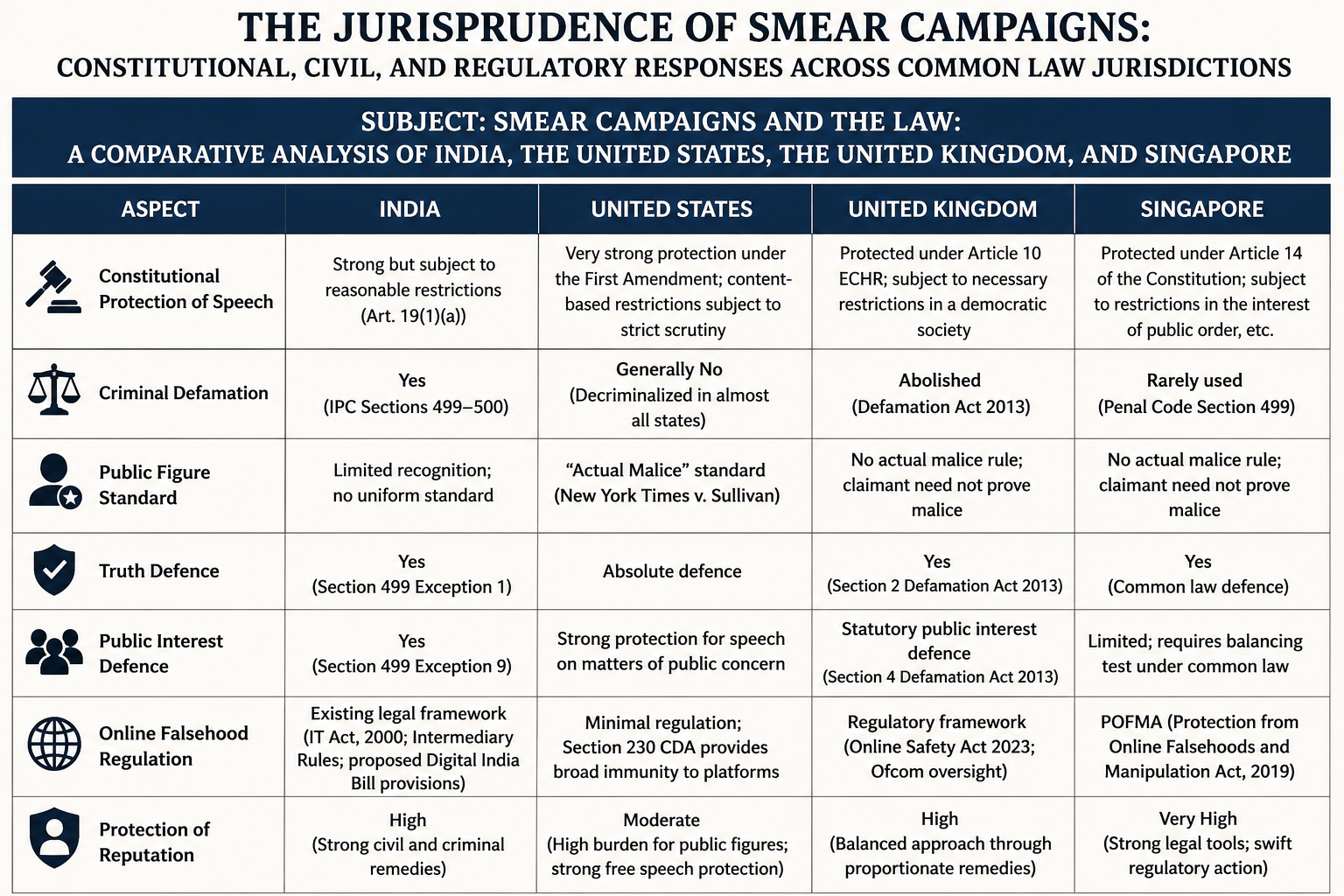
SUBJECT:
SMEAR CAMPAIGNS AND THE LAW: A COMPARATIVE ANALYSIS OF INDIA, THE UNITED STATES, THE UNITED KINGDOM, AND SINGAPORE
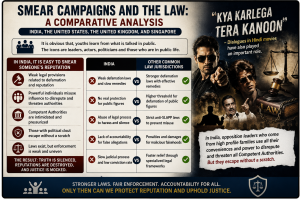
It is obvious that, youths learn from what is talked in public. The icons are leaders, actors, politicians and those who are in public life.
It’s easy in India to smear someone’s reputation. Reason is weak provisions. In India opposition leader who come from high profile family uses all his conveniences and power to disrepute and threaten all Competent Authorities. But he escapes without a scratch.
Dialogues in Hindi movies like “kya karlega tera kanoon” also played important role.
In my childhood we were taught by mothers not to say insulting or false about others. It was considered as sin. However it appears that deity of Karma is also tired of dealing with falsehood and false public allegations. There is a wait list for justice there too.
A famous bhajan ” ninda a kare keni re” loved by Bapu is forgotten.
With this common parlance discussion lets turn to the legal discussion.
USA:
UAE-Backed Dark PR (2023): The United Arab Emirates (UAE) hired Swiss firm Alp Services to conduct a covert, multi-year smear campaign targeting a US-based businessman, Hazim Nada, and his commodities-trading firm, Lord Energy. The campaign manipulated markets and successfully forced the company into liquidation by spreading false allegations of terrorist.
Martin Luther King Jr. FBI Surveillance (1960s): The FBI under J. Edgar Hoover orchestrated a massive, covert operation to discredit Dr. Martin Luther King Jr., labelling him a subversive. The agency sent defamatory packages, wiretapped his communications, and urged him to commit suicide to silence his activism. ( check: https://www.aclu.org/press-releases/aclu-releases-report-fbi-crusade-against-martin-luther-king-jr-urges-ashcroft-not )
Planned Parenthood Foetal Tissue Controversy (2015): Anti-abortion groups released deceptively edited videos to accuse Planned Parenthood of illegally selling foetal tissue for profit. The healthcare organization denounced the effort as a fabricated smear campaign designed to cut off their federal funding. ( check https://www.bbc.com/news/world-us-canada-34396751)
UNITED KINGDOM:
The Sir David Attenborough Climate Campaign (2019–2023): Following the release of the Netflix documentary Our Planet, which featured footage of Pacific walruses falling to their deaths, climate change deniers initiated a widespread smear campaign against Attenborough. The attackers falsely alleged that he and the production crew fabricated the tragedy to artificially push climate change narratives.
The Labour Together Corporate Intelligence Report (2024–2026): In a major political controversy, it was revealed that the UK think tank Labour Together commissioned a US public relations firm (APCO) to compile a 58-page report, codenamed “Operation Cannon”. The report targeted journalists at the Sunday Times who were investigating the group’s campaign funding and attempted to discredit them by alleging foreign interference and making personal attacks.
SINGAPORE
Singtel vs. Telco Rivals (2015)
The Incident: Telecommunications giant Singtel and social media agency Gushcloud were exposed for running an orchestrated online smear campaign against rival telcos StarHub and M1. Details: Bloggers were paid and incentivized to fabricate complaints and criticize the network connections of the rival telcos.
Resolution: Following whistleblowing by blogger Xiaxue, Singtel’s CEO publicly apologized, the responsible employees were fired, and the Infocomm Development Authority (IDA) issued a stern warning to the telco. (check https://www.campaignasia.com/article/ethical-crackdown-regulating-singapores-influencer-scene/2xnaatoej5nqkwmj28qr5s2lyl)
The Oxley Road Dispute (2024) The Incident: Following a prolonged family dispute over the demolition of founding Prime Minister Lee Kuan Yew’s house, the Singapore government accused Lee Hsien Yang of running an international smear campaign against the country and his family. ( check https://malaysia.news.yahoo.com/singapore-govt-accuses-lee-hsien-040007983.html)
INDIA
Smear campaigns in India are increasingly coordinated through coordinated troll networks, deepfake distributions, and targeted media pushes to harass journalists, political rivals, and human rights defenders. These attacks frequently weaponize social media algorithms to assassinate character and stifle dissent. Major instances of smear campaigns include:
Political Disinformation: Major political parties regularly accuse each other of orchestrating defamation campaigns on social media. Recently, Indian authorities have also characterized critical international media reports as “smear campaigns” intended to undermine the nation’s geopolitical standing.
Media Watchdogs: Independent watchdogs like Reporters Without Borders (RSF) track and publish reports on how organized propaganda networks operate in India to target dissenting voices and spread hostile content.
These are few examples.
LET US SEE DIGITAL ERA AND SMEAR CAMPAIGN
The digital era has transformed the manner in which reputations are created, protected, and destroyed. Social media platforms, online publications, blogs, and coordinated misinformation networks have facilitated the emergence of smear campaigns capable of causing severe reputational, economic, and psychological harm. While democratic societies recognize freedom of expression as a fundamental right, they also acknowledge the need to protect individuals from false and malicious attacks on their reputation. This article examines the legal framework governing smear campaigns in India and compares it with the approaches adopted in the United States, the United Kingdom, and Singapore. The article further analyzes leading judicial decisions and evaluates the balance struck between freedom of speech and protection of reputation in these jurisdictions.
Introduction
A smear campaign may be defined as a deliberate and systematic effort to damage the reputation of an individual, corporation, public official, or institution through false, misleading, defamatory, or malicious statements. Such campaigns may be carried out through traditional media, political propaganda, anonymous publications, or increasingly through digital platforms and social networking sites.
Historically, the law of defamation evolved as a mechanism to protect reputation, which has long been regarded as an important aspect of personal dignity and social standing. Modern constitutional democracies, however, must balance reputational interests against the equally important right to freedom of speech and expression.
The approaches adopted by India, the United States, the United Kingdom, and Singapore reveal significant differences in how legal systems reconcile these competing interests.
Smear Campaigns Under Indian Law
Constitutional Framework
Article 19(1)(a) of the Constitution of India guarantees freedom of speech and expression. However, Article 19(2) expressly permits reasonable restrictions in the interests of, inter-alia, defamation.
Unlike the United States, where free speech receives near-absolute constitutional protection in political discourse, the Indian Constitution specifically recognizes protection of reputation as a legitimate limitation on free expression.
The Supreme Court has repeatedly held that reputation forms an integral part of the right to life and personal liberty guaranteed under Article 21.
Civil Defamation
Indian civil defamation law is derived primarily from English common law principles.
To establish defamation, a plaintiff must prove:
- Publication of a defamatory statement;
- Reference to the plaintiff;
- Injury to the plaintiff’s reputation.
Civil remedies include:
- Damages;
- Permanent injunctions;
- Retractions and apologies;
- Interim relief restraining publication.
Criminal Defamation
India continues to retain criminal defamation.
Section 356 of the Bharatiya Nyaya Sanhita, 2023 (formerly Sections 499 and 500 of the Indian Penal Code, 1860) criminalizes defamatory publications.
The law recognizes several defenses including:
- Truth for public good;
- Fair comment;
- Good-faith criticism;
- Reporting judicial proceedings;
- Protection of lawful interests.
Leading Indian Judgments
Subramanian Swamy v. Union of India (2016) 7 SCC 221
This landmark decision upheld the constitutional validity of criminal defamation.
The Supreme Court held that:
- Reputation is an aspect of Article 21;
- Freedom of speech is not absolute;
- Criminal defamation constitutes a reasonable restriction under Article 19(2).
The judgment remains the principal authority supporting criminal action against malicious smear campaigns.
- Rajagopal v. State of Tamil Nadu (1994) 6 SCC 632
The Supreme Court recognized the right to privacy and emphasized that truthful publication based upon public records is generally protected.
Tata Sons Ltd. v. Greenpeace International (2011)
The Delhi High Court protected satire and parody, observing that criticism and commentary remain protected forms of expression unless they become defamatory.
III. Smear Campaigns Under United States Law
Constitutional Foundation
The First Amendment provides robust protection for speech.
American defamation law reflects a strong preference for uninhibited public debate, particularly regarding public officials and public figures.
Consequently, the legal threshold for establishing defamation is significantly higher than in India, Singapore, or the United Kingdom.
Elements of Defamation
A plaintiff generally must establish:
- A false statement of fact;
- Publication to a third party;
- Fault by the defendant;
- Damage to reputation.
Truth constitutes a complete defense.
Public Officials and Public Figures
American law distinguishes between:
- Private individuals;
- Public officials;
- Public figures.
Public figures face a substantially heavier burden in defamation proceedings.
New York Times Co. v. Sullivan (1964)
The United States Supreme Court established the “actual malice” doctrine.
The Court held that a public official must prove that the defendant:
- Knew the statement was false; or
- Acted with reckless disregard for its truth.
The decision transformed American defamation law by making it difficult for public officials to suppress criticism through litigation.
Curtis Publishing Co. v. Butts (1967)
The Supreme Court extended the actual malice standard to public figures.
Gertz v. Robert Welch, Inc. (1974)
The Court distinguished between public figures and private persons, holding that private individuals enjoy greater legal protection because they possess fewer opportunities to counter false accusations through media access.
Legal Position
The United States remains the most speech-protective jurisdiction among major democracies. Political criticism, investigative journalism, and public commentary receive extensive constitutional protection, even when statements are harsh, offensive, or controversial.
Smear Campaigns Under United Kingdom Law
Historical Development
The United Kingdom is the birthplace of the common law of defamation and historically maintained plaintiff-friendly defamation rules. Concerns regarding “libel tourism” and excessive restrictions on free speech eventually led to significant legislative reform.
Defamation Act 2013
The Defamation Act 2013 fundamentally reshaped English defamation law.
A claimant must establish that the publication has caused or is likely to cause “serious harm” to reputation.
For corporations, serious financial loss must generally be demonstrated.
Defences
The Act recognizes several statutory defenses:
Truth.A defendant is protected if the defamatory allegation is substantially true.
Honest Opinion
Protection is available for genuinely held opinions based upon existing facts.
Publication on Matters of Public Interest
Journalists and publishers may rely on this defense where publication concerns matters of public importance and reasonable steps were taken to verify the information.
Leading UK Judgments
Reynolds v. Times Newspapers Ltd. (2001)
The House of Lords developed the doctrine of responsible journalism, providing protection for publications concerning matters of public interest.
Jameel v. Wall Street Journal Europe (2006)
The House of Lords reinforced protections for investigative journalism and public-interest reporting.
Lachaux v. Independent Print Ltd. (2019) UKSC 27
The UK Supreme Court clarified the “serious harm” requirement under the Defamation Act 2013.
The Court held that claimants must demonstrate actual or probable serious reputational damage rather than merely relying upon the defamatory tendency of the words.
Current Position
The UK now occupies a middle ground between the United States and reputation-protective jurisdictions such as Singapore. It protects investigative journalism and public-interest reporting while continuing to provide meaningful remedies for reputational harm.
Smear Campaigns Under Singapore Law
General Framework
Singapore adopts one of the most reputation-protective legal regimes among common-law jurisdictions.
Its courts consistently emphasize the importance of personal reputation and public trust.
Civil Defamation
Singapore recognizes:
- Libel;
- Slander;
- Aggravated damages;
- Injunctions;
- Public apologies.
Damages awarded in serious cases can be substantial.
Protection from Online Falsehoods and Manipulation Act (POFMA), 2019
POFMA was enacted to combat online misinformation.
The legislation empowers authorities to issue:
- Correction Directions;
- Stop Communication Directions;
- Targeted Correction Orders.
Unlike traditional defamation proceedings, POFMA seeks to correct false information before reputational damage becomes widespread.
The Online Citizen Pte Ltd v. Attorney-General (2021)
The Singapore Court of Appeal clarified:
- The legal test for determining falsity;
- Standards applicable to POFMA directions;
- Judicial review mechanisms.
The decision remains the leading authority on misinformation regulation in Singapore.
Political Defamation Litigation
Singapore has witnessed several defamation actions involving political leaders and public officials. Courts have generally demonstrated willingness to grant substantial relief where allegations are shown to be false and damaging.
Comparative Analysis
The four jurisdictions represent different constitutional and policy choices.
The United States prioritizes freedom of expression above reputational interests, especially in political discourse. The actual malice doctrine makes successful actions by public figures difficult.
India adopts a balanced approach. Reputation is treated as a component of personal dignity under Article 21, while freedom of speech remains protected under Article 19(1)(a). The retention of criminal defamation reflects India’s emphasis on protecting individual reputation.
The United Kingdom occupies an intermediate position. The Defamation Act 2013 strengthened protections for free speech while preserving effective remedies for serious reputational injury.
Singapore adopts the strongest reputation-protective framework. Through defamation law and POFMA, the legal system seeks to prevent and remedy reputational harm at an early stage.
VII. Comparative Table
| COUNTRY | Preliminary
Civil Laws |
Criminal Laws and Penalties | Anti Harassment
Digital Laws |
Defences and Burden of Proofs |
| UK | Defamation Act 2013 | Common Law Libel/Slander (largely abolished in practice, though available) | Protection from Harassment Act 1997 (civil & criminal); Online Safety Act 2023 (punishes false communications causing non-trivial harm) | Truth is the primary defense. Defendant must prove honest opinion or public interest. The claimant must prove “serious harm” to reputation. |
| USA | Common Law Defamation (varies by state) | Criminal Defamation (mostly unconstitutional/rarely used) | Varies by state, but federal/state Anti-SLAPP statutes protect against retaliatory lawsuits. Severe penalties for intentional Cyberstalking | Truth is an absolute defense. Public figures must prove “Actual Malice” (knowing falsity or reckless disregard). |
| SINGAPORE | Defamation Act (Cap. 75) | Penal Code (Section 499 – Criminal Defamation; punishable with up to 2 years in prison or fine) | Protection from Harassment Act (POHA) 2014 (criminalizes harassment/doxxing; grants civil protection orders & stop-publication orders) | Truth is a defense. High focus on damages. POHA offers fast-track civil/injunctive relief regardless of standard defamation. |
| INDIA | Civil defamation under the Law of Torts | Indian Penal Code (Section 499 – Criminal Defamation; up to 2 years imprisonment / fine) | Information Technology (IT) Act 2000 (Section 66A was struck down, but Section 67 applies to obscenity). Civil Injunctions are available for ongoing damage. | Truth for public good, Public Conduct of public servants, and Fair Comment/Good Faith. Burden of proof heavily |
VIII. CONCLUSION
Smear campaigns present one of the most significant legal challenges of the digital age. Their capacity to rapidly disseminate falsehoods across borders has forced legal systems to reconsider traditional defamation doctrines.
The comparative study reveals four distinct models. The United States prioritizes free speech and democratic debate. India seeks equilibrium between dignity and expression through both civil and criminal remedies. The United Kingdom increasingly emphasizes public-interest speech while preserving protection against serious reputational harm. Singapore adopts a proactive regulatory approach designed to suppress misinformation and safeguard reputation.
As online platforms continue to amplify the reach and impact of smear campaigns, future legal developments are likely to focus on misinformation, platform accountability, artificial intelligence-generated content, and cross-border enforcement of defamation judgments. The challenge for all legal systems will remain the same: preserving robust democratic discourse while protecting individuals from malicious attacks upon their reputation.
SHRUTI DESAI
19th June 2026
Post a comment