
INTRODUCTION
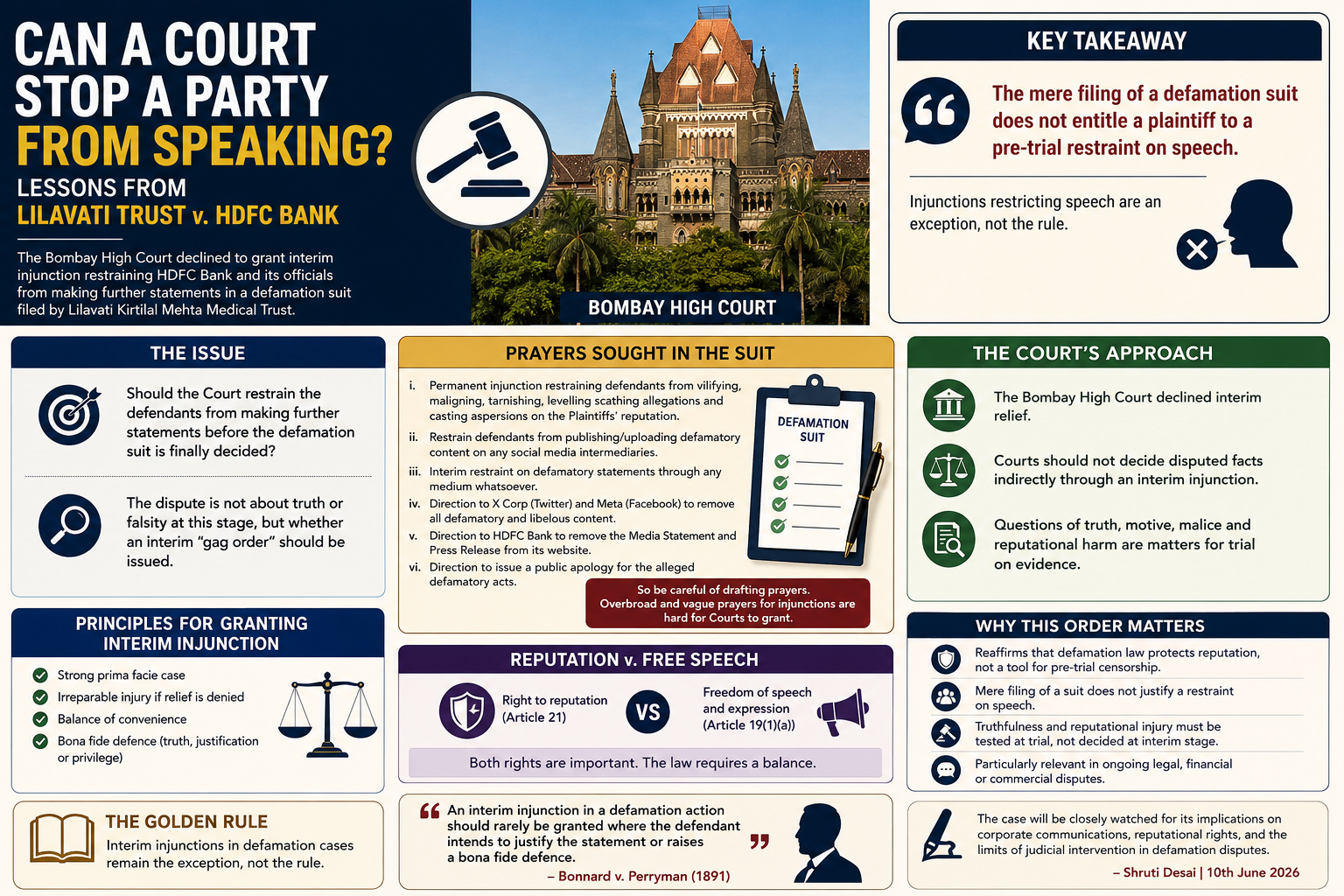
The Bombay High Court recently dealt with an important issue arising in a high-profile dispute between the Lilavati Kirtilal Mehta Medical Trust and HDFC Bank. The Trust instituted a defamation suit against HDFC Bank and its officials and sought interim relief restraining the defendants from making further statements allegedly affecting the reputation of the Trust and its trustees.
The Court declined to grant the interim injunction.
Although the final rights of the parties will be decided at trial, the order raises an important question:
Can a person obtain a court order preventing another person from speaking merely because the statements are alleged to be defamatory?
The answer, according to long-settled principles of Indian law, is generally no.
WHY IS THIS CASE IMPORTANT?
Many litigants believe that once a defamation suit is filed, the Court will immediately restrain the opposite party from making further statements. However, Indian courts have consistently adopted a cautious approach while granting injunctions in defamation matters.
An injunction restricting speech is considered a serious remedy because it directly affects the constitutional guarantee of freedom of speech and expression under Article 19(1)(a) of the Constitution.
Consequently, courts insist upon a very high threshold before issuing what is effectively a “gag order”.
THE REAL ISSUE BEFORE THE COURT
The dispute before the Court was not whether the statements were ultimately true or false.
The issue was much narrower:
Here are the Prayers sought:
the prayers in the Suit that forms the basis of IA 3095 are extracted below:
i. A Decree may be passed for Permanent Perpetual Injunction in favour of the Plaintiffs and against the Defendants thereby restraining the Defendants, their representatives, employees, agents, heirs, or any other person from vilifying ,maligning, tarnishing, levelling scathing allegations and casting aspersions upon the reputation, good will and image of the Plaintiffs and family through any medium whatsoever;
ii. The Defendants and their representatives may be permanently restrained from circulating/publishing/ uploading any defamatory content harming/injuring or damaging the reputation of the Plaintiffs on any social media intermediaries;
iii. Pending the hearing and final disposal of the present Suit, this Hon’ble Court may be pleased to restrain the Defendants, their representatives, employees, agents, heirs, or any other person from vilifying, maligning, tarnishing, levelling scathing allegations and casting aspersions upon the reputation, good will and image of the Plaintiffs and family through any medium whatsoever;
iv. That pending the hearing and final disposal of the present Suit, this Hon’ble Court may be pleased to direct the Defendants and media channels including the X Corp/Defendant No. 5 (X. Com, formerly known as Twitter) and Meta Platforms Inc. (FaceBook)/ Defendant No. 6 to remove all defamatory and libelous articles/materials from all accounts, which has been published in any form against the Plaintiff and Mr. Prashant Mehta and his family;
v. That pending the hearing and final disposal of the present Suit, this Hon’ble Court may be pleased to direct the Defendant No.1 i.e., the HDFC Bank to remove the Media Statement and the Press Release from the website of theDefendant No. 1 Bank (which are accessible at)i.e.,https://www.hdfcbank.com/personal/about-us/news-room/press-release/2025/q2/media-statement and https://www.hdfcbank.com/
vi. That this Hon’ble Court may be pleased to pass the Decree for Permanent Perpetual Injunction in favour of the Plaintiff and against the Defendants thereby directing the Defendants to issue a public apology to the Plaintiff, Mr. Prashant Mehta and his family members for the wilful and deliberate tortuous acts of defamation committed by them. [Emphasis Supplied]
So be careful of drafting prayers.
Should the Court restrain the defendants from making further statements before the defamation suit is finally decided?
This distinction is important.
A plaintiff may eventually succeed in proving defamation. However, that does not automatically entitle the plaintiff to obtain an interim injunction.
Courts generally examine:
- whether the plaintiff has established a strong prima- facie case;
- whether irreparable injury will be caused if relief is denied;
- whether the balance of convenience favours the grant of an injunction; and
- whether the defendant has raised a bonafide defense such as truth, justification, or privilege.
THE COURT’S APPROACH
The Bombay High Court declined to grant interim relief.
The significance of the order lies in the Court’s unwillingness to interfere with speech at an interlocutory stage where the controversy remains disputed.
Indian courts have repeatedly held that questions relating to truth, motive, malice, and reputational harm are ordinarily matters to be determined on evidence during trial. Unless the impugned statements are clearly indefensible, courts are reluctant to impose prior restraints.
The underlying principle is simple:
Courts should not decide disputed facts indirectly through an interim injunction.
REPUTATION VERSUS FREE SPEECH
The case once again highlights the tension between two important legal rights.
On one hand is the right to reputation, recognised as a component of Article 21 of the Constitution.
On the other hand is the freedom of speech and expression guaranteed by Article 19(1)(a).
Neither right is absolute.
The law therefore requires courts to strike a balance between protecting reputation and avoiding unnecessary restrictions on public discussion.
Where parties are engaged in ongoing legal, financial, or commercial disputes, courts generally permit reasonable public responses unless the statements are clearly malicious or entirely without factual foundation.
WHY THIS ORDER MATTERS
The order is important not merely because of the parties involved, but because it reaffirms a broader legal principle.
Defamation law is intended to protect reputation. It is not intended to become a mechanism for obtaining pre-trial censorship.
The decision serves as a reminder that the mere filing of a defamation suit does not automatically justify a restraint on speech. Questions relating to truthfulness and reputational injury must ordinarily be tested through evidence and cross-examination rather than decided at the interim stage.
CONCLUSION
The Bombay High Court’s refusal to grant interim relief in the Lilavati Trust-HDFC Bank dispute reinforces the judiciary’s traditional reluctance to issue gag orders in defamation cases. The ruling underscores that injunctions restricting speech remain an exceptional remedy and that contested questions of fact are best resolved at trial.
The decision illustrates a principle that lies at the heart of defamation jurisprudence: while reputation deserves protection, courts are generally reluctant to silence speech before the truth of the dispute has been tested at trial. Unless a statement is plainly indefensible, interim injunctions in defamation actions remain the exception rather than the rule. For practitioners, the case is also a reminder that carefully drafted prayers are often as important as the substantive claim itself.
As the substantive proceedings continue, the case will be closely watched for its implications on corporate communications, reputational rights, and the limits of judicial intervention in defamation disputes.
Shruti Desai
10th June 2026

Post a comment