
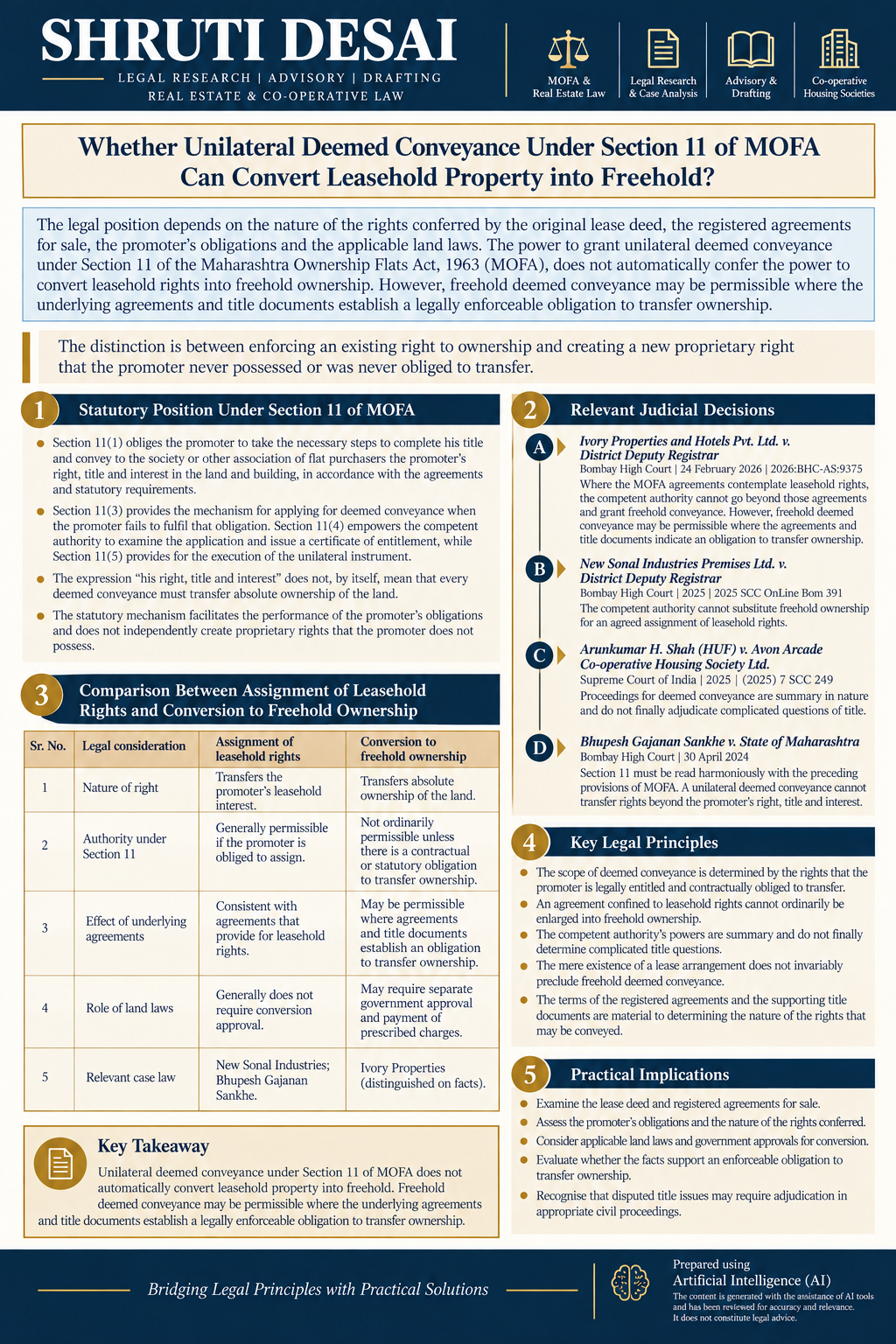
Whether Unilateral Deemed Conveyance Under Section 11 of MOFA Can Convert Leasehold Property into Freehold?
The legal position depends on the nature of the rights conferred by the original lease deed, the registered agreements for sale, the promoter’s obligations and the applicable land laws.
The power to grant unilateral deemed conveyance under Section 11 of the Maharashtra Ownership Flats Act, 1963 (MOFA), does not automatically confer the power to convert leasehold rights into freehold ownership. However, freehold deemed conveyance may be permissible where the underlying agreements and title documents establish a legally enforceable obligation to transfer ownership.
The distinction is between enforcing an existing right to ownership and creating a new proprietary right that the promoter never possessed or was never obliged to transfer.
- Statutory Position Under Section 11 of MOFA
Section 11(1) of MOFA obliges the promoter to take the necessary steps to complete his title and convey to the society or other association of flat purchasers the promoter’s right, title and interest in the land and building, in accordance with the agreements and statutory requirements.
Section 11(3) provides the mechanism for applying for deemed conveyance when the promoter fails to fulfil that obligation. Section 11(4) empowers the competent authority to examine the application and issue a certificate of entitlement, while Section 11(5) provides for the execution of the unilateral instrument.
The statutory expression “his right, title and interest” is significant. It does not, by itself, mean that every deemed conveyance must transfer absolute ownership of the land.
There is a fundamental distinction between the power to execute a conveyance without the promoter’s cooperation and the power to enlarge the proprietary rights that are the subject of that conveyance.
- Relevant Bombay High Court and Supreme Court Decisions
- Ivory Properties and Hotels Pvt. Ltd. v. District Deputy Registrar
Bombay High Court | 24 February 2026 | 2026:BHC-AS:9375
This judgment directly examines whether deemed conveyance under MOFA can confer freehold ownership where the underlying arrangements refer to leasehold rights.
The Court accepted the legal proposition that where the MOFA agreements clearly contemplate only the assignment of leasehold rights, the competent authority cannot go beyond those agreements and grant freehold conveyance.
However, the Court distinguished the facts before it. The registered agreements for sale contained provisions indicating the transfer of ownership, and the purchasers had paid consideration towards the land. Having regard to the material before it, the Court upheld the freehold deemed conveyance.
The Court also clarified that complicated questions of title remain open for adjudication in appropriate civil proceedings.
The decision, therefore, recognises that the mere existence of a lease arrangement does not invariably preclude freehold deemed conveyance. The terms of the registered agreements and the supporting title documents are material to determining the nature of the rights that may be conveyed.
- New Sonal Industries Premises Ltd. v. District Deputy Registrar
Bombay High Court | 2025 | 2025 SCC OnLine Bom 391
This decision is relevant where the governing agreements specifically provide for the assignment of leasehold rights.
The legal proposition relied upon in Ivory Properties is that the competent authority cannot substitute freehold ownership for an agreed assignment of leasehold rights merely by exercising its powers under Section 11 of MOFA.
The scope of deemed conveyance must be determined by reference to the rights that the promoter is legally entitled and contractually obliged to transfer.
- Arunkumar H. Shah (HUF) v. Avon Arcade Co-operative Housing Society Ltd. Supreme Court of India | 2025 | (2025) 7 SCC 249
The Supreme Court explained the nature and limits of the competent authority’s powers under Sections 11(3), 11(4) and 11(5) of MOFA.
The proceedings for deemed conveyance are summary in nature and are not intended to finally adjudicate complicated questions of title. The competent authority is required to give reasons for its decision.
Accordingly, a deemed conveyance certificate should not be treated as equivalent to a final judicial declaration of absolute ownership. Questions involving complex or disputed title may require adjudication in appropriate proceedings.
- Bhupesh Gajanan Sankhe v. State of Maharashtra Bombay High Court | 30 April 2024
The Bombay High Court explained that Section 11 must be read harmoniously with the preceding provisions of MOFA.
A unilateral deemed conveyance cannot transfer rights beyond the promoter’s right, title and interest. The statutory mechanism is intended to facilitate the performance of the promoter’s conveyance obligations and does not independently create proprietary rights that the promoter does not possess.
- Comparison Between Assignment of Leasehold Rights and Conversion to Freehold Ownership
Comparison Between Assignment of Leasehold Rights and Conversion to Freehold
| Sr. No. | Legal consideration | Assignment of leasehold rights | Conversion to freehold |
| 1 | Nature of transfer | Transfers the existing leasehold interest of the promoter to the society, subject to the terms of the lease. | Transfers absolute ownership of the land, subject to applicable law and valid title. |
| 2 | Section 11 jurisdiction | Permissible where the promoter is legally entitled and contractually obliged to assign the leasehold rights. | May be permissible where the agreements and supporting title documents establish a legal basis for transferring ownership. |
| 3 | Effect on original landowner | The original landowner ordinarily retains the reversionary interest, subject to the lease. | A valid transfer of freehold ownership may extinguish the original landowner’s reversionary interest. |
| 4 | Competent authority’s power | The competent authority may facilitate the transfer of the promoter’s existing leasehold interest. | The competent authority cannot independently create freehold rights contrary to the governing agreements, title documents and applicable law. |
| 5 | Relevance of land laws | The assignment remains subject to the applicable laws and restrictions governing the lease. | Conversion may require separate statutory approval, payment of a premium, consent or other prescribed permissions, depending on the applicable land laws. |
Top of Form
Bottom of Form
The distinction is material because an assignment of leasehold rights and a transfer of freehold ownership have different proprietary consequences. The former transfers an existing interest in the land, whereas the latter involves the transfer of ownership itself.
- A Lease for 999 Years Does Not Necessarily Confer Freehold Ownership
A lease for 999 years may confer extensive and long-lasting rights of possession, occupation and enjoyment. However, the duration of the lease does not, by itself, extinguish the lessor’s reversionary ownership.
The following propositions must be distinguished:
- A society receiving an assignment of a 999-year lease may enjoy extensive and long-lasting rights of possession and enjoyment.
- An assignment of a 999-year lease does not automatically make the society the absolute owner of the land.
- A deemed conveyance of freehold ownership requires a legally sustainable basis for transferring ownership. The mere existence of a long-term lease is insufficient.
- This distinction is particularly important where the original landowner retains the reversionary interest and the lease deed contains restrictions on assignment, transfer or conversion.
Therefore, the duration of the lease cannot, by itself, be treated as proof of freehold ownership.
- Whether the Principle That a Special Law Overrides a General Statute Changes the Legal Position
The principle generalia specialibus non derogant does not, by itself, authorise the conversion of leasehold land into freehold land.
MOFA is a special statute governing the obligations of promoters towards flat purchasers. The Transfer of Property Act, 1882, governs leases and related proprietary rights. Both statutes can ordinarily operate harmoniously, as follows:
| Sr. No. | Legislation | Legal function |
| 1 | Maharashtra Ownership Flats Act, 1963 (MOFA) | Provides the statutory mechanism to enforce the promoter’s obligation to convey the rights promised to flat purchasers. |
| 2 | Transfer of Property Act, 1882 | Governs the nature and incidents of leasehold interests and the applicable principles relating to leases. |
| 3 | Applicable land laws and government regulations | May separately regulate the conversion of leasehold land into freehold land and prescribe the necessary permissions, conditions and charges. |
Section 11 of MOFA does not expressly establish a general procedure for converting all leasehold land into freehold land. Consequently, the fact that MOFA is a special statute does not, by itself, displace the legal requirements governing conversion of the underlying lease.
The decisive question is whether the society is seeking to enforce an existing right to ownership or to obtain a new proprietary right that was never conferred by the underlying transaction.
- Relevant Subsequent Decision: Navin Kantilal Parekh v. State of Maharashtra Bombay High Court | 17 July 2026
In this case, the Bombay High Court rejected a challenge to a deemed conveyance assigning leasehold rights to a society.
The Court held that Section 11 of MOFA is not confined to the transfer of absolute ownership. The promoter’s existing leasehold rights can also be conveyed through the statutory mechanism.
The decision reinforces the distinction between the authority’s power to facilitate the transfer of existing leasehold rights and the separate question of whether a society is legally entitled to freehold ownership.
Thus, the statutory mechanism can be used to convey leasehold rights without necessarily converting those rights into freehold ownership.
- Application to Cases Involving Unilateral Conversion of Leasehold Land Into Freehold
The legality of a deemed conveyance granting freehold ownership must be examined in the light of the original lease deed, the registered agreements for sale, the promoter’s title and the applicable land laws.
| Sr. No. | Relevant question | Legal significance |
| 1 | Does the original lease deed expressly restrict the transfer to leasehold rights? | May establish that the promoter has no contractual entitlement to transfer freehold ownership. |
| 2 | Do the registered agreements for sale expressly provide for freehold ownership? | May provide a basis for claiming freehold conveyance, as illustrated by Ivory Properties. |
| 3 | Was a formal lease deed executed? | Helps establish the nature of the rights and title existing when deemed conveyance was sought. |
| 4 | Does the original landowner retain the reversionary interest? | Is relevant to determining whether freehold ownership can lawfully be transferred. |
| 5 | Is a separate government conversion order or approval required? | Determines whether independent statutory conditions must be fulfilled before conversion. |
| 6 | Did the competent authority examine the relevant title and contractual documents? | Is relevant to determining whether the authority exercised its jurisdiction lawfully and passed a reasoned order. |
Where the original documents unambiguously provide only for the assignment of leasehold rights, an order granting freehold ownership may be challenged on the ground that the competent authority exceeded its statutory and contractual limits.
Conversely, where the registered agreements for sale provide for ownership and the relevant title documents support that obligation, Ivory Properties demonstrates that freehold deemed conveyance is not automatically impermissible merely because some earlier documents refer to lease arrangements.
The legality of the order must, therefore, be assessed on the basis of the specific contractual and proprietary rights involved, rather than solely on the fact that the land was originally held on lease.
- Legal Conclusion
Unilateral deemed conveyance converting leasehold rights into freehold ownership is neither categorically prohibited nor automatically permissible under Section 11 of MOFA. Its legality depends on the underlying agreements, the promoter’s title and the applicable statutory framework.
The relevant judicial decisions establish the following legal distinctions:
| Sr. No. | Legal proposition | Consequence |
| 1 | Where the governing MOFA agreements provide only for leasehold rights, the competent authority cannot ordinarily enlarge those rights into freehold ownership. | A freehold conveyance in such circumstances may be challenged as exceeding the authority’s jurisdiction. |
| 2 | Where the registered agreements and supporting title documents establish an obligation to transfer ownership, freehold deemed conveyance may be permissible. | The mere existence of earlier lease arrangements does not automatically invalidate freehold deemed conveyance. |
| 3 | Section 11 enables the conveyance of the promoter’s existing leasehold rights. | The statutory mechanism is not restricted exclusively to the transfer of freehold ownership. |
| 4 | Complicated questions of title are not finally determined in summary deemed conveyance proceedings. | Disputed title issues may require adjudication in appropriate civil proceedings. |
| 5 | Where conversion requires independent statutory approval, Section 11 cannot automatically be treated as dispensing with that requirement. | Compliance with the applicable land laws and prescribed conversion conditions remains material. |
Where the governing MOFA agreements provide only for leasehold rights, the competent authority cannot ordinarily enlarge those rights into freehold ownership.
Accordingly, the central issue is not merely whether the competent authority has the power to grant unilateral deemed conveyance. It is whether the particular rights granted under the deemed conveyance are supported by the promoter’s title, the registered agreements and the applicable law.
Where only leasehold rights were agreed upon and the original landowner retains the reversionary interest, the competent authority cannot ordinarily use Section 11 of MOFA to create freehold ownership independently of the governing legal instruments. Conversely, where the contractual and title documents establish an enforceable obligation to transfer ownership, freehold deemed conveyance may be legally sustainable, subject to compliance with any independent statutory requirements.
Shruti Desai
29th September 2026
Post a comment