
ROHINI GUPTA v. DISTRICT DEPUTY REGISTRAR: A CRITICAL LEGAL ANALYSIS OF THE SCOPE AND LIMITS OF DEEMED CONVEYANCE UNDER SECTION 11 OF MOFA
ROHINI GUPTA: CRITICAL LEGAL ANALYSIS AND FALLACIES The following analysis identifies potential issues in the reasoning of Rohini Gupta by comparing the judgment with the principles discussed in Ivory Properties, A.H. Wadia Trust and the other decisions referred to in the draft. The points below are arguable grounds for examination; they should not be treated as established findings of error without verification against the complete judgments and underlying documents. 1. Rohini Gupta v. District Deputy Registrar Bombay High Court | 8 September 2026 | Writ Petition No. 5991 of 2026 | Justice Sandeep V. Marne The judgment dismissed the original landowners’ writ petition and upheld the deemed conveyance of 3,901.70 sq. m. of land to the society. The principal issue is whether the Court correctly moved from its finding that the landowners were promoters to the conclusion that they were obliged to convey their reversionary ownership of the land. 2. The principal legal conflict The central issue is that Rohini Gupta recognises the principle that deemed conveyance cannot ordinarily exceed the promoter’s rights, but nevertheless upholds freehold conveyance on the particular facts before the Court. The comparison requires distinguishing between an error in interpreting Section 11 of MOFA, an error in appreciating the lease deed and registered agreements, and an error in exercising the competent authority’s jurisdiction. A different conclusion on the facts does not, by itself, establish an error of law. Legal issue Earlier legal position Rohini Gupta judgment Extent of rights under Section 11 Society ordinarily receives the rights the promoter is entitled and obliged to convey. The Court held that the landowners were also promoters and were obliged to convey their ownership interest. Leasehold versus freehold An authority cannot ordinarily substitute freehold ownership for an agreement expressly limited to leasehold rights. The Court upheld freehold conveyance, relying on the landowners’ participation in the project and the agreements concerning ownership. Effect of an existing lease assignment An assignment may fulfil the promoter’s obligation to transfer the leasehold interest. The Court held that the earlier assignment fulfilled only part of the statutory obligation because the landowners had a separate obligation. Jurisdiction under Section 11 Deemed conveyance requires failure to fulfil the statutory obligation. The Court found a continuing failure on the part of the landowners, notwithstanding the earlier assignment. Nature of proceedings Summary proceedings do not finally determine complicated title disputes. The Court upheld the order while preserving the parties’ right to pursue appropriate civil proceedings. The judgment relies on A.H. Wadia Trust, Haresh Vijaysinh Bhatia and other decisions to distinguish cases where the promoter is merely a lessee from cases where the landowner is also a promoter or has an independent statutory obligation to convey. 3. Possible errors in Rohini Gupta judgment The following are potential grounds for challenging the reasoning. They are arguable errors, not findings that the judgment is necessarily erroneous. Sr. No. Paragraph of Rohini Gupta Possible error in reasoning Legal significance 1 Paras 14–15, 21–24 Treating participation in construction as sufficient to establish an obligation to convey freehold ownership. The Court inferred that the landowners became promoters because they exercised control over construction […]
Read more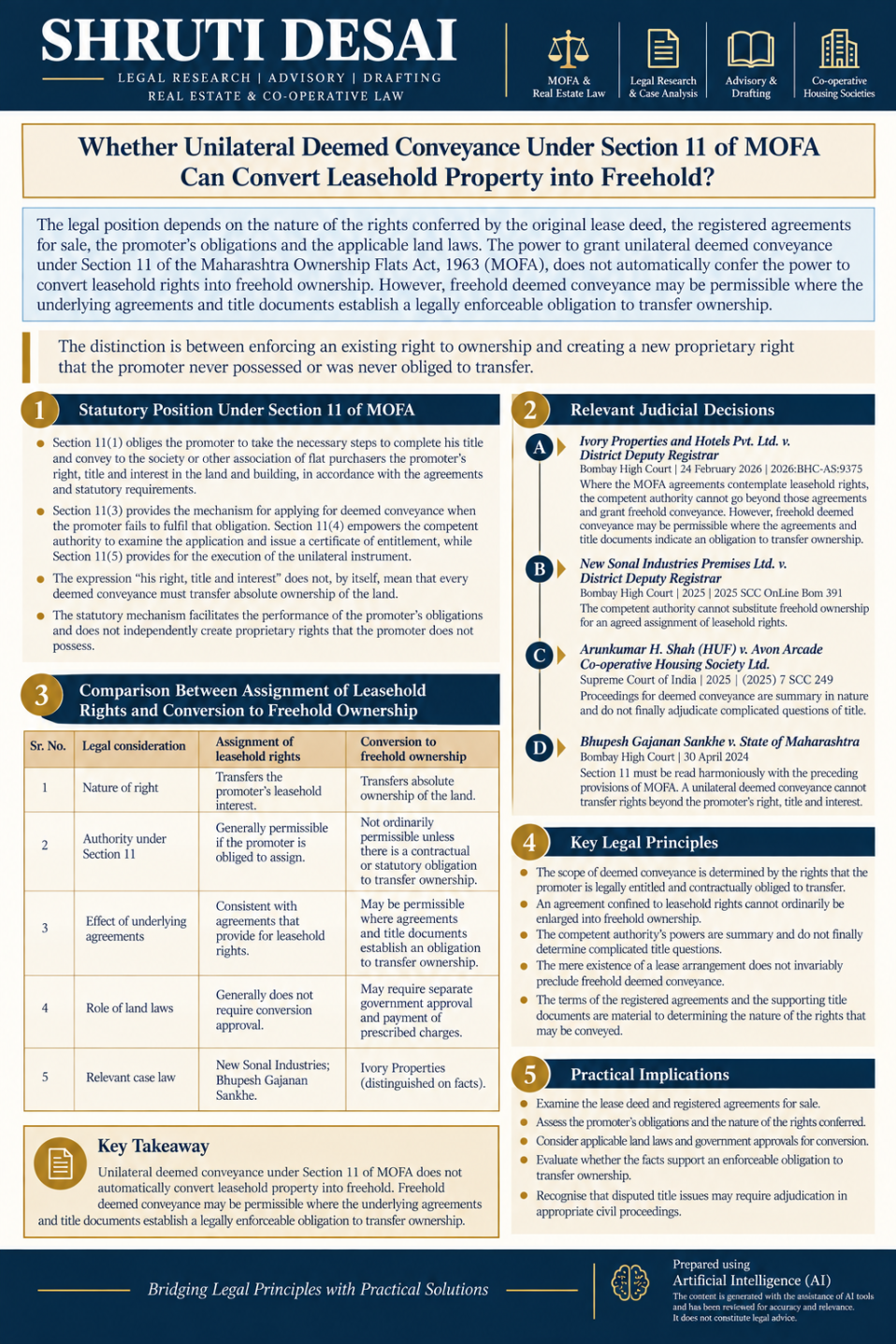
From Leasehold to Freehold: The Scope and Limitations of Unilateral Deemed Conveyance under Section 11 of MOFA
Whether Unilateral Deemed Conveyance Under Section 11 of MOFA Can Convert Leasehold Property into Freehold? The legal position depends on the nature of the rights conferred by the original lease deed, the registered agreements for sale, the promoter’s obligations and the applicable land laws. The power to grant unilateral deemed conveyance under Section 11 of the Maharashtra Ownership Flats Act, 1963 (MOFA), does not automatically confer the power to convert leasehold rights into freehold ownership. However, freehold deemed conveyance may be permissible where the underlying agreements and title documents establish a legally enforceable obligation to transfer ownership. The distinction is between enforcing an existing right to ownership and creating a new proprietary right that the promoter never possessed or was never obliged to transfer. Statutory Position Under Section 11 of MOFA Section 11(1) of MOFA obliges the promoter to take the necessary steps to complete his title and convey to the society or other association of flat purchasers the promoter’s right, title and interest in the land and building, in accordance with the agreements and statutory requirements. Section 11(3) provides the mechanism for applying for deemed conveyance when the promoter fails to fulfil that obligation. Section 11(4) empowers the competent authority to examine the application and issue a certificate of entitlement, while Section 11(5) provides for the execution of the unilateral instrument. The statutory expression “his right, title and interest” is significant. It does not, by itself, mean that every deemed conveyance must transfer absolute ownership of the land. There is a fundamental distinction between the power to execute a conveyance without the promoter’s cooperation and the power to enlarge the proprietary rights that are the subject of that conveyance. Relevant Bombay High Court and Supreme Court Decisions Ivory Properties and Hotels Pvt. Ltd. v. District Deputy Registrar Bombay High Court | 24 February 2026 | 2026:BHC-AS:9375 This judgment directly examines whether deemed conveyance under MOFA can confer freehold ownership where the underlying arrangements refer to leasehold rights. The Court accepted the legal proposition that where the MOFA agreements clearly contemplate only the assignment of leasehold rights, the competent authority cannot go beyond those agreements and grant freehold conveyance. However, the Court distinguished the facts before it. The registered agreements for sale contained provisions indicating the transfer of ownership, and the purchasers had paid consideration towards the land. Having regard to the material before it, the Court upheld the freehold deemed conveyance. The Court also clarified that complicated questions of title remain open for adjudication in appropriate civil proceedings. The decision, therefore, recognises that the mere existence of a lease arrangement does not invariably preclude freehold deemed conveyance. The terms of the registered agreements and the supporting title documents are material to determining the nature of the rights that may be conveyed. New Sonal Industries Premises Ltd. v. District Deputy Registrar Bombay High Court | 2025 | 2025 SCC OnLine Bom 391 This decision is relevant where the governing agreements specifically provide for the assignment of leasehold rights. The legal proposition relied upon in Ivory Properties is that the competent authority cannot substitute freehold ownership for an agreed assignment of […]
Read more