

Description: Learn about the Maharashtra Co-operative Societies (Amendment) Act, 2026, including changes to Sections 73AAA, 73B, 73C, 73CB, 73F, 81 and 157, their legal implications, and what co-operative societies need to do to comply.

Maharashtra Co-operative Societies (Amendment) Act, 2026: What Every Co-operative Society Should Know
The Maharashtra Co-operative Societies (Amendment) Act, 2026 has introduced several important changes to the Maharashtra Co-operative Societies Act, 1960. Although the amendments are limited to a few provisions, they significantly impact the governance, election process, committee administration, and regulatory compliance of co-operative societies across Maharashtra.
The amendments primarily strengthen the role of the State Co-operative Election Authority (SCEA), streamline the procedure for filling committee vacancies, update audit thresholds, and improve transparency in the management of co-operative societies.
Whether you are a committee member, housing society office bearer, director of a credit society, auditor, advocate, chartered accountant, or consultant, understanding these amendments is essential for ensuring statutory compliance.
Why Was the Amendment Necessary?
The co-operative sector in Maharashtra is one of the largest in India, comprising housing societies, credit societies, consumer societies, agricultural societies, industrial co-operatives, and numerous other institutions.
Over the years, practical issues emerged relating to:
- delays in filling committee vacancies;
- disputes concerning multiple-seat elections;
- lack of uniform supervision during committee proceedings;
- ambiguity regarding election authorities; and
- outdated financial thresholds.
The Amendment Act addresses these concerns by introducing clearer procedures and strengthening institutional oversight.
Key Amendments Introduced by the 2026 Amendment Act

- Amendment to Section 73AAA – Exemption for Type “A” Societies
The first proviso to Section 73AAA(3) has been deleted.
Further, the second proviso has been amended to exclude committees of Type “A” Societies prescribed under Rule 4 of the Maharashtra Co-operative Societies (Election to Committee) Rules, 2014.
Practical Impact
The amendment differentiates Type “A” societies from other classes of co-operative societies for the purpose of this provision. Societies falling within this category should carefully examine whether the amended provision applies to them before initiating committee-related actions.
- Amendments to Sections 73B and 73C – Greater Election Supervision
Sections 73B and 73C deal with representation of reserved categories on the managing committee.
The Amendment Act now provides that whenever vacancies are filled under these provisions, the committee meeting must be presided over by an officer authorized by the State Co-operative Election Authority (SCEA).
Why This Matters
Earlier, committee meetings were conducted internally, which occasionally resulted in procedural disputes.
Independent supervision by an authorized election officer is expected to:
- improve transparency;
- reduce allegations of bias;
- ensure procedural compliance; and
- increase confidence in the election process.
- Amendment to Section 73CB – Clarification of Election Authorities
Section 73CB contains provisions relating to election administration.
The Explanation has now been amended by specifically referring to:
- Divisional Co-operative Election Officers;
- District Co-operative Election Officers;
- Taluka Co-operative Election Officers;
- Ward Co-operative Election Officers;
- Observers; and
- Zonal Officers.
Importance
The amendment removes ambiguity by expressly identifying the authorities responsible for election-related functions.
This provides greater administrative certainty during election proceedings.
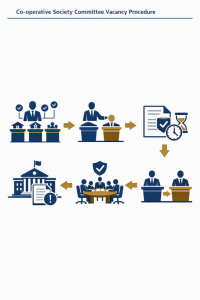
- Complete Substitution of Section 73F – Election to Multiple Committee Seats
One of the most significant amendments is the complete substitution of Section 73F.
Earlier Position
The earlier provision did not comprehensively regulate situations where one individual was elected to multiple committee seats.
New Law
Under the substituted provision:
- a person elected to more than one committee seat must retain only one seat;
- resignation from all remaining seats must be submitted within 15 days;
- failure to resign results in automatic vacation of all seats;
- the committee must immediately notify the State Co-operative Election Authority and the concerned Election Officer; and
- the vacancy must be filled within one month through nomination by the committee in a meeting presided over by an officer authorized by the SCEA.
Practical Significance
This amendment seeks to:
- prevent concentration of representation;
- avoid prolonged vacancies;
- ensure continuity in committee functioning; and
- facilitate timely constitution of representative committees.
- Amendment to Section 81 – Increase in Audit Threshold
The Amendment Act revises the monetary threshold in Section 81.
The amount has been increased from:
₹1,00,000 → ₹2,00,000
Significance
This increase reflects present-day financial realities and updates a statutory threshold that had become outdated due to inflation and economic growth.
Societies should nevertheless continue to maintain proper books of account and comply with all applicable audit requirements under the Act.
- Amendment to Section 157 – No Exemption from Section 73CB
A second proviso has been inserted in Section 157. It expressly provides that the State Government shall not exempt any society or class of societies from the provisions of Section 73CB.
Effect
The amendment ensures uniform application of election-related provisions across all co-operative societies.
This reinforces the independence and authority of the election framework established under the Act.
Impact on Co-operative Housing Societies
Although the amendments apply to co-operative societies generally, housing societies should particularly note:
- stricter supervision of committee proceedings;
- greater compliance during committee elections;
- timely filling of vacancies;
- enhanced accountability of committee members; and
- reduced scope for election disputes.
Managing committees should review their election procedures to ensure compliance with the amended provisions.
Compliance Checklist for Co-operative Societies
Following the Amendment Act, societies should:
- Review their bye-laws and internal election procedures.
- Ensure committee meetings relating to elections are conducted under the supervision of the authorized SCEA officer wherever required.
- Monitor situations involving members elected to multiple committee seats.
- Report vacancies promptly to the concerned election authorities.
- Fill eligible vacancies within the prescribed time.
- Update compliance manuals and governance policies.
- Train committee members regarding the amended legal provisions.
Frequently Asked Questions (FAQs)
Does the Amendment Act apply to all co-operative societies?
Yes. The amendments apply to societies governed by the Maharashtra Co-operative Societies Act, 1960, subject to specific provisions applicable to particular classes of societies.
What happens if a person is elected to multiple committee seats?
The individual must retain only one seat and resign the remaining seats within fifteen days. Failure to do so results in all such seats becoming vacant.
Who will supervise meetings for filling committee vacancies?
Where the amended provisions apply, the meeting must be presided over by an officer authorized by the State Co-operative Election Authority.
Has the audit threshold changed?
Yes. The threshold referred to in Section 81 has been increased from ₹1 lakh to ₹2 lakhs.
Can the State Government exempt societies from Section 73CB?
No. The Amendment Act expressly prohibits such exemptions.
Conclusion
The Maharashtra Co-operative Societies (Amendment) Act, 2026 reflects the State’s continued effort to modernize the governance of co-operative societies by promoting transparency, accountability, and procedural certainty.
The amendments strengthen the role of the State Co-operative Election Authority, establish a structured mechanism for dealing with multiple-seat elections, expedite the filling of committee vacancies, revise financial thresholds, and ensure consistent application of election-related provisions.
While the changes are targeted, they carry important compliance implications for co-operative housing societies, credit societies, agricultural co-operatives, auditors, legal practitioners, and office bearers. Societies should review their governance practices, election procedures, and compliance frameworks to align with the amended law and minimize the risk of disputes or statutory non-compliance.
As with any legislative reform, proactive compliance and informed governance remain the most effective tools for ensuring the smooth and lawful functioning of co-operative institutions in Maharashtra.
Keywords: Maharashtra Co-operative Societies Amendment Act 2026, Maharashtra Co-operative Societies Act 1960, Section 73F amendment, State Co-operative Election Authority, Co-operative Society Election Rules Maharashtra, Housing Society Committee Election, Maharashtra Housing Society Law, MCS Act 1960, Co-operative Society Compliance, Maharashtra Society Law 2026.
Suggested URL Slug: maharashtra-co-operative-societies-amendment-act-2026-key-changes
Shruti Desai
3rd July 2026

Post a comment