
America rules the world because trade is dominated by dollar. The U.S. dollar’s dominance stems from the massive, stable U.S. economy, its deep and liquid financial markets (like US Treasury markets), the rule of law, and trust in American institutions, solidified by the 1944 Bretton Woods Agreement that pegged other currencies to the dollar, backed by gold. Even after abandoning the gold standard, its role as the primary currency for global trade (especially oil), its role as a safe haven in crises, and the established infrastructure for dollar transactions (like SWIFT) cemented its status, giving the U.S. unique financial power.
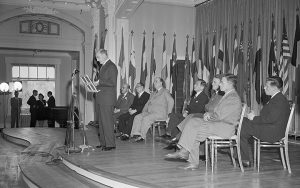
29a Henry J. Morgenthau Jr. Speaking at a Conference 883×600 ( Curtsy Federal Reserve History)
The 1944 Bretton Woods Agreement, signed by 44 nations alliance in New Hampshire, which was established after-WWII to run and manage international monetary system based on fixed exchange rates, with the U.S. dollar pegged to gold ($35/ounce) and other currencies pegged to the dollar. It created the IMF and World Bank to foster stability, lasting until 1971
The Bretton Woods Framework: Foundations of Modern Global Finance
In July 1944, nearly 730 representatives from 44 countries gathered at Bretton Woods to design a stable and efficient system for international currency exchange, discourage harmful currency devaluations, and encourage global economic development. The resulting Bretton Woods Agreement was instrumental in achieving these aims, establishing the International Monetary Fund (IMF) and the World Bank as key institutions. Although the original Bretton Woods system ended in the 1970s, both the IMF and World Bank continue to play essential roles in supporting international currency exchange and maintaining global financial stability.
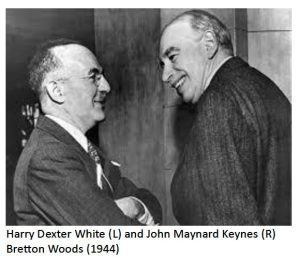
( curtsy National WWII Museum)
Harry Dexter White: Architect of Bretton Woods and Controversial Legacy
Harry Dexter White played a pivotal role in shaping the Bretton Woods Agreement, which led to the creation of the International Monetary Fund (IMF) and the World Bank. As a government economist, White was instrumental in designing the postwar global economic order and contributed significantly to establishing the United States as a dominant world power. Despite these achievements, his legacy has often been clouded by allegations of espionage, with claims that he acted as a Soviet spy. While these accusations have persisted over time, they remain unproven, and some evidence suggests his innocence.
Bretton Woods 1944: The Birth of Modern Global Finance
Two major institutions were created:
- The International Monetary Fund (IMF), tasked with monitoring exchange rates and providing short-term loans to countries facing balance-of-payments deficits.
- The International Bank for Reconstruction and Development (IBRD/World Bank), designed to finance postwar reconstruction and economic development.
- The agreement delivered nearly three decades of monetary stability for Western economies, fostering international trade. However, it ultimately collapsed in 1971 when the U.S. ended dollar-to-gold convertibility. Despite this, the institutions founded at Bretton Woods remain central pillars of the global financial system today.
The Nixon Shock: What Happened?
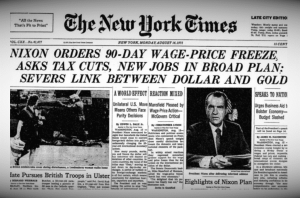
On August 15, 1971, U.S. President Richard Nixon announced a series of sweeping economic measures that fundamentally changed the global financial system. The most significant of these was the unilateral suspension of the U.S. dollar’s convertibility into gold, effectively ending the Bretton Woods system of fixed exchange rates that had governed international finance since World War II. [en.wikipedia.org]
Key Actions Taken
- Suspension of Dollar-Gold Convertibility: Foreign governments could no longer exchange their U.S. dollar reserves for gold at the fixed rate of $35 per ounce. This move ended the gold standard for international transactions and marked the beginning of the modern era of fiat currencies. [en.wikipedia.org]
- Wage and Price Controls: Nixon imposed a 90-day freeze on wages and prices to combat inflation.
- Import Surcharges: A 10% surcharge was placed on imports to protect American industries and encourage other countries to revalue their currencies. [investopedia.com]
Causes and Context
- Mounting U.S. Deficits: The U.S. was running persistent trade and budget deficits, largely due to spending on the Vietnam War, foreign aid, and domestic programs. This led to an oversupply of dollars in global markets, undermining confidence in the dollar’s value. [history.state.gov]
- Pressure on Gold Reserves: As foreign nations, especially France, began demanding gold in exchange for their dollar holdings, U.S. gold reserves dwindled, threatening the stability of the Bretton Woods system. [heydidyouk…owthis.com]
- Global Economic Shifts: The postwar economic boom was fading, and other economies (notably Germany and Japan) had become more competitive, reducing U.S. dominance in global trade. [insights.s…m.yale.edu]
Immediate and Long-Term Consequences
- Collapse of Bretton Woods: The suspension of dollar-gold convertibility rendered the Bretton Woods system inoperative. By 1973, most major currencies had shifted to floating exchange rates, where their values were determined by market forces rather than being pegged to the dollar or gold. [en.wikipedia.org]
- Stagflation: The 1970s saw a period of stagflation—high inflation combined with stagnant economic growth—partly as a result of the Nixon Shock and subsequent oil crises. [ainvest.com]
- Rise of Fiat Currency: The world moved to a fiat currency system, where money is not backed by physical commodities but by government decree. This gave central banks more flexibility to manage monetary policy but also introduced new risks, such as currency volatility and inflation. [investopedia.com]
- Global Financial Volatility: The end of fixed exchange rates led to increased volatility in currency markets and required countries to adapt to a more dynamic and unpredictable global financial environment. [heydidyouk…owthis.com]
Legacy and Ongoing Debate
- Central Bank Independence: The Nixon Shock gave central banks greater control over their nations’ monetary policies, allowing them to adjust interest rates and money supply to respond to economic conditions. [investopedia.com]
- Debate Over Merits: Economists continue to debate whether the Nixon Shock was ultimately beneficial. Supporters argue it was necessary to address inflation and trade imbalances, while critics point to the instability and inflation that followed. [herobullion.com]
The Historical Summary from 1944 to 1971.
The Nixon Shock was a pivotal moment in economic history, ending the era of gold-backed currencies and ushering in the modern system of floating exchange rates and fiat money. Its effects continue to shape global finance, central banking, and economic policy debates to this day. Dollar is now a flat currency.
The Dollar’s Global Influence in a Changing Economic Landscape
- Dollar still shapes global markets
The U.S. dollar remains the dominant global currency, widely used for trade, foreign exchange reserves, and international finance — a status rooted in post-World War II arrangements. Dollar movements influence commodities prices (like oil and gold), financial markets, and global investor sentiment.
- Recent dollar weakness affects global economies: As of early 2026 the dollar has weakened significantly reaching a multi-year low with both global markets and everyday economics affected. A softer dollar tends to boost emerging markets: local assets often rise as capital flows out of dollar-denominated investments, helping stock markets in countries like Brazil, Mexico and South Africa. Commodity exporters benefit when the dollar drops because their prices in local currency terms rise, attracting investor interest.
- Impact on imports, inflation & borrowers: A weaker dollar typically makes imports more expensive in dollar-importing countries, pushing up the cost of goods and fuel. Many countries and companies hold dollar-denominated debt. When the dollar is strong, repaying that debt becomes more expensive for non-U.S. borrowers. A strong dollar can force other central banks to raise interest rates to defend their currencies or control inflation, which may slow growth outside the U.S.
- Spillover effects of U.S. monetary policy: Changes in U.S. interest rates set by the Federal Reserve have global repercussions: Higher U.S. rates often attract capital into the U.S., strengthening the dollar and tightening financial conditions abroad. Lower U.S. rates can weaken the dollar and encourage investment in riskier or higher-yield markets outside the U.S.
- Reserve status gives the U.S. leverage: Because the dollar is a global reserve currency, the U.S. benefits from lower borrowing costs and more stable financing even allowing it to run larger deficits at lower interest costs. This status also gives the U.S. geopolitical leverage (e.g., through sanctions) because many transactions and international loans are tied to dollar settlement.
- Debate continues: de-dollarization pressure: Some countries and blocs (like parts of BRICS) are exploring alternatives to reduce reliance on the dollar, potentially shifting trade and reserve patterns over time.
Although these movements are gaining attention, the dollar’s dominance isn’t expected to end suddenly, it would be a gradual shift if it happens.
📌 In summary:
The U.S. dollar continues to play a central role in the global economy. Its strength or weakness influences imports, exports, debt costs, interest rates, investment flows, and market performance across many countries. Recent trends of a weaker dollar have buoyed emerging markets and commodity prices, but also raised costs for imports and influenced global inflation and capital movements. Meanwhile, central banks watch U.S. monetary policy closely because of its outsized spillover effects worldwide.
SHRUTI DESAI
30January 2026

Post a comment