
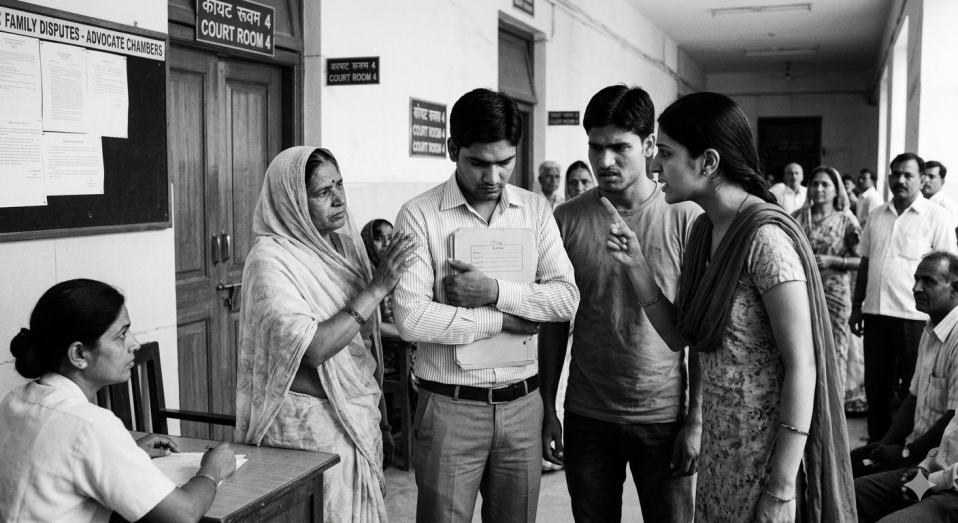
“Can Sons Restrain a Mother from Transferring Property? A Legal Analysis under Hindu Law”
CAN SONS FILE SUIT AGAINST MOTHER (HINDU) FOR STAY AGAINST TRANSFER OF SHARES / PROPERTY HELD BY MOTHER IN A FAMILY PROPERTY/ PRIVATE COMPANY ABSOLUTELY TO DAUGHTER? Hindu law prohibits dowry. But dowry is given in one form or another. Hindu Law after 2004 amendment gave equal right to married daughter in father’s property. View of Author Equal property rights for married daughters are an important step toward fairness and gender equality. However, in some families this can also create tensions in relationships. After marriage, daughters may be influenced by their husband or in-laws, and when disputes over property arise, disagreements can escalate into legal battles or serious family conflicts. While the intention behind laws like the Hindu Succession (Amendment) Act, 2005 is to ensure justice and equal rights, the practical implementation sometimes leads to strained family ties when expectations about property are unclear or contested. In such situations, disagreements over inheritance may even end up in court or cause long-lasting rifts within families. Therefore, along with legal equality, maintaining open communication, clear property planning, and mutual understanding within families is important to prevent conflicts and preserve relationships. Law makers must prevent this situation resulting into strained relationships. Broken relations makes society psychologically weaker. Continue… with article… Let us see Section 14 of the Hindu Succession Act 1956. Property of a female Hindu to be her absolute property.―(1)Any property possessed by a female Hindu, whether acquired before or after the commencement of this Act, shall be held by her as full owner thereof and not as a limited owner. Explanation.―In this sub-section, “property” includes both movable and immovable property acquired by a female Hindu by inheritance or devise, or at a partition, or in lieu of maintenance or arrears of maintenance, or by gift from any person, whether a relative or not, before, at or after her marriage, or by her own skill or exertion, or by purchase or by prescription, or in any other manner whatsoever, and also any such property held by her as stridhana immediately before the commencement of this Act. (2) Nothing contained in sub-section (1) shall apply to any property acquired by way of gift or under a will or any other instrument or under a decree or order of a civil court or under an award where the terms of the gift, will or other instrument or the decree, order or award prescribe a restricted estate in such property. If the shares are the mother’s self-acquired property (bought by her or gifted to her), she has absolute authority to transfer them to anyone she wishes, and the sons have no legal standing to stop her during her lifetime. Section 5 of the said Act provides for exception: Act not to apply to certain properties. ―This Act shall not apply to― (i) any property succession to which is regulated by the Indian Succession Act, 1925 ( 39 of 1925), by reason of the provisions contained in section 21 of the Special Marriage Act, 1954 (43 of 1954); (ii) any estate which descends to a single heir by the terms of any covenant or agreement entered […]
Read more
Ownerless Property and State Claims: Bona Vacantia, Escheat, and Evacuee Property in India and Beyond
In India, Bona Vacantia (meaning “ownerless goods”) is the legal doctrine where property without a rightful owner reverts to the State. This principle is primarily codified under Article 296 of the Constitution of India. CONSTITUTIONAL FRAMEWORK (ARTICLE 296) Article 296 dictates how unclaimed property is distributed between the Union and the States: Vesting in States: Property located within a State that lacks a rightful owner (due to escheat, lapse, or bona vacantia) vests in that particular State Government. Vesting in the Union: Property located outside any State (such as in Union Territories) or property that was under the control of the Central Government at the time it became ownerless vests in the Union Government. It reads as under: Article 296 in Constitution of India Property accruing by escheat or lapse or as bona vacantia Subject as hereinafter provided any property in the territory of India which, if this Constitution had not come into operation, would have accrued to His Majesty or, as the case may be, to the Ruler of an Indian State by escheat or lapse, or as bona vacantia for want of a rightful owner, shall, if it is property situate in a State, vest in such State, and shall, in any other case, vest in the Union: Provided that any property which at the date when it would have so accrued to His Majesty or to the Ruler of an Indian State was in the possession or under the control of the Government of India or the Government of a State shall, according as the purposes for which it was then used or held were purposes of the Union or a State, vest in the Union or in that State. Explanation. –In the article, the expressions “Ruler” and “Indian Slate” have the same meanings as in article 363. Article 363 in Constitution of India provides as under: Bar to interference by courts in disputes arising out of certain treaties, agreements, etc. (1) Notwithstanding anything in this Constitution but subject to the provisions of article 143, neither the Supreme Court nor any other court shall have jurisdiction in any dispute arising out of any provision of a treaty, agreement, covenant, engagement, sanad or other similar instrument which was entered into or executed before the commencement of this Constitution by any Ruler of an Indian State and to which the Government was a party and which has or has been continued in operation after such commencement, or in any dispute in respect of any right accruing under or any liability or obligation arising out of any of the provisions of this Constitution relating to any such treaty, agreement, covenant, engagement, sanad or other similar instrument. (2) In this article— (a)”Indian State” means any territory recognised before the commencement of this Constitution by his Majesty or the Government of the Dominion of India as being such a State; and (b)”Ruler” includes the Prince, Chief or other person recognised before such commencement by his Majesty or the Government of the Dominion of India as the Ruler of any Indian State. How and when it works: When property is identified as ownerless, […]
Read more