
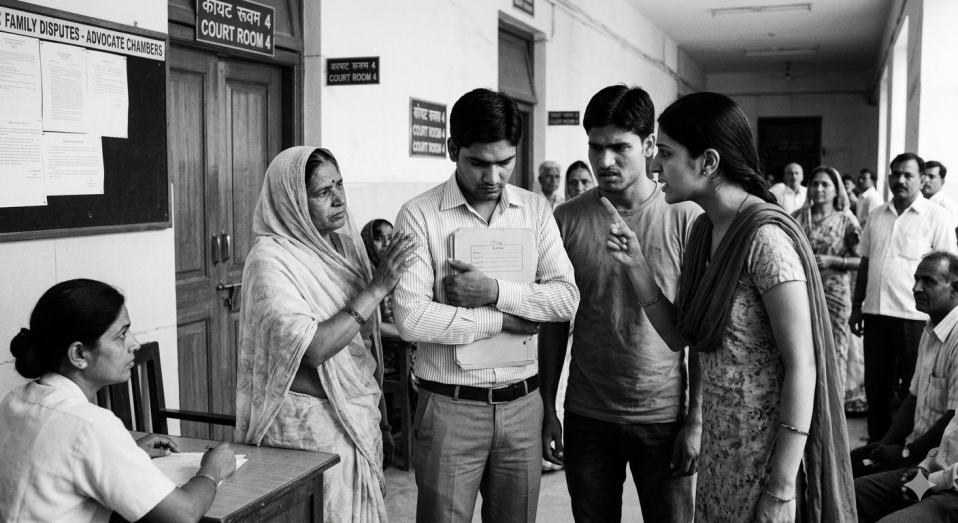
“Can Sons Restrain a Mother from Transferring Property? A Legal Analysis under Hindu Law”
CAN SONS FILE SUIT AGAINST MOTHER (HINDU) FOR STAY AGAINST TRANSFER OF SHARES / PROPERTY HELD BY MOTHER IN A FAMILY PROPERTY/ PRIVATE COMPANY ABSOLUTELY TO DAUGHTER? Hindu law prohibits dowry. But dowry is given in one form or another. Hindu Law after 2004 amendment gave equal right to married daughter in father’s property. View of Author Equal property rights for married daughters are an important step toward fairness and gender equality. However, in some families this can also create tensions in relationships. After marriage, daughters may be influenced by their husband or in-laws, and when disputes over property arise, disagreements can escalate into legal battles or serious family conflicts. While the intention behind laws like the Hindu Succession (Amendment) Act, 2005 is to ensure justice and equal rights, the practical implementation sometimes leads to strained family ties when expectations about property are unclear or contested. In such situations, disagreements over inheritance may even end up in court or cause long-lasting rifts within families. Therefore, along with legal equality, maintaining open communication, clear property planning, and mutual understanding within families is important to prevent conflicts and preserve relationships. Law makers must prevent this situation resulting into strained relationships. Broken relations makes society psychologically weaker. Continue… with article… Let us see Section 14 of the Hindu Succession Act 1956. Property of a female Hindu to be her absolute property.―(1)Any property possessed by a female Hindu, whether acquired before or after the commencement of this Act, shall be held by her as full owner thereof and not as a limited owner. Explanation.―In this sub-section, “property” includes both movable and immovable property acquired by a female Hindu by inheritance or devise, or at a partition, or in lieu of maintenance or arrears of maintenance, or by gift from any person, whether a relative or not, before, at or after her marriage, or by her own skill or exertion, or by purchase or by prescription, or in any other manner whatsoever, and also any such property held by her as stridhana immediately before the commencement of this Act. (2) Nothing contained in sub-section (1) shall apply to any property acquired by way of gift or under a will or any other instrument or under a decree or order of a civil court or under an award where the terms of the gift, will or other instrument or the decree, order or award prescribe a restricted estate in such property. If the shares are the mother’s self-acquired property (bought by her or gifted to her), she has absolute authority to transfer them to anyone she wishes, and the sons have no legal standing to stop her during her lifetime. Section 5 of the said Act provides for exception: Act not to apply to certain properties. ―This Act shall not apply to― (i) any property succession to which is regulated by the Indian Succession Act, 1925 ( 39 of 1925), by reason of the provisions contained in section 21 of the Special Marriage Act, 1954 (43 of 1954); (ii) any estate which descends to a single heir by the terms of any covenant or agreement entered […]
Read more
“No Privilege in the Machine: A Case Study in AI-Assisted Defense”
AI DOCUMENTS ARE PRIVILEGED DOCUMENTS? ARE AI‑GENERATED LEGAL DOCUMENTS PRIVILEGED? A COMPARATIVE LEGAL PERSPECTIVE To understand the nuances of the issue under discussion we must know the provisions of the Indian laws. The two main laws applicable during evidence and cross examination oof a witness are the Bharatiya Sakshya Adhiniyam (BSA), 2023, and Code of Civil Procedure 1908. Prior to Bharatiya Sakshya Adhiniyam (BSA), 2023, it was The Evidence Act 1872. Professional Communications (Section 126-128, Evidence Act): Attorneys, pleaders, and their employees cannot disclose any communication made by a client, or documents shared, in the course of professional employment without the client’s express consent. Confidentiality Requirement: Privilege only applies to communications made to seek legal advice; it does not protect advice sought for illegal purposes. Client Protection (Section 129, Evidence Act): Clients cannot be compelled to disclose confidential communications with their legal advisors. Spousal Privilege (Section 122, Evidence Act): Communications between husband and wife during marriage are protected, with exceptions like suits between them. Official Communications (Sections 123-124, Evidence Act): Public officers cannot be compelled to disclose communications made in official confidence if it harms public interest. CPC Application: Under the Code of Civil Procedure, if a party is asked to produce a document that is privileged under the Evidence Act, they can object to its production. If a document loses its confidentiality, the privilege is lost. The Query: So, a question arises when a document is drafted by an Artificial Intelligence Application, whether such document or a draft is a privileged document and exempted from cross examination? Now issue arose before a Court in USA. United States v. Heppner in which said that when documents prepared by an AI application same is not a privileged document? If we talk of India, there is no law. However, a warning is issued by the Supreme Court of India not to rely on AI. It was an incident where a lawyer cited Judgements during his arguments, were never passed by any court of law in India. Factual Background On November 4, 2025, Bradley Heppner was arrested on the charges of securities and wire fraud. Pursuant to a search warrant, federal agents searched his residence and seized electronic devices. A forensic review revealed approximately thirty-one documents generated through Heppner’s interactions with “Claude,” a generative AI system operated by an application called Anthropic. The documents contained AI-generated analyses addressing potential defences, legal theories, and litigation strategy related to Heppner’s criminal case. After receiving a grand jury subpoena and retaining counsel, Heppner continued to use Claude independently to analyse the charges, evaluate defences, and draft strategy memoranda. He saved the AI-generated materials on his personal devices and later shared them with his attorneys. During discovery disputes, defence counsel conceded that they neither directed nor supervised Heppner’s use of the AI system and had no role in creating the documents. The government moved to compel production, arguing that the materials were not privileged because they were created through communications with a third-party AI platform without attorney involvement. Judge Jed Rakoff of the U.S. District Court for the Southern District of New York granted the motion, holding […]
Read more
India’s Emerging AI Hub
Vizag: India’s Emerging Metro City of Opportunity Narendra Modi, the Prime Minister of India, recently inaugurated the world’s largest AI Impact Summit, attended by global leaders in artificial intelligence and advanced technologies. The summit highlighted India’s growing leadership in AI, semiconductors, and high-performance computing. Among India’s rising technology hubs, Visakhapatnam (Vizag) is rapidly transforming into a global center for artificial intelligence and data infrastructure. 🌐 Vizag’s Transformation into a Global Data City Located in Andhra Pradesh, Vizag is emerging as one of the world’s largest AI data center hubs, driven by an estimated $15 billion investment from Google and other major industry leaders. This ambitious “Data City” initiative aims to build more than 2.5 GW+ of digital infrastructure capacity, positioning Vizag as a cornerstone of India’s digital economy. 🔹 Key Partners and Investments Google Developing its largest AI data center outside the United States in Vizag. AdaniConnex A joint venture between Adani Enterprises and EdgeConneX, focused on creating a 1GW+ AI-driven data center ecosystem. Reliance–BrookfieldPlatform A collaboration between Reliance Industries and Brookfield Asset Management, contributing to large-scale infrastructure development. 📍 Location and Scope Project Area: Madhurawada–Kapuluppada corridor Land Area: ~500 acres Purpose: Dedicated technology and data center cluster This region is being developed as a future-ready digital and innovation zone. ⚡ Capacity, Timeline, and Vision Target Capacity: 2.5 GW+ Implementation Period: 2026–2030 Goal: Establish Vizag as a leading global AI and cloud computing hub The initiative will significantly strengthen India’s digital sovereignty and computing capabilities. 🌱 Advanced Features Integration of renewable and green energy systems Subsea cable landing stations for global connectivity High-performance AI and machine learning infrastructure Smart grid and cooling technologies These features ensure sustainability and global competitiveness. 👩💼 Economic and Employment Impact Creation of thousands of direct and indirect jobs Growth in IT services, construction, logistics, and support industries Boost to local entrepreneurship and skill development Increased foreign direct investment Vizag is set to become a major employment and innovation hub for the region. 🌍 Global Competitiveness With these developments, Vizag is positioning itself to compete with established global data center clusters such as Northern Virginia, one of the world’s largest digital infrastructure hubs. 🚀 Conclusion The Vizag Data City initiative represents a landmark step in India’s journey toward technological leadership. Backed by global corporations, strong government support, and sustainable infrastructure, Visakhapatnam is poised to become: Shruti Desai 17th February 2026
Read more
THE INSOLVENCY AND BANKRUPTCY CODE (IBC) AND THE STATE REGULATORY AUTHORITY (SRA) CAN HAVE CONFLICTS IN HOW THEY HANDLE CORPORATE INSOLVENCY.
The Slum Rehabilitation Scheme (SRS) and the Insolvency and Bankruptcy Code (IBC) are different frameworks that are used to address housing issues and insolvency. Slum Rehabilitation Scheme (SRS) A PPP scheme that encourages private developers to invest in slum rehabilitation projects The Slum Rehabilitation Authority (SRA) oversees, coordinates, and approves the SRS The SRS offers extra Floor Square Index (FSI) to developers in exchange for their investment Insolvency and Bankruptcy Code (IBC) A structured framework that helps resolve insolvencies The IBC aims to recover maximum asset value and resolve distressed entities quickly. The IBC has a stipulated resolution time of 330 days, including litigations POWERS OF SRA Attachment of property The SRA (Slum Rehabilitation Authority) may want to attach property under the PMLA, but the IBC’s Section 32A protects property from confiscation. Pre-CIRP electricity dues The SRA shouldn’t be held liable for pre-CIRP electricity dues once a resolution plan is approved. Stay of acquisition process The RP may want to stay the SRA’s acquisition process, but the HC ruled that the IBC doesn’t allow staying the operation of another law remove defaulting developers under the Insolvency and Bankruptcy Code (IBC). How the SRA can pursue avoidance applications If the Resolution Plan gives the SRA the power to pursue avoidance applications, then the SRA can do so. The SRA can pursue avoidance applications that were filed by the erstwhile Administrator and are pending before the NCLT. How the IBC prevails over other laws The IBC’s Section 238 states that the IBC prevails over other laws in cases of conflict. In the case of Rakesh Kumar Gupta v. Mahesh Bansal, the NCLT ruled that the IBC’s Section 7 can be applied even if there are proceedings pending under other laws. The IBC is a more recent special legislation, so it prevails over earlier laws. However, the IBC is a special legislation that prevails over other laws, including the SRA, in cases of conflict. the Insolvency and Bankruptcy Code (IBC) of 2016 prevails over other laws if there is a conflict, according to Section 238 of the IBC. This means that the IBC takes precedence over any other law, including state enactments. How IBC prevails over other laws. Section 238 includes a “non-obstante clause” that neutralizes any contrary provisions. The IBC’s provisions have effect notwithstanding anything inconsistent with any other law. The IBC’s overriding effect has been upheld by the Supreme Court. Examples of IBC overriding other laws: In Leo Edibles & Fats Ltd v. the Income-tax Department, the court ruled that the IBC overrides the Income Tax Act when determining dues during liquidation. In Alchemist Asset Reconstruction Company Limited v Hotel Gaudavan Private Limited and Others, the Supreme Court ruled that the IBC prevails over state enactments. BUT SLUM LAW AND IBC VIEW OF COURT IS AS UNDER: The provisions of the IBC are not meant to defeat slum redevelopment and similar or allied statutes. To hold otherwise would simply be unthinkable. It would mean that a Writ Court would put a premium on corporate wrongdoing and that even a defaulting corporate debtor who had not complied with the terms of a LoI […]
Read more
ARE LAWS CAUSING THE DESTRUCTION OF THE FAMILY NUCLEUS THREAD?
#BREAKING Union Law Minister Arjun Ram Meghwal confirmed a review of BNS Sections 85 and 86, replicating the repealed IPC Section 498A, due to misuse and inadequate safeguards for men. This is the first review of the new Indian criminal codes, aimed at preventing frivolous complaints while protecting women under domestic violence laws ( 9th January 2025) HINDU MARRIAGES AND LAW – A BRIEF ANALYSIS Why we are discussing this point. Has emotional, civic, cultural and aesthetic moral, values and responsibilities ruptured? Girls are pregnant from illicit or unauthenticated relationship and then when man is not ready to marry, she does two things apply for abortion and FIR for rape. The sense of responsibility towards parents has evaporated? Let’s discuss the various issues. Oyo, a hotel chain has made policy to not to permit couples unless they show marriage certificate. This shows the hotel chain doesn’t want to get involved in criminal and other consequential legal trouble. It says that we are not running a brothel. Hotel authorities are right. But do youngsters understand what path they have chosen? Whether girls understand what matrimonial responsibilities she is objecting is much better than having unauthenticated relationships. In such unauthenticated relation she does not get more than stress, insecurity and no legal rights, sometimes even cut into pieces and thrown in jungle. Misuse of freedom and education will in long run reverse entire process and in future again women will be arrested to household and early marriage. You may say that there is advancement in science but there is no change in biological science. Hindu marriage rituals contains two main ceremony. One is Kanyadaan and another is phera. Marriage has four basic vows. Pious institution of marriage is taken over by physical need. Girls were married at 16 may become right ritual if the trend of unauthenticated relations continue to play real havoc. There are questions asked on social media platforms that does school criminalize love? Those who are involved in school always get married? . All such incidents are not forceful. First phera: The couple prays for nourishment and prosperity, and promises to support each other’s needs and establish a stable home Second phera: The couple prays for strength and courage, and promises to support each other through challenges Third phera: The couple prays for wealth, and asks for the strength to share happiness and pain together Fourth phera: The couple prays for increased love and respect for each other and their families Fifth phera: The couple prays for noble children Sixth phera: The couple prays for a long and peaceful life together Seventh phera: The couple prays for companionship, togetherness, loyalty, and understanding Nowadays youngsters have multiple heart breaks and relationships. Which ultimately leads to mental disorders. Sundown parties and unaccountability take a toll of beautiful life song. Divorces are common and courts also promote by reducing waiting time of six months for mutual divorces. Demand for alimony and maintenance is the main fighting point for which multiple FIRs are filed as per legal advice against husband and his family members. The irresponsibility towards children before coming to conclusion […]
Read more
ARTIFICIAL INTELLIGENCE A BOON OR BANE
INTRODUCTION AI is a blessing for health care. When we are scared of an AI in such an arena if I say it’s a boon then of course I must explain how. In the Western world healthcare is good but the patient has to wait for days or months. While in my Country India, it’s immediate. We just get admission and the next day the patient is operated on. In the West, there is a shortage of human resources. Many countries issue visas for medical and para-medical services with benefits attached. So AI can be a blessing in disguise for the West. Let’s analyze how. FACTS AND TECHNOLOGY In India, for various types of surgeries, doctors are already using robots. These surgeries are complicated like cancer, dental surgeries, stone, spine, etc. These surgeries are affordable because of the use of robots by doctors. It’s called robotic surgery. India is now a medical hub because of its competitive price, availability of doctors, immediate care, and affordability. If AI is brought in, in the medical field many lives can be saved as there will be immediate attention given to the patient. This will help even a person who is going through pain to get early relief. Nowadays there is much discussion on new invention of an AI “eye”. If this EYE is introduced in the medical field then we do not require huge machines like X-rays and MRIs. This will save cost and also space. Especially in metro cities space crunch is always an issue. I understand that this EYE technology will give an instant cause of disease and doctors can treat patients fast. Many patients are scared of huge machines which catch their body in. So this issue of scare will also be resolved. DISCUSSION But with blessings, there are shortcomings too. The question arises when robotic surgery fails. Who is responsible for error done by robots? The hospital? The doctor who was in command of the robot? or the company which designed and activated software and algorithms? Usually, if a surgery is done by a human being a certified licensed surgeon then of course he is liable. But in the case of robotic surgery malfunction maker of the robot company is responsible. Certain fundamental laws are dictums about liability. But it needs to be codified. Certain resolutions are passed by the UN but it is in the nascent stage. CONCLUSION Use technology for the benefit of humankind. As such rockets and bombs are also technology but it’s for destruction. During surgery if the internet signal is lost who is responsible? Well, human race is ready for AI? Surgeries were done even in ancient India. Sushrut Samhita speaks of it. Another question therefore arise is do we need AI? All these questions will be answered with the passage of time. But at present whatever inventions are there in the market it’s a blessing to humankind SHRUTI DESAI 22th June 2023
Read more