
The Bombay High Court Clarifies Tax Exemptions for Hospitals
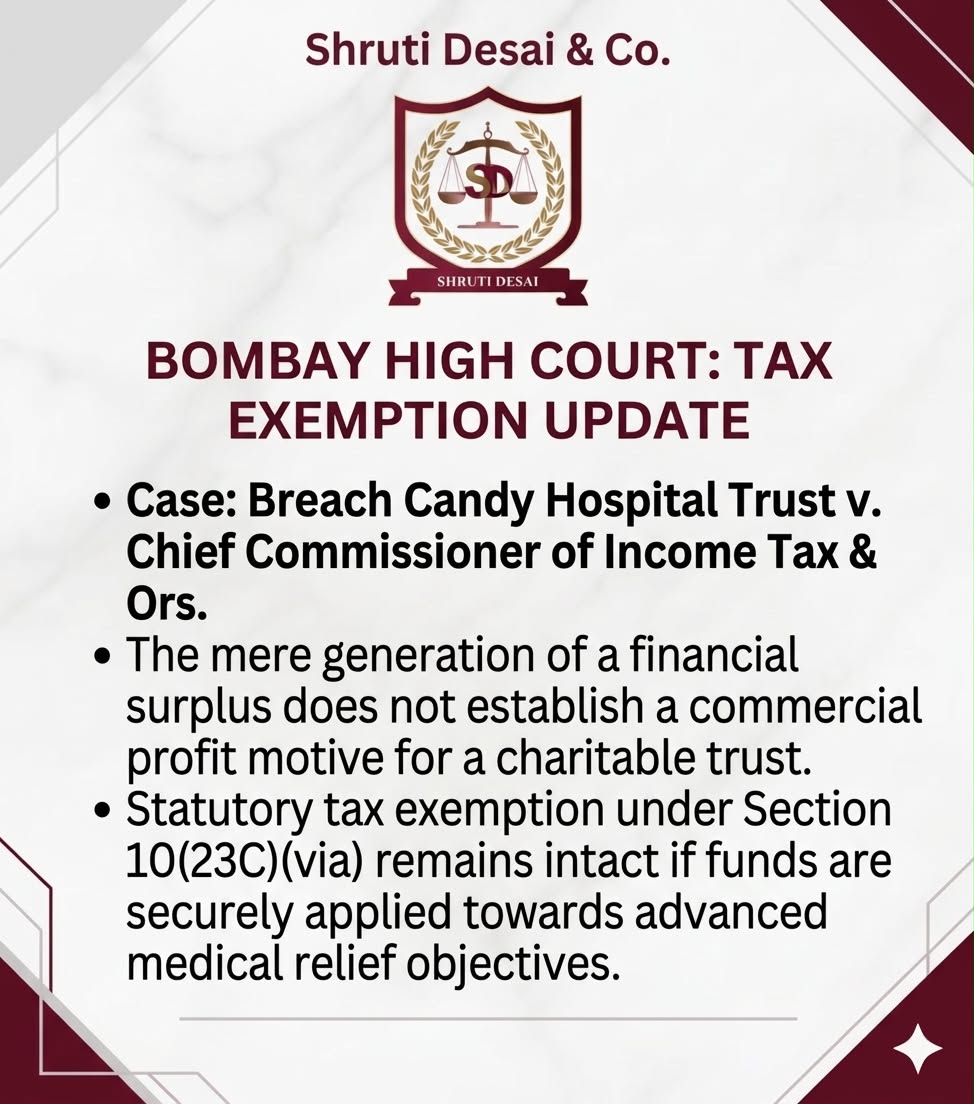
A landmark ruling by the Bombay High Court has brought significant clarity to the tax obligations of charitable and philanthropic healthcare institutions in India. In the case of Breach Candy Hospital Trust v. Chief Commissioner of Income Tax & Ors., the court firmly established that generating a financial surplus does not automatically imply a commercial profit motive, safeguarding the tax-exempt status of public trusts.
For legal professionals, trustees, and administrative boards managing public charitable trusts, this judgment provides a robust framework for understanding the limits of the Income Tax Department’s scrutiny regarding surplus income.
The Core Conflict: Is Surplus Proof of Profit?
The dispute arose after the Income Tax Department rejected the hospital trust’s applications for tax exemption under Section 10(23C)(via) of the Income-tax Act, 1961, for assessment years spanning nearly two decades (2002–03 to 2021–22).
The tax authorities argued that the institution’s substantial surplus income, modern specialist infrastructure, and collection of professional fees indicated that it was operating as a profit-driven enterprise rather than a philanthropic endeavor. They also raised concerns regarding the proportion of free vs. paid treatments and doctor consultation arrangements.
Key Legal Pronouncements by the High Court
The Division Bench consisting of Justice B.P. Colabawalla and Justice Farhan P. Dubash quashed the department’s rejection orders, outlining several critical legal boundaries:
* Surplus Does Not Equal Profit Motive: The court ruled that an institution’s receipts and expenditures do not need to balance perfectly at zero at the end of each financial year. The mere existence of a surplus cannot be treated as definitive proof that the entity operates for profit.
* The “Destination of Funds” Test: The true inquiry must look at how the income is ultimately utilized. If the trust’s constitutional documents strictly prohibit the distribution of dividends or profits to individuals, and all funds are funneled back into the institution’s core objectives—such as acquiring advanced medical relief equipment and upgrading infrastructure—the charitable character remains intact.
* Modernization is Not Commercialization: Charging fees for high-end medical facilities, utilizing modern specialist infrastructure, or paying professional consultation fees to doctors does not strip a hospital of its philanthropic nature.
Broader Implications for Charitable Trusts
This judgment reinforces a long-standing principle: the law distinguishes between earning a surplus to sustain and improve a public utility and operating with a commercial motive for private gain.
As long as a trust can demonstrate that its funds are securely locked into its foundational public objectives, and there is no evidence of fictitious expenditure or private appropriation, regular operational surpluses cannot be used as a tool to deny statutory tax exemptions.
Disclaimer: This publication is intended for general informational and educational purposes only. It does not constitute formal legal advice or establish an attorney-client relationship. Readers should consult qualified legal counsel regarding specific legal queries or case assessments
Shruti Desai
15th October 2026
Post a comment